
Most conversations about telecommuting treat it like a perk, something nice to offer alongside snacks and a gym stipend. But the real story shows up in the numbers HR and finance teams already track: retention rates, productivity output, absenteeism, and cost per employee.
This article breaks down what telecommuting actually delivers, backed by data rather than assumptions, and what happens when companies get the supporting structure wrong.
TL;DR
- Telecommuting lets people do their jobs outside a traditional office while staying connected through digital tools
- Well-structured programs improve productivity, cut costs, and boost retention
- Employees gain greater flexibility, less commute stress, and better work-life balance
- Poorly supported setups create isolation, communication gaps, and unequal access to support
- Pairing telecommuting with flexible family care benefits maximizes value for employees and employers
What Is Telecommuting (Brief Context)
Telecommuting means performing your job duties from a location outside the traditional office, using phone, internet, and collaboration tools to stay connected to your team.
It shows up in several forms across industries like tech, finance, healthcare administration, and customer service:
- Full-time remote roles — no regular office requirement at all
- Hybrid schedules — a mix of in-office and remote days each week
- Occasional work-from-home — flexibility for specific days or circumstances
The distinction matters less than the function. Whether it's called telework, telecommuting, or remote work, organizations use it for operational flexibility and to reach talent beyond a single office location.
Key Advantages of Telecommuting for Employees and Employers
The advantages below are grouped by measurable outcomes, not lifestyle claims. Each one connects to a KPI that HR and finance teams already monitor, which makes the internal business case far easier to build than a generic "employees like flexibility" pitch.
Increased Productivity and Operational Efficiency
Fewer in-office distractions and flexible scheduling let people work during their most focused hours. In practice, that means fewer interruptions, more self-managed output, and faster completion of concentration-heavy tasks like reporting or analysis.
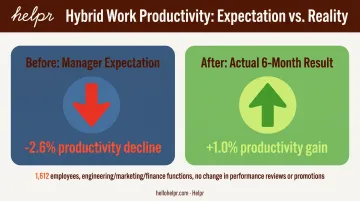
Reduced context-switching and commute time translate directly into more usable work hours per day. A large randomized controlled trial of 1,612 employees across engineering, marketing, and finance functions tested this in practice.
Before the experiment, managers expected hybrid work to reduce productivity by 2.6%. After six months of actual hybrid schedules, their estimate flipped to a 1.0% productivity gain, with no measurable difference in performance reviews, promotions, or output quality, according to a study published in Nature.
KPIs impacted:
- Output per employee
- Project turnaround time
- Error rates on deadline-driven tasks
This advantage matters most for roles built around independent, focus-heavy work such as writing, coding, or data analysis. It matters less for roles that depend on constant in-person collaboration.
Cost Savings and Reduced Overhead
Telecommuting cuts employer costs tied to office space, utilities, and equipment while lowering employees' commuting expenses. Smaller real estate footprints, reduced turnover-driven onboarding costs, and lower per-employee overhead all follow from a smaller in-office headcount.
Global Workplace Analytics modeled an average savings of $11,000 per year for every half-time telecommuter, factoring in productivity, real estate, absenteeism, turnover, and business continuity based on their 2021 workplace analysis. That's a conservative modeled estimate, not a guarantee, but it gives finance teams a real number to plan around.
KPIs impacted:
- Real estate cost per employee
- Average onboarding and replacement cost
- General operating expenses
This matters most for organizations scaling headcount quickly or operating in expensive real estate markets, where every square foot carries a premium.
Stronger Retention, Talent Access, and Work-Life Balance
Telecommuting widens the talent pool past commuting distance and gives employees room to manage caregiving, appointments, and personal needs without burning PTO for every disruption.
Employees with schedule control report higher job satisfaction and are less likely to jump ship for a competing offer. In the same hybrid work study referenced above, six-month attrition fell from 7.2% to 4.8% for hybrid employees compared to office-based peers, a 33% relative reduction, alongside higher work satisfaction scores.
Recruiting also gets easier. Organizations offering flexible arrangements reported recruiting difficulty at just 22%, compared to 29% among those without flexibility, according to SHRM's 2025 talent trends research of over 2,000 HR professionals.
This benefit compounds for employees managing family care responsibilities. Flexible scheduling alone doesn't solve a last-minute daycare closure or an elderly parent's doctor appointment.
Pairing telecommuting with backup care benefits, like the global stipends and on-demand care access Helpr provides, helps distributed and global teams cover childcare or elder care gaps without missing work. That reduces both absenteeism and turnover in ways schedule flexibility alone can't reach.
KPIs impacted:
- Employee turnover rate
- Time-to-fill open roles
- Absenteeism and unplanned leave rates
This matters most for organizations with distributed or global teams, employees juggling caregiving duties, and industries competing hard for skilled talent.
What Happens When Telecommuting Is Poorly Supported
Telecommuting without the right structure creates problems that are entirely predictable:
- Communication breakdowns: misaligned expectations between managers and remote staff over deadlines, availability, and priorities
- Isolation and burnout: blurred lines between work and home make it harder to switch off
- Inequitable access to support: employees juggling caregiving responsibilities without adequate benefits fall behind quietly
- Rising IT and security risk: unmanaged remote access widens the threat surface for data breaches
- Reactive management: difficulty measuring performance leads managers to guess rather than guide
Gallup's global workplace research consistently finds that fully remote employees report higher rates of stress, loneliness, and sadness than hybrid or on-site peers, even when income is held constant. Isolation is a documented pattern that shows up whenever the supporting structure is missing.
How to Get the Most Value from Telecommuting
Telecommuting delivers its strongest results when policies are documented clearly and applied consistently across roles, not improvised team by team.
A few practices separate programs that work from ones that quietly erode:
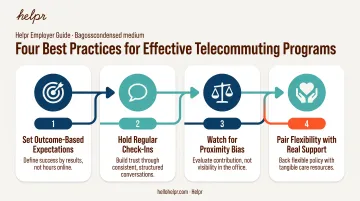
- Set outcome-based expectations, not time-tracking rules. Measure results, not hours logged online.
- Hold regular check-ins. One meaningful weekly conversation per direct report, even 15-30 minutes, keeps managers and employees aligned on goals, barriers, and well-being.
- Watch for proximity bias. Use objective performance criteria so remote employees aren't overlooked for promotions or feedback compared to in-office peers.
- Pair flexibility with real support. Mental health resources and family or backup care access help retain the employees who need flexibility most.
That last point is where a lot of programs fall short. Flexible scheduling helps until a caregiver cancels or a school closes without notice.
Helpr's My Choice technology lets employees formalize care through people they already trust, such as family, neighbors, or an existing sitter. They can pay those caregivers through the app with employer subsidies instead of scrambling for an unfamiliar provider mid-workday.
For distributed teams spread across time zones or countries, that kind of flexibility turns a documented policy into a benefit employees actually use.
Conclusion
Telecommuting's real value comes from combining flexibility, cost control, and access to a wider talent pool.
Those advantages compound over time, but only when they're backed by clear communication, the right tools, and complementary benefits—like backup family care—that address what employees need day to day.
Treat telecommuting as an ongoing, well-supported practice rather than a one-time policy announcement. The returns in retention, productivity, and cost savings keep paying off.
Frequently Asked Questions
What are the main benefits of telecommuting?
The core benefits are productivity gains from fewer distractions, cost savings on real estate and lower turnover costs, and improved work-life balance for employees. Together, they support stronger retention and easier recruiting.
What is a telecommuting allowance?
A telecommuting allowance is a stipend employers offer to cover home office costs such as internet, equipment, utilities, or basic office supplies for remote employees.
What's the difference between telecommuting and remote work?
Telecommuting often involves occasional or hybrid offsite work while still maintaining ties to a physical office. Remote work typically means working from anywhere with no regular office requirement at all.
What types of jobs are best suited for telecommuting?
Computer-based, independent roles like writing, analysis, customer support, and programming suit telecommuting well. Roles requiring constant physical presence or hands-on equipment don't translate as easily.
How can employers measure the ROI of telecommuting?
Track turnover rate, absenteeism, real estate savings, and productivity output against a pre-policy baseline. Comparing these metrics over time shows whether the program is delivering real, not just modeled, savings.
What tools do employees need to telecommute successfully?
Reliable internet, video conferencing and project management software, and secure remote access tools are the essentials. Strong endpoint protection and multi-factor authentication also matter for keeping company data secure.