
Introduction
Finding reliable childcare while holding down a full-time job is one of the most persistent pressures working parents face. It's a financial decision, a safety call, and often a career-shaping one — made under time pressure, with limited information, and rarely any margin for error.
The stakes are real. According to a 2026 ReadyNation report, childcare challenges cost families $134 billion in lost earnings annually — a figure that reflects missed shifts, reduced hours, and jobs left behind when care arrangements collapse. For employers, that translates directly into absenteeism, turnover, and lost productivity.
This guide covers the main childcare options available to working parents — how each works in practice and what to evaluate before committing. Whether you're preparing for your first child or rethinking a setup that's stopped working, it gives you a clear place to begin.
Key Takeaways
- Childcare options span in-home nannies, center-based daycare, family daycare, cost-sharing arrangements, and employer-sponsored backup care — each with distinct cost profiles and flexibility levels.
- No single option suits every family; your work schedule, budget, and child's age should drive the decision.
- Most families need a primary arrangement and a backup plan — set up the second layer before you need it.
- Employer-sponsored backup care can reduce both cost and disruption when primary arrangements fall through.
- Before signing anything, verify licensing, sick-child policies, and contract terms.
Why the Right Childcare Choice Matters
Childcare reliability and workplace performance are directly connected. When an arrangement breaks down — a sick caregiver, an unexpected center closure, a school holiday with no coverage — parents face an immediate choice: miss work or scramble for last-minute alternatives, and neither option comes without a cost.
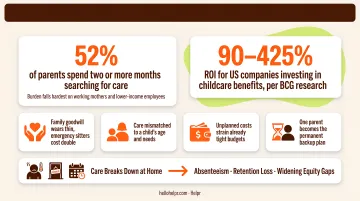
Recent cost-of-care research found that 52% of parents spend two or more months searching for care, and many reduce hours or leave jobs entirely when they can't find a workable solution. The burden falls disproportionately on working mothers and lower-income employees, who have fewer resources to absorb disruptions.
What goes wrong without a well-matched plan:
- Burning through goodwill with family members — or paying twice as much for emergency sitters — when primary care falls through
- Placing a child in an environment mismatched to their age, such as an infant in a high-ratio setting or a toddler with a provider unequipped for developmental needs
- Absorbing unplanned alternative care costs on top of regular expenses, straining already-tight budgets
- Pushing one parent into the role of permanent backup plan, accelerating burnout
Those disruptions don't stay home. Childcare instability drives absenteeism, weakens retention, and widens equity gaps — which is why more employers now treat childcare benefits as a core workforce strategy, not an optional add-on. Research cited by BCG puts the return on childcare benefit investment at 90–425% for US companies, largely through reduced turnover and fewer lost workdays.
Types of Childcare Options for Working Parents
Childcare options differ across four key dimensions: who provides the care, where it takes place, how costs are structured, and how much flexibility they offer. Understanding those differences is the foundation for making a choice that actually holds up during a real workweek.
In-Home Care: Nannies and Au Pairs
A nanny comes to your home and provides dedicated care for one child or siblings. Au pairs are international participants who live with the family under a formal J-1 visa cultural exchange program.
Best for: Infants and families with multiple children on different schedules; parents with early starts, late finishes, or irregular hours.
Cost (2026): Nannies average $870/week for one infant; au pairs involve a program fee around $11,100 plus a weekly stipend of approximately $195.75.
Strengths:
- Maximum schedule flexibility — care adjusts to your hours, not a facility's posted schedule
- No commute for the child, which matters most for infants
- Sick-day coverage built in (the child stays home; the nanny still comes)
Limitations:
- High ongoing cost, especially relative to other options
- Parent takes on employer responsibilities: payroll, taxes, backup when the nanny is ill
- Managing an in-home employment relationship adds complexity that surprises many families
Center-Based Daycare
A licensed facility staffed by early childhood educators, organized into age-grouped classrooms with structured routines and activities.
Best for: Toddlers and preschoolers whose parents work standard hours and want a socialization-rich, professionally regulated environment.
Cost (2026): Approximately $332/week for one infant, $308 for one toddler.
Strengths:
- Professional licensing, state inspections, and standardized safety ratios
- Built-in peer interaction that supports social development
- Operational burden stays with the center, not the parent
Limitations:
- Fixed hours (typically 7am–6pm) that don't work for shift workers or long commutes
- Infant rooms have the longest waitlists — 43% of parents wait four or more months for a spot
- Sick-day exclusions mean the child stays home, but the parent still needs to be at work
Home-Based (Family) Daycare
A licensed or registered provider who cares for a small group of children — often mixed ages — in their own home.
Best for: Infants and toddlers who do better in smaller, calmer environments; families seeking a middle ground between center-based structure and in-home warmth.
Cost (2026): Approximately $323/week for one infant, slightly less than center care.
Strengths:
- Lower cost than centers or private nannies
- Home-like atmosphere with a more consistent caregiver-child relationship
- Often offers more flexible hours than licensed centers
Limitations:
- Single-provider risk: if the caregiver is sick or on vacation, coverage disappears entirely
- Quality varies widely — licensing requirements differ by state and oversight is less standardized than in licensed centers
Cost-Sharing Models: Nanny Shares and Parent Co-ops
Two families jointly hire one nanny and split costs (nanny share), or community-run programs where families take turns providing care in exchange for lower fees (co-op).
Best for: Families who want in-home quality at reduced cost; community-oriented parents willing to contribute time.
Strengths:
- Nanny share can cut private nanny costs by 30–40% while adding peer socialization for the child
- Co-ops give parents direct input into the program's culture and values
Limitations:
- Nanny shares require tight alignment on schedules, illness rules, and caregiving approach — friction between families is the most common failure point
- Co-ops demand availability that many full-time working parents realistically don't have
Employer-Sponsored Childcare and Backup Care
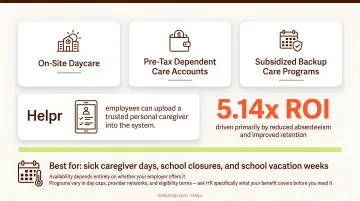
All the options above are family-managed. Employer-sponsored benefits shift part of that burden to your workplace — and for many parents, that makes the difference. These range from on-site daycare and pre-tax dependent care accounts to subsidized backup care programs.
Best for: Any working parent whose employer offers these benefits; especially valuable for covering sick caregiver days, school closures, and school vacation weeks without missing work.
When primary care fails, parents need a reliable fallback — fast. Platforms like Helpr give employers a way to provide on-demand backup care, connecting employees with vetted caregivers through a booking app. Employees can even upload a trusted personal caregiver into the system. Helpr's employer clients report a 5.14x ROI on the program, driven primarily by reduced absenteeism and improved retention.
Limitations:
- Availability depends entirely on whether your employer offers it
- Programs vary in day caps, provider networks, and eligibility terms — ask HR specifically what your benefit covers before you need it
How to Choose the Right Childcare Option for Your Family
Start With Your Actual Schedule
Map out your real workday — including commute time, early meetings, late calls, and the days when "leaving at 5" doesn't happen. A daycare that closes at 5:30pm is a poor fit for a parent with a 45-minute commute and unpredictable end times, regardless of how good the program is.
Calculate True Total Cost
The headline weekly rate doesn't capture everything. Factor in:
- Registration and supply fees
- Sick-day coverage costs (when the center won't take a feverish child)
- Backup care expenses
- Management time for private arrangements
A home-based provider charging $280/week can become more expensive than a $320/week center once you add even two or three sick-day backup sitter bookings per month, for example.
Match the Option to Your Child's Age
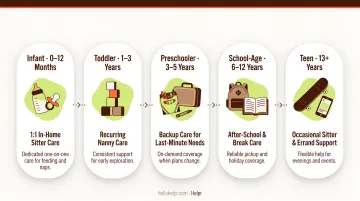
Care needs shift significantly as children grow:
| Age | Priority | Best-Fit Options |
|---|---|---|
| 0–12 months | Low ratios, consistency, responsive care | Nanny, family daycare, nanny share |
| 1–3 years | Socialization + structure | Center, family daycare |
| 3–5 years | Learning environment, peer interaction | Center-based preschool |
| School-age | Supervision + enrichment | After-school programs, nanny |
Build Your Backup Plan From Day One
Most childcare plans fall apart at the backup layer, not the primary one. Before your first week of coverage begins, ask every provider:
- What is your illness exclusion policy, and how much notice do you give?
- Are you closed on federal holidays or during school vacation weeks?
- Who covers if you (the provider) are sick?
If you have access to employer backup care through a platform like Helpr, confirm exactly how it works: how to book, what's covered, and whether you can use your own trusted caregiver within the benefit.
What to Check Before Committing to a Childcare Arrangement
Before you sign anything or hand over a deposit, run through three quick checks. Most childcare problems are avoidable — they trace back to things parents either skipped or assumed would work itself out.
Verify Credentials and References
- Centers and home-based providers: Check current license status through your state's licensing system and read recent inspection reports. The HHS National Database of Child Care Licensing Regulations is the starting point for finding state-specific records.
- Nannies and au pairs: Require a background check and contact former employers with specific questions — not just "was she good?" but "what did she do when a child was hurt?" and "how did she handle an unexpected situation?"
Read the Contract Before You Sign
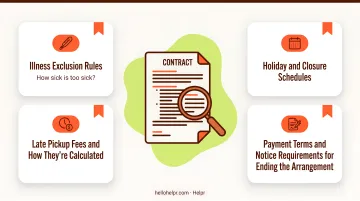
Most childcare disputes trace back to terms that were in the contract but never read. Flag these before signing:
- Illness exclusion rules (how sick is too sick?)
- Holiday and closure schedules
- Late pickup fees and how they're calculated
- Payment terms and notice requirements for ending the arrangement
Avoid These Common Mistakes
- Picking the most prestigious option when a simpler arrangement actually fits the schedule better
- Overlooking a provider's real limitations because their strengths are appealing
- Underestimating the management effort — especially for private hires, where you become the employer
- Skipping the backup plan because the primary arrangement feels solid
Frequently Asked Questions
How do both parents manage childcare while working full time?
Most dual-working families combine a primary care arrangement — daycare, nanny, or family provider — with employer backup care or family support as a fallback. The difference between arrangements that hold up and ones that don't usually comes down to confirming your backup before you need it, not after.
What is the most affordable childcare option for working parents?
Home-based daycare, nanny shares, relative care, and parent co-ops tend to be the most cost-effective. Government assistance programs — including the Child Care and Development Fund and the Child and Dependent Care Tax Credit (up to $6,000 for two or more children in 2026) — can reduce costs substantially for qualifying families.
What childcare benefits can I ask my employer to provide?
Ask HR about pre-tax dependent care accounts, subsidized backup care programs, and flexible scheduling policies. Specifically ask how many backup care days are covered annually, which providers are eligible, and whether you can use your own caregiver within the benefit — not all programs are equal in practice.
What is the income limit for childcare assistance in Michigan?
Michigan's Child Development and Care program income thresholds are updated periodically by the state Department of Health and Human Services. For a family of four, the 2026 entry limit is approximately $4,189/month. Check the Michigan DHHS website directly for current eligibility criteria, as figures change.
When should I start looking for childcare?
For center-based care — especially infant rooms — start researching and joining waitlists as early as the first trimester of pregnancy in competitive markets. For nannies and home-based providers, two to four months before the care start date is generally sufficient, though more lead time is always better.
What is backup care, and why do working parents need it?
Backup care covers unplanned gaps when a primary arrangement fails — a sick caregiver, center closure, or school holiday that falls on a workday. Without it, parents either miss work or pay emergency rates for last-minute help. Ask your HR team whether your employer offers backup care days as part of your benefits package.