

This scenario plays out constantly. 8% of privately insured Americans used out-of-network care in a single year, and 40% of those claims turned into surprise bills, according to KFF's research on surprise medical billing. Understanding what "out-of-network" actually means, and why it costs so much more, is the first step toward protecting your wallet.
This guide breaks down what out-of-network care means, why the price tag balloons, how your specific plan type changes the rules, and what you can actually do about it.
Key Takeaways
- Out-of-network providers have no contract with your insurer, so you lose negotiated pricing.
- Coverage depends on your plan type: HMOs often pay nothing, PPOs pay partially.
- The No Surprises Act covers emergencies and certain facility-based care, not voluntary out-of-network choices.
- Verify network status before a non-emergency visit to avoid a shocking bill.
What Does Out-of-Network Care Actually Mean?
An out-of-network provider is any doctor, hospital, or facility that hasn't signed a contract with your specific health plan. No contract means no agreed-upon pricing. The provider hasn't accepted your insurer's negotiated "allowed amount," which CMS defines as the maximum a plan will pay for a covered service, sometimes labeled the eligible expense or negotiated rate (CMS glossary).
Here's the part that trips people up: out-of-network doesn't mean the provider is worse. It simply means no pricing agreement exists between that provider and your plan. A few things explain why:
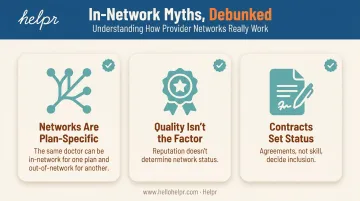
- Networks are plan-specific, not company-specific — a surgeon can be in-network for your employer's PPO but out-of-network for a different PPO sold by the same insurer
- Quality isn't the deciding factor — a highly regarded specialist can be out-of-network for your coverage while in-network for your neighbor's plan
- Contracts, not reputation, set status — whether a provider is in-network depends solely on whether they signed an agreement with your specific plan
For you as the patient, being treated out-of-network means one thing above all: you absorb the cost gap. Without a negotiated rate acting as a buffer, you're financially exposed in a way that in-network care simply doesn't allow.
This isn't a rare edge case, either. Among insured adults struggling with medical bills, out-of-network charges show up roughly one in three times. Nearly 7 in 10 people hit with unaffordable out-of-network bills had no idea the provider was out-of-network when they received care, according to KFF's research on surprise medical bills.
In-Network vs. Out-of-Network at a Glance
| Factor | In-Network | Out-of-Network |
|---|---|---|
| Price basis | Contracted, negotiated rate | Provider's full charge, no discount |
| Who sets the price | Insurer and provider, jointly | Provider alone |
| Balance billing risk | None (provider accepts negotiated rate) | Possible — you can be billed the difference |
| Emergency exception | Standard in-network rules apply | Must be covered at in-network cost-sharing under federal law |
Why Out-of-Network Care Costs More
Without a contract, an out-of-network provider isn't bound to any discount. They can bill their standard rate, full price, no negotiation required.
That opens the door to balance billing: after your insurance pays its (often smaller) share, the provider bills you for the leftover difference. In-network providers agree never to do this, but out-of-network providers, in most situations, legally can.
The financial gap here isn't theoretical. A study of nearly 9,000 emergency visits by privately insured adults found:
- Patients with likely surprise out-of-network bills paid physicians an average of $151, versus $15 for other ER visits.
- For higher-charge cases (above $1,000), that gap widened to $393 versus $34.
- Physicians actually recovered 65% of billed charges in surprise-bill cases, compared to 52% otherwise (Health Affairs).
Beyond balance billing, most plans stack the deck further:
- Separate, higher deductibles apply specifically to out-of-network care.
- Higher coinsurance percentages kick in (you might pay 40% instead of 20%).
- Some plans cap their total contribution instead of paying a percentage, leaving you exposed to any remaining balance.
Here's the detail that catches people off guard: your out-of-pocket maximum often doesn't apply. HealthCare.gov explicitly excludes out-of-network charges, non-covered services, and amounts above the allowed rate from what counts toward your annual limit.
Plans may count out-of-network spending toward that cap, but they're not required to (CMS). That means out-of-network costs can, in effect, run uncapped.
How Different Health Plans Handle Out-of-Network Care
Your plan type is the single biggest factor in whether out-of-network care gets covered at all. This is worth understanding before you need care, not after.
HMO, PPO, and Emergency Care Exceptions
Coverage varies significantly by plan type:
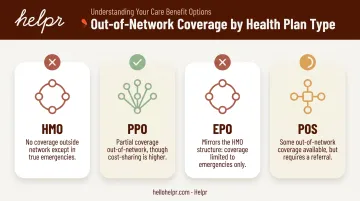
- HMO plans offer zero out-of-network coverage outside emergencies, leaving you responsible for the entire bill for routine care.
- PPO plans cover out-of-network care, but at a lower reimbursement rate and higher cost-share than staying in-network.
- EPO plans generally mirror HMOs, covering out-of-network care only in emergencies.
- POS plans typically allow some out-of-network coverage but often require a referral from your primary care doctor first.
Always check your specific plan documents. Acronyms give you a general idea, but the fine print determines your actual exposure.
One rule cuts across every plan type: true emergency care must be covered at the in-network benefit level, no matter where you're treated. This protection comes from the No Surprises Act and applies regardless of your plan type.
A quick but important distinction: urgent care is not automatically treated like emergency care. An urgent care center visit for a sprained ankle doesn't get the same automatic in-network protection that a genuine ER emergency does. The legal standard hinges on whether an average person would reasonably believe they faced serious harm without immediate treatment, not just which building you walked into.
What Happens If You See an Out-of-Network Provider?
The outcome depends on your plan and the circumstances. Broadly, you'll land in one of three scenarios:
- Claim denied entirely — common with HMOs for non-emergency situations.
- Partial reimbursement — typical with PPOs, where you pay the remaining balance.
- Full bill, no coverage — happens when the service isn't covered out-of-network at all.
If the situation was unavoidable, say, you went to the ER and an out-of-network anesthesiologist happened to be on duty, the No Surprises Act likely protects you. Since January 1, 2022, this federal law has barred balance billing for most emergency services and specified non-emergency services delivered by out-of-network clinicians at in-network facilities, according to CMS's fact sheet on surprise billing protections.
Coverage under the Act extends to ancillary specialists you rarely choose yourself:
- Anesthesiologists
- Radiologists
- Pathologists
- Assistant surgeons
- Hospitalists and intensivists
If you get hit with a large bill anyway, you have options:
- File an internal appeal with your insurer within 180 days of the denial.
- Negotiate directly with the provider's billing department. Many will settle for less than the sticker price.
- Request a network gap exception, particularly if no in-network specialist exists for your specific need.
- Contact the CMS No Surprises Help Desk at 1-800-985-3059 if you suspect a violation.
How to Avoid Unexpected Out-of-Network Costs
Prevention beats appeal every time. A few habits go a long way:
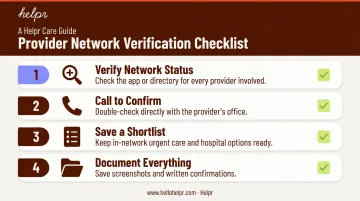
- Verify network status before every appointment. Check your insurer's directory or app, and confirm your surgeon, anesthesiologist, and the hospital separately, not just one.
- Call the provider's office directly to double-check. Directories go stale faster than you'd expect.
- Keep a saved shortlist of in-network urgent care centers and hospitals near your home and workplace, before you're standing in an ER parking lot trying to figure it out under stress.
- Save every confirmation: screenshots, reference numbers, written estimates. If a billing dispute happens later, this paper trail is your leverage.
This confusion around "who's covered" isn't unique to health insurance, either. Employee benefits like backup childcare or eldercare can carry the exact same problem. A family books a caregiver assuming it's covered, only to discover it's "out-of-network" for their plan, and now they owe the full rate.
This is part of why Helpr built its backup care platform around a pre-vetted global network with transparent, use-based pricing. Employees never have to guess whether a caregiver "counts."
They see what's covered and what it costs before booking. Arranging urgent childcare or elder care shouldn't carry the same surprise-bill anxiety as an unexpected ER visit.
Frequently Asked Questions
Will insurance cover out-of-network care?
It depends on your plan type. HMOs typically don't cover non-emergency out-of-network care at all, while PPOs offer partial coverage at a higher cost-share. Always confirm specifics in your plan documents.
What happens if I see an out-of-network provider?
You may face a separate, higher deductible, increased coinsurance, and potential balance billing for the gap between the provider's charge and what your plan reimburses. The exact impact depends on your plan type and the situation.
What does it mean for a patient to be out-of-network?
It means your treating provider has no contracted rate with your specific insurance plan. Standard in-network cost protections, like capped coinsurance and no balance billing, simply don't apply.
Is emergency care always covered even if the hospital is out-of-network?
Yes, the No Surprises Act requires true emergencies to be covered at the in-network benefit level regardless of the facility's network status. Urgent care, however, doesn't automatically get this same protection.
Can I ask my insurer to treat an out-of-network provider as in-network?
Sometimes. You can request a network gap exception, especially when no in-network specialist is available for your specific need. Approval isn't guaranteed and varies by insurer and state.
How can I check if a provider is in-network before my appointment?
Use your insurer's online provider directory or mobile app first. Then confirm with a direct call to both the provider's office and your insurer's member services line, since directories aren't always current.