Introduction
The calculus of employee compensation has shifted. According to MetLife's 2024 U.S. study, 59% of employees say their benefits are an important reason they stay with their employer — a number that reflects how seriously workers now weigh their total package, not just their paycheck.
HR teams are navigating real pressure on both sides of this equation. Mercer projects employer health benefit costs will rise 6.7% in 2026, while a multigenerational workforce demands benefits that reflect very different life stages and priorities.
That tension — rising costs, rising expectations — is reshaping what competitive benefits look like. The organizations winning on talent are moving beyond standard offerings toward packages that are genuinely personalized.
This article covers 25 new and emerging employee benefits ideas for 2026, organized into five categories:
- Health & Wellbeing — physical, mental, and financial health support
- Family & Caregiving — childcare, eldercare, and dependent care benefits
- Flexibility & Work-Life Balance — schedule, location, and time-off policies
- Financial Benefits — savings, debt relief, and compensation innovations
- Growth & Purpose — learning, development, and values-aligned perks
TL;DR
- Employees in 2026 expect benefits that support their whole lives — not just their workday.
- Mental health, family caregiving, and financial wellness are rising priorities across every workforce segment.
- The 2026 pre-tax dependent care account limit increases to $7,500 — a significant change HR teams should prioritize in open enrollment communications.
- Backup care programs reduce lost workdays and protect productivity across all employee types, not just office-based staff.
- Benefits equity for frontline, hourly, and distributed employees is becoming a measurable competitive differentiator.
Health, Mental Wellness & Women's Health Benefits (Ideas 1–6)
Health-related benefits have expanded well beyond basic medical coverage. Employers in 2026 are expected to address physical, mental, and gender-specific health needs as part of a comprehensive strategy.
Idea 1: Expanded Mental Health Coverage
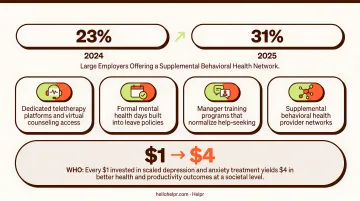
Mental health benefits have outgrown the basic Employee Assistance Program model. Employers are now offering:
- Dedicated teletherapy platforms and virtual counseling access
- Formal mental health days built into leave policies
- Manager training programs that normalize help-seeking
- Supplemental behavioral health provider networks
The scale of adoption is growing fast: 31% of large employers expected to provide a supplemental virtual or in-person behavioral health network in 2025, up from 23% in 2024. The WHO estimates that every $1 invested in scaled depression and anxiety treatment yields $4 in better health and productivity outcomes at a societal level — a signal employers are increasingly taking seriously.
Idea 2: Preventive Care & Telehealth Access
Telehealth reduces both cost and friction. SHRM estimates savings of $309 to more than $1,500 per avoided emergency visit, plus less time away from work. The scheduling barriers that delay treatment hit hardest for hourly and shift-based employees who can't easily take a half-day for a routine appointment. Virtual care removes that barrier entirely.
Idea 3: Wellness Stipends & Holistic Wellness Programs
Flexible wellness stipends — covering fitness memberships, mindfulness apps, nutrition coaching, or ergonomic equipment — outperform rigid wellness programs because employees define wellness differently. A 55-year-old may prioritize physical therapy; a 28-year-old may value meditation tools. Stipends respect that difference without requiring HR to predict it.
Idea 4: Women's Health Benefits
Women's health is moving from a niche offering to a business imperative. McKinsey research finds that women spend 25% more time in poor health than men, and closing that gap could add $1 trillion annually to global GDP by 2040.
Employer adoption is still uneven: only 17% of employers offered menopause support in 2024, while 70% of the largest employers covered IVF. Conditions like endometriosis, PCOS, and maternal mental health remain underserved — categories where coverage gaps translate directly into talent and retention risk.
Idea 5: Specialty Drug & Chronic Condition Coverage
GLP-1 medications (weight-loss and diabetes drugs) are creating a coverage decision most employers can no longer postpone. In 2025, 19% of firms with 200+ workers covered GLP-1s for weight loss, rising to 43% among employers with 5,000+ workers. Blanket exclusions risk talent loss. Blanket coverage without guardrails blows up plan budgets. The employers getting this right are pairing coverage with clinical criteria — tying GLP-1 access to BMI thresholds, diabetes diagnoses, or active lifestyle program participation.
Idea 6: Behavioral Health Integration with Primary Care
Keeping behavioral health as a separate, optional program creates a self-selection problem: the employees who most need help are least likely to opt in. When mental health is integrated into primary care visits instead, the dynamic shifts. Utilization goes up. Intervention happens earlier. Stigma drops because the conversation starts with a doctor, not a referral form.
Key integration models employers are adopting:
- Embedding behavioral health screenings into annual physicals
- Co-locating therapists within primary care practices or virtual care platforms
- Training PCPs to initiate mental health conversations rather than routing patients elsewhere
Family Care, Caregiving & Work-Life Balance Benefits (Ideas 7–12)
Caregiving responsibilities are among the leading drivers of absenteeism, stress, and turnover. AARP's 2025 Caregiving in the US report found that 29% of U.S. family caregivers actively supported both children and aging adults simultaneously. Among those working caregivers, 28% reduced hours, 21% cut their workload, and 14% changed jobs entirely.
The math is clear: employers who build comprehensive family support systems — not just parental leave policies — protect productivity at scale.
Idea 7: Backup Childcare & Elder Care Programs
Backup care is the benefit that prevents an unexpected childcare gap from becoming a lost workday. When a regular care arrangement falls through, employees without a backup option face an impossible choice: miss work, bring a distracted mind to the office, or ask colleagues to cover.
More than one-third of large employers now offer backup care, according to Mercer's 2025 strategy survey. Platforms like Helpr give enterprises a global, equitable solution — covering both childcare and elder care across 150+ countries, with a use-based pricing model that means employers only pay when care is actually utilized.
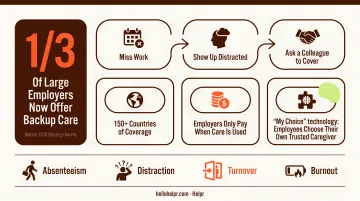
Helpr extends this access to hourly workers, shift-based employees, and globally distributed teams — not just office-based staff — through its patented "My Choice" technology, which lets employees use their own trusted caregivers within the platform's subsidy structure.
When employees can't access dependable care, employers absorb the cost — through absenteeism, distraction, turnover, and burnout.
Idea 8: Expanded & Gender-Neutral Paid Parental Leave
FMLA provides 12 weeks of unpaid, job-protected leave — a floor, not a ceiling. 40% of employers offered paid parental leave in 2024, and forward-thinking organizations are extending that coverage to adoptive parents, same-sex couples, and non-traditional family structures. Gender-neutral policies that treat all parents equally remove an implicit bias that has long disadvantaged women's career trajectories.
Idea 9: Pre-Tax Dependent Care Account Enhancements
This is one of the most concrete benefits wins HR teams can deliver in 2026. The pre-tax dependent care account limit has been permanently increased under H.R.1 enacted in 2025 — up from limits that had gone unchanged for decades:
- Married filing jointly: $7,500 (up from $5,000)
- Married filing separately: $3,750 (up from $2,500)
Platforms like Helpr support pre-tax dependent care payments directly within their booking app, allowing employees to apply pre-tax dollars at the point of booking or generate receipts for reimbursement. Make this a priority in open enrollment communications — many employees don't know the limit changed.
Idea 10: Elder Care Support & Caregiver Leave
Most benefits packages ignore eldercare — and employees managing aging parents alongside full-time work feel that gap daily. Employers adding caregiver leave policies, eldercare navigation services, and concierge care placement reduce the cognitive load those employees carry. Helpr's platform includes dedicated elder care support and 1:1 concierge care placement for employees who need more than on-demand booking.
Idea 11: Fertility, Surrogacy & Family-Building Benefits
Fertility and family-building benefits signal an inclusive employer culture. Coverage among the largest employers in 2024 reached:
- 70% for IVF
- 21% for egg freezing
- 20% for sperm freezing
Adoption assistance and surrogacy support round out a comprehensive family-building package. These benefits are increasingly decisive for employees in active family-planning stages.
Idea 12: EAPs With Caregiver-Specific Resources
EAPs are being redesigned to serve caregivers specifically — with eldercare referral networks, counseling for caregiver burnout, and legal support for estate planning. A well-communicated EAP can serve as the central hub that pulls family care benefits together, ensuring employees know what's available before a crisis hits.
Financial Wellness, Retirement & Career Growth Benefits (Ideas 13–18)
Financial stress is among the most underaddressed productivity drains in the modern workplace. PwC's 2025 Global Workforce Survey found that 55% of global workers experienced financial strain. A benefits package that stops at 401(k) matching misses most of that problem.
Idea 13: 401(k) With Employer Match & SECURE 2.0 Features
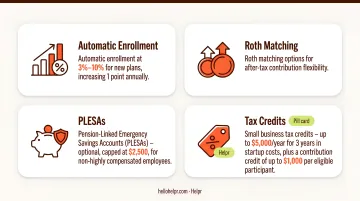
SECURE 2.0 gives employers new tools to drive retirement plan participation:
- Automatic enrollment at 3%–10% for new plans, increasing 1 point annually
- Roth matching options for after-tax contribution flexibility
- Pension-Linked Emergency Savings Accounts (PLESAs) — optional, capped at $2,500, for non-highly compensated employees
- Small business tax credits — up to $5,000/year for 3 years in startup costs, plus a contribution credit of up to $1,000 per eligible participant
Idea 14: Student Loan Repayment Assistance
Student loan benefits rose from 4% of employers in 2019 to 14% in 2024. Under SECURE 2.0 (effective for plan years after December 31, 2023), employers can now match qualified student loan payments with 401(k) contributions — building retirement savings and reducing debt simultaneously. For employers competing for younger workers, this is a high-visibility benefit.
Idea 15: Financial Wellness Programs
Financial wellness now extends well beyond retirement planning:
- Access to certified financial planners
- Budgeting apps and debt management tools
- Earned wage access (EWA) — allowing employees to draw earned wages before payday
EWA is particularly valuable for hourly and lower-income workers. In a case study of hospitality workers using EWA, 40% said it helped them avoid late fees and 32% avoided overdraft charges. These aren't luxuries — they're stability tools.
Idea 16: Upskilling, Reskilling & AI Skills Training
Deloitte's 2025 global survey ranks learning and development among the top three reasons Gen Z and Millennial employees choose an employer. As AI transforms how work gets done across every sector, professional development benefits need to reflect that shift. Effective programs now include:
- LMS platform access for self-directed learning
- Cross-functional reskilling for employees moving into new roles
- Dedicated AI literacy tracks tied to specific job functions
Done well, these programs serve retention and business performance at the same time.
Idea 17: Tuition Reimbursement & Learning Stipends
Tuition reimbursement signals long-term investment — which builds loyalty. The format has evolved well beyond traditional degree programs. Flexible learning stipends that cover the following options are more inclusive and faster to deliver ROI:
- Micro-credentials and professional certifications
- Stackable digital badges tied to specific skills
- Industry-recognized short-form programs
Career development benefits and financial stability aren't separate concerns — employees who feel invested in professionally are better positioned to manage financial stress too.
Idea 18: Emergency Savings Programs
Emergency savings accounts address the immediate financial fragility that pulls employee attention away from work. Three common structures employers are adopting:
- Payroll-deducted accounts — automatic contributions from each paycheck
- Employer-matched savings — incentivizing employees to build a buffer
- SECURE 2.0 PLESAs — retirement-linked emergency accounts capped at $2,500
An employee who can't cover a $500 emergency is not fully present at their desk, regardless of their salary level.
Flexibility, Recognition & Emerging Benefits (Ideas 19–25)
These benefits define how an employer treats employees as whole people — from where and how they work, to how their contributions are recognized.
Idea 19: Hybrid & Remote Work Support
Hybrid work is permanent. Effective employers equip remote and hybrid employees with:
- Home-office stipends and ergonomic equipment reimbursements
- Commuter benefits for on-site days
- Equitable access to wellness programs regardless of location
The last point matters most: remote employees who can't access in-person wellness perks need equivalent alternatives built into the benefits design, not afterthoughts.
Idea 20: Flexible Scheduling
Beyond remote options, employees value control over when they work. Compressed workweeks, flexible start/end times, results-only work environments, and choice-based floating holidays signal trust — and typically cost employers nothing. For retention, especially among younger workers, that signal carries significant weight.
Idea 21: AI-Personalized Benefits Platforms
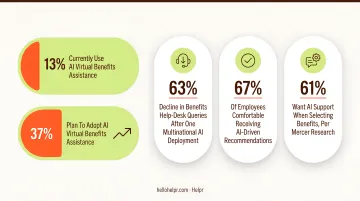
AI-powered benefits platforms now make individualized benefits guidance practical for organizations of any size. The adoption curve is steep:
- 13% of organizations currently use AI virtual benefits assistance
- 37% plan to adopt it — a shift that will accelerate as the technology matures
- One multinational deployment reported a 63% decline in benefits help-desk queries after implementation
- 67% of employees are comfortable receiving AI-driven recommendations, and 61% want AI support when selecting benefits, per Mercer research
What was once an enterprise-only capability is now accessible to mid-sized organizations.
Idea 22: Peer-to-Peer Recognition Programs
Formal recognition programs that let employees publicly acknowledge peer contributions build culture in hybrid environments where good work often goes unseen. Effective programs tie recognition to company values — making it a cultural reinforcement tool, not just a popularity mechanism.
Idea 23: Lifestyle Spending Accounts (LSAs) & Voluntary Benefits
LSAs give employees a flexible employer-funded stipend for approved wellness, caregiving, education, or lifestyle expenses — on their own terms. Adoption is growing: 7% of employers offered LSAs in 2024, with another 31% considering them for 2025. Paired with voluntary benefits like pet insurance, legal plans, or identity theft protection, LSAs allow employers to expand their benefits footprint without significant overhead.
Idea 24: Benefits Equity & Equitable Access Across All Roles
The fastest-growing design requirement for 2026 is ensuring that frontline, part-time, and globally distributed employees receive the same quality of benefits as corporate staff. BLS data from March 2025 puts the gap in stark terms: medical benefits were available to 96% of workers in the highest wage decile but only 31% in the lowest.
Employers who address this gap — through platforms like Helpr that extend backup care access to hourly workers and field employees on equal footing with executives — build more inclusive cultures and reduce turnover in the hardest-to-retain segments.
Idea 25: Long-Term Care & Aging Support Benefits
Closing the equity gap doesn't stop at access — it extends to life stage. Long-term care insurance, eldercare navigation tools, and flexible caregiving leave are gaining traction, particularly among employees in their 40s and 50s juggling aging parents alongside their own health planning. This category will keep growing as the "sandwich generation" effect intensifies across the workforce.
What's Driving These Employee Benefits Trends in 2026
Several converging forces are reshaping what employees expect and what employers must offer.
Workforce demographics: Millennials and Gen Z now represent a majority of the workforce, and their priorities are documented: 89% of Gen Z and 92% of Millennials globally say purpose is important to job satisfaction and wellbeing, according to Deloitte's 2025 survey. The "sandwich generation" effect — nearly 29% of caregivers simultaneously supporting children and aging parents — amplifies demand for comprehensive family care benefits.
Rising healthcare costs: Mercer projects a 6.7% increase in employer health benefit costs per employee in 2026. The Business Group on Health's large-employer survey puts the median trend at 9% before plan changes and 7.6% after. These aren't abstractions — they're forcing HR teams to innovate in preventive care, plan design, and use-based benefit models rather than simply absorbing cost increases.
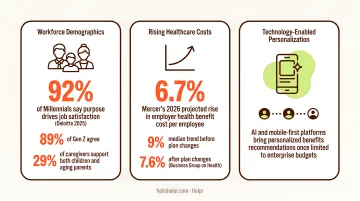
Those cost pressures have accelerated a third shift: technology-enabled personalization. AI and mobile-first platforms now make it feasible for mid-sized organizations to deliver personalized, employee-specific benefits recommendations that previously required enterprise-level budgets. Static benefits packages are giving way to adaptive models — and the organizations moving in that direction early are already pulling ahead.
Future Signals: Where Employee Benefits Are Headed Beyond 2026
Three emerging signals are worth watching:
Benefits-as-equity: Access and quality of benefits are treated as a workplace fairness issue — not just an HR metric. Employers who design benefits with wage equity in mind will face less regulatory and reputational pressure as this expectation solidifies.
Predictive benefits analytics: AI will move from simplifying enrollment to forecasting workforce care needs before they become retention problems — identifying which employee segments are at risk and what benefits would address that risk most efficiently.
Global care benefits expansion: Distributed workforces that span international borders need benefits that function across legal systems and cultures. Global backup care platforms covering 150+ countries with local provider networks will become a baseline expectation for multinational employers.
Employers who audit their current benefits against these 25 ideas, identify their biggest gaps, and act on 2–3 high-impact changes will be better positioned to attract and retain talent in 2026 and beyond. Early movers build on that advantage year over year — each retention win lowers the cost of backfilling the roles that competitors scramble to fill.
Frequently Asked Questions
What's new in employee benefits for 2026?
The most notable additions include the expanded pre-tax dependent care account limit ($7,500), AI-personalized benefits platforms, backup care programs covering both childcare and elder care, Lifestyle Spending Accounts, and broader women's health coverage. The through-line: employers are moving away from one-size-fits-all packages toward benefits that support employees across their whole lives.
What are the four major types of employee benefits?
The four primary categories are: (1) health and medical benefits, (2) retirement and financial benefits, (3) paid time off and leave, and (4) supplemental or fringe benefits. Modern packages increasingly blur these lines — wellness stipends, LSAs, and backup care benefits don't fit cleanly into any one bucket.
What are the health benefits for federal employees in 2026?
Federal employees are covered under the Federal Employees Health Benefits (FEHB) program, which offers medical, dental, and vision options distinct from private-sector plans. This article focuses on private-sector employer benefits trends rather than federal program specifics.
What employee benefits do workers value most in 2026?
Mental health support, flexible work arrangements, retirement matching, emergency savings access, and family caregiving benefits consistently top the list of valued non-salary benefits. Younger workers weigh learning and development opportunities especially heavily when evaluating employers.
What is backup care as an employee benefit?
Backup care is an employer-sponsored benefit providing on-demand, vetted childcare or elder care when a regular care arrangement falls through. It directly reduces unplanned absences and the productivity disruption that follows when employees can't find last-minute care coverage.
How can smaller companies afford to offer new employee benefits in 2026?
Small and mid-size employers can start with high-impact, low-overhead options: flexible scheduling, EAPs, Lifestyle Spending Accounts, and use-based care programs — which only charge when services are actually utilized. These models allow smaller organizations to compete for talent without the fixed cost burden of traditional benefit structures.