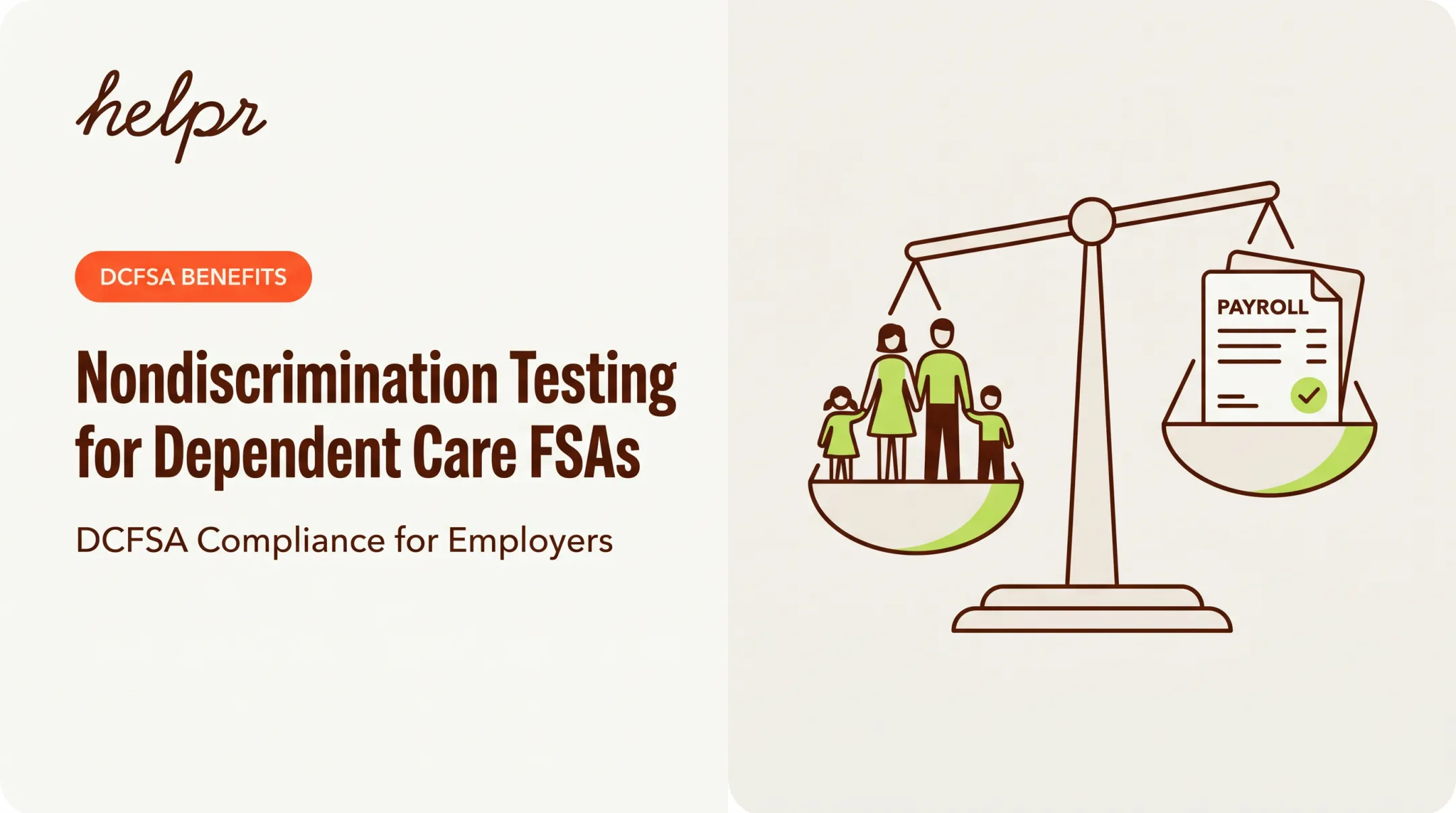

This guide is written for US employers — HR and benefits leaders, payroll teams, finance teams, and third-party plan administrators — who need to get this testing right. A failing result doesn't just create paperwork. It can strip tax-favored treatment from HCE benefits, trigger payroll corrections, and require W-2 adjustments after the fact.
Dependent care FSA testing gets mentioned constantly in benefits documentation, but few employers understand how it actually works operationally. This guide walks through what the testing measures, which data drives the outcome, when to test, and what happens if the plan fails.
Key Takeaways
- DCFSA testing includes eligibility, owner concentration, and contributions-and-benefits rules—not only the 55% Average Benefits Test
- The 55% test hinges on employee classification, participation data, and calculation methodology
- Mid-year preliminary testing leaves time to adjust HCE elections before year-end
- A failed test can make HCE benefits taxable and create payroll, W-2, and correction work
What Is Dependent Care FSA Discrimination Testing?
A dependent care flexible spending account (DCFSA) lets employees set aside pre-tax salary — up to $5,000 per year for most households — to pay for childcare, elder care, or other dependent care that allows them to work or look for work. Internal Revenue Code Section 129 governs these programs and requires them to run on nondiscriminatory terms.
Section 129(d) states that a dependent care assistance program must be a separate written plan, and that contributions or benefits can't discriminate in favor of highly compensated employees or their dependents. The same section requires that the plan's eligibility classification not favor HCEs either.
In plain terms: employees who aren't highly compensated need a genuine, fair shot at the benefit. They shouldn't be shut out by eligibility rules, contribution caps, or plan design that quietly steers value toward owners and top earners.
DCFSA testing is separate from other compliance checks employers sometimes lump together:
- Cafeteria plan (Section 125) testing covers the full pre-tax benefits menu, not dependent care alone
- Medical FSA testing uses different nondiscrimination rules and eligibility math
- Individual expense eligibility decides whether a daycare or babysitting cost can be reimbursed; that is a claims question, not a discrimination test
A weekend date-night sitter, for example, is not a qualifying work-related expense. That claims call does not tell you whether the plan design passes nondiscrimination testing.
Why and When Employers Use the Testing Process
A DCFSA can be written identically for every employee and still fail nondiscrimination testing. The rules test outcomes, not just plan language. If HCEs participate at higher rates or contribute larger amounts than everyone else, the plan can fail even when eligibility was open to all.
The Four Testing Categories
Section 129 sets out four areas to check each year:
- Eligibility: Is the classification of who can participate reasonable and nondiscriminatory?
- Contributions and benefits: Do actual amounts favor HCEs?
- Owner concentration: Does more than 25% of total benefits go to more-than-5% owners, spouses, or dependents?
- 55% Average Benefits Test: Do NHCEs receive, on average, at least 55% of what HCEs receive?

Confirm with your administrator which of these apply to your plan design, and which exclusions are currently permitted for the plan year.
Knowing which tests apply is only half the work. When you run them decides whether you still have time to correct a failure.
Mapping Testing to the Plan Year
| Timing | Action |
|---|---|
| Before open enrollment | Review plan design, eligibility rules, and classifications |
| After enrollment | Gather elections and workforce data |
| Mid-year | Run a preliminary test |
| Ongoing | Monitor material workforce or election changes |
| Year-end | Complete the final assessment or correction |
Many benefits administrators build testing into a standard annual cycle, starting well before plan-year end so there is runway for corrections. Waiting until December leaves little room to fix a problem before it becomes a tax issue.
How Dependent Care FSA Testing Works
Running dependent care FSA testing well means treating it as a repeatable process, not a scramble in December. The workflow starts with the governing plan document and ends with a documented, defensible result.
Data You Need to Pull Together
Before classifying anyone or running a single test, gather clean data from payroll, HR, and your FSA administrator:
- Employee status and dates, including hires and terminations during the plan year
- Ownership percentages for any employee with an equity stake
- Compensation history for the current and prior lookback year
- Eligibility dates and elected contribution amounts
- Reimbursements or benefits actually paid out
- Participation status for everyone who worked at any point during the plan year
Ask your administrator exactly which fields they pull automatically and which ones you need to supply manually. This varies by vendor and is a common source of testing delays.
The 55% Average Benefits Test, Explained
This test compares the average dependent care benefit received by non-highly compensated employees (NHCEs) against the average received by HCEs. Section 129(d)(8) requires the NHCE average to reach at least 55% of the HCE average.
Under the calculation method described in proposed 2026 IRS regulations, average benefit equals total DCAP assistance paid to a group during the plan year. Divide that total by the number of employees in the group who received more than zero in benefits.
A simplified, hypothetical illustration:
- 40 NHCEs receive benefits totaling $120,000 → average benefit of $3,000
- 10 HCEs receive benefits totaling $50,000 → average benefit of $5,000
- $3,000 ÷ $5,000 = 60%. This plan passes.

If the same total benefits go to fewer NHCE recipients, the average per NHCE rises. Low enrollment is still a risk: when fewer NHCEs use the plan at all, total NHCE benefits drop and the ratio can fall below 55% with no change to plan design.
Who Counts as a Highly Compensated Employee
For 2026, an employee is generally an HCE if they were a more-than-5% owner at any point during the current or prior year. They also qualify if their prior-year compensation exceeded the indexed Section 414(q) threshold of $160,000.
Employers can also elect to apply the "top-paid group" limitation, treating only the top 20% of employees by compensation as HCEs even if more employees technically clear the dollar threshold. If you make this election, it must apply consistently across all benefit plans determined in the same calendar year, including your retirement plan. Coordinate with your retirement plan administrator before locking it in.
The Three-Step Testing Process
A preliminary test uses interim data, often mid-year, to forecast where the plan is headed and give you time to act. The final test uses complete plan-year data and the compliance rules in effect for that year. Treat the preliminary result as a warning system, not a substitute for the year-end determination.
- Confirm the plan design and population. Review the written plan document, eligibility provisions, ownership structure, controlled-group relationships, and any collectively bargained employees who may be excludable.
- Prepare and validate the data. Reconcile your administrator's election and reimbursement records against payroll, HRIS, and termination data. Chase down missing or duplicate records before you test, not after.
- Run and review the tests. Pinpoint whether a failure traces back to plan design, low NHCE participation, benefit levels, or a data and methodology issue. Have your administrator or counsel walk through any assumption that materially changes the outcome.
Key Factors and Common Issues That Affect Test Results
Most DCFSA failures don't stem from bad plan language. They stem from real-world participation patterns and data errors that no one caught until testing time.
Participation Gaps Drive the 55% Test
The 55% test measures pure utilization, and it can be unforgiving. Nonparticipants can make up the majority of both the HCE and NHCE groups. A plan can still fail even when the average benefit among actual participants looks identical between groups.
Low NHCE enrollment, not generous HCE elections, is usually the real driver.
The Denominator Question
How you count the denominator matters. Do you divide by all employees, eligible employees, or only employees who received a nonzero benefit?
Proposed 2026 guidance would count only employees who received more than zero in benefits. That clarification is useful, but it is still proposed rather than final. Confirm which methodology your administrator currently applies.
Common Classification Errors
- Misidentifying HCEs by using outdated compensation thresholds
- Overlooking more-than-5% owners who don't hold obvious executive titles
- Excluding employees who worked only part of the plan year
- Mishandling new hires or terminated employees in the data pull
- Failing to combine data across related employers or controlled-group entities

Uniform Availability Isn't Enough
A plan-design failure comes from the written rules themselves — say, an eligibility class that quietly excludes lower-paid roles. An operational failure comes from execution: payroll errors, late enrollment processing, or elections that don't match what employees actually signed up for. Both produce the same failing result, but the fix is completely different.
A practical checklist for improving future results:
- Review employee communications so NHCEs understand the benefit exists
- Make enrollment genuinely accessible (timing, language, and process all matter)
- Monitor elections early rather than waiting for year-end totals
- Validate data monthly or at agreed checkpoints with your administrator
- Ask how your administrator documents its testing methodology, in writing
What Happens When a Plan Fails?
A failing result isn't the end of the plan, but it does start a clock.
The Immediate Response
- Confirm the failed test and the assumptions behind it — sometimes a data error, not a real discrimination problem, drives the result
- Loop in your FSA administrator and benefits counsel or tax adviser right away
- Determine exactly which employees are affected and by how much
- Establish a correction deadline based on the plan year and current law
Correction Approaches
Available options depend on timing and current guidance, but typically include:
- Reduce or cap affected HCE elections before the plan year closes
- Refund excess contributions through payroll as taxable wages
- Recharacterize otherwise pre-tax benefits as taxable income
When a plan fails, HCE benefits generally become taxable unless corrected before the affected year's W-2s are issued. Once the plan year closes, the entire HCE election amount may need to be treated as taxable income. The 55% test typically can't be fixed retroactively after that point.
Payroll and Reporting Fallout
A correction usually touches more than one system:
- Withholding adjustments for affected employees
- Taxable income changes reflected on Form W-2
- Employee communications explaining the change
- Reconciliation between your FSA administrator and payroll
Verify current reporting treatment and deadlines with your tax adviser before communicating anything to employees.
Early testing matters here. Catching a likely failure mid-year gives you room to adjust HCE elections proactively, often preserving some tax-advantaged benefit. Waiting until after the deadline narrows your options considerably.
A Failed Test Isn't Solved by Adding a New Benefit
It's tempting to respond to a failed DCFSA test by layering on a different care benefit. That response is a separate decision, not a correction for the failed test.
An employer-sponsored backup care benefit, such as Helpr's backup care platform, can complement a DCFSA by helping employees access childcare, elder care, or short-notice support. It does not replace nondiscrimination testing or change the FSA's tax rules, so manage the two on separate tracks.

Conclusion
Dependent care FSA testing looks at two things at once: how the plan is designed on paper, and how real employees actually use it. The 55% Average Benefits Test tends to demand the most operational attention, since participation gaps — not generous plan language — cause most failures.
Accurate workforce data, consistent HCE classification, and a mid-year pre-test beat guesswork every time. Waiting until the plan year closes to check your numbers removes most of your options if something's off.
Confirm current IRS requirements before you finalize testing, and loop in your FSA administrator, payroll team, and tax advisor or benefits counsel early. Building a repeatable annual testing process now saves you from a scramble and a tax problem later.
Frequently Asked Questions
What happens if a dependent care FSA fails nondiscrimination testing?
You generally need to identify which HCE benefits are affected and complete any permitted correction, which may mean reducing elections or treating amounts as taxable income. Confirm current deadlines and procedures with your FSA administrator and tax adviser.
What does the 55% Average Benefits Test measure?
It compares the average dependent care benefit received by non-highly compensated employees against the average received by highly compensated employees. Proposed IRS guidance has also clarified how the denominator is counted, so match your math to the current methodology.
When should an employer perform dependent care FSA nondiscrimination testing?
Review plan design before open enrollment, run a preliminary test mid-year, and complete a final review using full plan-year data before your deadline. This sequence gives you time to correct issues before they become tax problems.
Who is considered a highly compensated employee for dependent care FSA testing?
Generally, an employee who owned more than 5% of the company at any point in the current or prior year, or whose prior-year compensation exceeded the indexed threshold. Confirm the current year's threshold and whether your organization uses a top-paid group election.
Do all employees have to be included in dependent care FSA testing?
It depends on which test you're running and which exclusions currently apply — some tests exclude certain new hires or collectively bargained employees, others don't. Don't drop nonparticipants or former employees unless the specific test rules allow it.
Can an employer correct a failed dependent care FSA test after the plan year ends?
Correction options narrow significantly once the plan year closes, and available remedies depend on current IRS guidance. Act quickly, and confirm whether payroll or tax reporting deadlines limit what you can still fix.