

Introduction
Nearshoring has turned Mexico into one of the top destinations for US companies building distributed teams. Tech, e-commerce, and manufacturing employers are hiring Mexican talent at a pace that's outstripping most HR departments' knowledge of local labor law.
Here's the catch: Mexico's Federal Labor Law (Ley Federal del Trabajo) mandates benefits far more generous than anything required in the US. Christmas bonuses, profit sharing, and paid vacation premiums are legal obligations—not optional perks.
Violations can trigger fines calculated in UMA units that scale with severity and repeat offenses.
This guide breaks down what US employers need to know: mandatory statutory benefits, common supplemental perks, the emerging family care gap, and practical compliance paths for hiring in Mexico.
Key Takeaways
- Mexico's statutory benefits (Aguinaldo, profit sharing, IMSS coverage) are legal minimums, not optional extras
- Independent contractors don't receive statutory benefits, but misclassification exposes US employers to real penalties
- Elective perks like food vouchers and savings funds help differentiate offers in competitive talent markets
- Childcare support remains underdeveloped in Mexico, giving employers who offer it a real edge in hiring and retention
- Local entities, EORs, and PEOs each offer a different balance of control, cost, and compliance risk
Understanding Mexico's Employment Landscape for US Employers
Every employment relationship in Mexico falls under the Ley Federal del Trabajo, and enforcement isn't theoretical. Labor inspectors have authority to demand records, question employers and workers directly, and report violations for penalty action.
Fines aren't flat fees. Under LFT Article 992, penalty amounts scale with the UMA (Unidad de Medida y Actualización) in effect at the time of the violation, adjusted for intent, harm, and prior offenses. Recidivism doubles the previous fine.
Profit-sharing violations alone carry penalties between 250 and 5,000 UMA under Mexico's Federal Labor Law. Improper subcontracting arrangements can reach 50,000 UMA.
A critical distinction for US employers: statutory benefits apply to classified employees only. Independent contractors aren't entitled to Aguinaldo, profit sharing, or IMSS coverage.
Labeling someone a "contractor" doesn't make it true under Mexican law. If the relationship shows subordination, set hours, or exclusive dependence on one employer, authorities will treat that person as an employee regardless of the contract's title.
The Instituto Mexicano del Seguro Social (IMSS) is the backbone of Mexico's social security infrastructure. It covers:
- Healthcare (medical, surgical, pharmaceutical, hospital)
- Retirement and old-age pensions
- Disability and life insurance
- Occupational risk coverage
- Childcare services for qualifying working parents
Every employer contribution funds this system directly, which is why IMSS registration isn't optional for compliant hiring.
Statutory (Mandatory) Employee Benefits in Mexico
These aren't negotiable line items. They're the floor every full-time employee in Mexico is legally owed, and skipping them isn't a gray area. It's a violation with a price tag attached.
Christmas Bonus (Aguinaldo)
Every employee is entitled to a minimum of 15 days' salary, paid no later than December 20. Employees who haven't completed a full year receive a proportional amount based on time worked.
Many employers pay 20 to 30 days as a retention gesture, since the legal minimum is often viewed as barely competitive in tighter labor markets like tech and logistics.
Paid Vacation & Vacation Premium (Prima Vacacional)
Mexico's vacation schedule scales with tenure:
- Year 1: 12 days
- Years 2–5: 14, 16, 18, then 20 days
- Years 6–10: 22 days
- Beyond year 10: add 2 days for every 5 years of service
On top of paid days off, employers must pay a vacation premium of at least 25% of the employee's regular salary for those days. At least 12 vacation days must be taken consecutively unless the employee requests otherwise.
Profit Sharing (PTU)
Companies must distribute 10% of pre-tax profits annually to employees (the mandated national rate). The distribution follows a two-part formula: half is divided equally by days worked, and half is allocated proportionally by wages earned.
Deadlines are strict: May 30 for corporate entities and June 29 for individual employers, tied to roughly 60 days after tax filing. Newly formed businesses are exempt during their first year of operation. Genuine independent contractors without a subordinate relationship fall outside PTU eligibility entirely.
Social Security (IMSS) Contributions
Employer IMSS contributions aren't a single flat rate. They vary by salary level, occupational risk classification, and insurance branch, covering:
- Occupational risk (rates from roughly 0.5% to 7.6%, depending on class)
- Disability and life insurance (1.75%)
- Retirement (2%)
- Advanced-age and old-age coverage (3.15% to nearly 12%)
- Childcare and social benefits (1%)
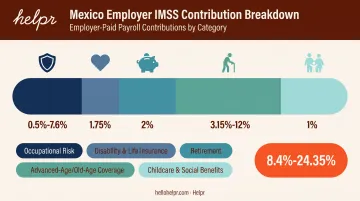
Total employer cost depends on payroll mix and risk class, so budget with your workforce profile in mind rather than a single headline percentage. IMSS coverage replaces the employer-run health plans US companies typically administer directly.
Maternity, Paternity & Sick Leave
Maternity leave runs six weeks before and six weeks after birth. IMSS pays 100% of the employee's contribution-base salary during that period if they meet the 30-weekly-contribution eligibility threshold.
Fathers receive five paid working days for birth or adoption, an employer obligation under the LFT and separate from IMSS cash benefits. For ordinary sickness, IMSS covers 60% of salary starting on day four, for up to 52 weeks, extendable by another 26 weeks.
Severance & Termination Pay
Severance obligations shift dramatically depending on how employment ends:
| Separation Type | Employer Obligation |
|---|---|
| Voluntary resignation | Proportional Aguinaldo, vacation, premium; seniority premium after 15+ years |
| Termination with cause | Accrued benefits only, contingent on valid legal grounds |
| Termination without cause | Reinstatement or three months' salary, plus seniority premium and unpaid benefits |
Unjustified dismissal claims must be filed within a short statutory window, and employers who terminate without documented cause face significant exposure beyond the standard three-month figure.
Common Elective & Supplemental Benefits in Mexico
Because statutory minimums already set a high bar, elective benefits are where US employers actually compete for talent, especially in tech, logistics, and nearshoring roles where candidates have multiple offers on the table.
Food & Grocery Vouchers (Vales de Despensa)
Vouchers (vales de despensa) are among the most common perks. When delivered in kind or through an authorized electronic wallet and kept at or below 40% of monthly UMA, they're excluded from the salary base used to calculate social security contributions. That exclusion makes them tax-efficient for employers. Cash equivalents don't qualify for this treatment.
Private Health & Life Insurance
Even though IMSS provides universal healthcare, many employees still want private coverage for shorter wait times and better facility access. For roles competing against multinational offers, private insurance is often what makes a package stand out.
Savings Funds (Fondo de Ahorro)
Employer-matched savings accounts let both parties contribute toward an annual payout. Contributions are capped at 13% of salary under tax rules, with a corresponding limit tied to annual reference amounts. These funds function similarly to a forced-savings retirement supplement and are well understood by Mexican employees.
Transportation, Company Cars & Connectivity Perks
Common additions include:
- Gas or parking stipends
- Company vehicles for senior or field-based roles
- Cell phone and internet allowances, increasingly standard for remote workers
Productivity Bonuses & Employee Loans
Two other levers show up often in competitive packages:
- Tiered productivity bonuses that reward performance beyond base pay
- Low-interest employer loans (personal, auto, mortgage) that double as retention tools
Family Care & Childcare Benefits: An Emerging Competitive Advantage
IMSS does offer basic daycare services to some working mothers, but capacity and quality are limited. That gap has real consequences for the labor force.
Among economically inactive women ages 15 to 60 in Mexico, 6.3 million cited lacking someone to care for children, older adults, or sick family members as their reason for staying out of paid work, according to Mexico's 2022 national caregiving survey. That figure points to a labor supply problem tied directly to unmet care needs.
Dual-income households are becoming the norm in Mexico's growing tech, manufacturing, and nearshoring sectors. As more companies chase this talent pool, flexible family care solutions are shifting from nice-to-have to competitive differentiators.
Global employers are noticing. Companies with distributed teams increasingly extend childcare and backup care benefits to international offices, not just US headquarters staff, to keep benefits equitable across their workforce.
Helpr's global backup care platform addresses this gap directly. Through the patented My Choice technology, employees in Mexico and 150+ other countries can:
- Designate trusted caregivers already in their personal network — family, friends, neighbors — and pay them through the app using employer subsidies
- Access center-based care with receipt reimbursement, even outside Helpr's partner network
- Use a 1:1 Care Specialist for more complex childcare or eldercare arrangements
- Transact in local currency, with the platform available in both English and Spanish
The use-based pricing model means employers only pay for care that's actually booked, not flat-rate coverage sitting unused. For US enterprises hiring in Mexico's tight labor market, that mix of equity, flexibility, and cost control is a real differentiator—especially against benefits packages still built only for US employees.
How US Employers Can Offer Compliant Benefits in Mexico
There are three realistic paths for delivering benefits to employees in Mexico, and the right one depends on scale, timeline, and appetite for risk.
Establish a local entity. Full control over benefits design and payroll, with direct IMSS registration, ongoing filings, and hire, departure, and salary-change reports due within five business days. Best for long-term, large-scale Mexican headcount.
Partner with an Employer of Record (EOR). The EOR is the legal employer on paper and runs payroll, statutory benefits, and IMSS compliance while you direct day-to-day work. Faster to launch than a local entity, but Mexico limits personnel subcontracting for core business activities. Specialized-service setups must sit outside that scope and need REPSE registration.
Use a PEO. Similar risk profile to an EOR, usually focused on HR administration and benefits access rather than a full employment transfer. A fit when you want shared HR support without standing up your own entity.
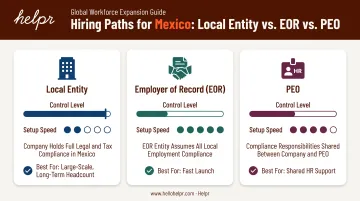
A few administrative realities to plan around regardless of path:
- Benefit thresholds and fine calculations are tied to UMA values, which update annually
- Documentation often needs to exist in both Spanish and English for enrollment and compliance purposes
- Some enrollment processes still rely on physical paperwork rather than fully digital workflows
Misclassification and subcontracting violations carry real financial exposure. Most companies work with in-country legal or payroll experts, or established global benefits platforms, to keep filings, registrations, and benefit delivery aligned with current rules.
Frequently Asked Questions
What benefits are mandatory for employees in Mexico?
Full-time employees are entitled to Aguinaldo (Christmas bonus), paid vacation with a 25% premium, profit sharing (PTU), IMSS coverage, parental leave, and severance protections. These are legal minimums.
Do independent contractors receive benefits in Mexico?
No. Only classified employees are entitled to statutory benefits under the Federal Labor Law. Misclassifying an employee as a contractor to avoid these obligations carries legal and financial risk for US employers.
How much is the Christmas bonus (Aguinaldo) in Mexico?
The legal minimum is 15 days' salary, payable by December 20 each year. Many employers pay 20 to 30 days to stay competitive in tighter talent markets.
Can US companies hire employees in Mexico without a local entity?
Yes. Employer of Record (EOR) and PEO services let US companies hire employees in Mexico compliantly without setting up their own Mexican legal entity, though specific rules around subcontracting still apply.
Is profit sharing (PTU) mandatory for all companies in Mexico?
For most companies, yes, at 10% of pre-tax profits distributed to eligible employees. Newly formed businesses are exempt during their first year of operation.
What supplemental benefits do employees in Mexico value most?
Private health insurance, food vouchers, and savings funds remain top choices. Family and childcare support is a fast-growing category, especially among dual-income households in tech and nearshoring roles.