
Here's the confusion that trips most families up: there is no single national "free daycare" program. Instead, help comes from a patchwork of government subsidies, early education programs, tax credits, community organizations, and employer benefits. Each has its own income limits, state-specific rules, and application process.
Families also face practical roadblocks:
- Income limits that shift by state and household size
- Funding caps that create waitlists even for eligible families
- Confusing paperwork requirements that vary by county
This guide walks through the types of assistance available, how eligibility gets determined, how to apply, and how employer benefits like those from Helpr can fill the gaps.
Key Takeaways
- Childcare subsidies pay for ongoing care now; tax credits reimburse eligible expenses later.
- Income, family size, work or school status, child age, and residency usually decide eligibility.
- Submit applications through your state's official childcare agency—not outdated online charts.
- Start early, organize documents, and confirm your provider accepts subsidy payments before enrolling.
Types of Childcare Assistance Programs
Childcare help comes through several distinct systems, each built for different needs.
Federal and State Subsidy Programs
The Child Care and Development Fund (CCDF) is the backbone of most state subsidy programs. It's administered by the Office of Child Care within HHS, which distributes funding to state, territory, and Tribal Lead Agencies. Under federal CCDF eligibility rules, a family generally qualifies if:
- The child is under age 13
- A parent or guardian is working, in job training, or enrolled in an education program
- Household income doesn't exceed 85% of the state median income
- Family assets stay under $1,000,000
States can add stricter requirements or priority categories on top of this floor. That's why two families with identical incomes in different states can get very different answers.
Head Start and Early Head Start
These federally funded programs combine early learning with family support services. According to HeadStart.gov's eligibility guidance, children from birth to age five in families below the federal poverty guidelines typically qualify.
Foster children, kids in homeless families, and those receiving TANF or SSI are eligible too, often regardless of income documentation. Early Head Start specifically serves infants, toddlers under three, and pregnant women.
State Pre-K and Public Preschool
Don't confuse pre-K with full childcare coverage. State-funded pre-K generally serves children ages 3-5 on a school-day schedule focused on kindergarten readiness. It rarely covers the extended hours working parents need, so many families layer pre-K with a separate subsidy or after-care arrangement.
Tax-Based Benefits
Two tax tools help offset costs:
- Child and Dependent Care Credit: offsets a percentage of work-related care expenses based on adjusted gross income—see the IRS's current credit information for this year's rates
- Dependent Care FSA: pre-tax payroll deductions through an employer plan, often used for backup care or ongoing daycare
Unlike a subsidy, tax benefits typically arrive as a reduction in what you owe, not upfront help paying a provider.

Additional Avenues Worth Checking
- Military family fee assistance for active-duty and reservist parents
- Tribal childcare programs administered by Tribal Lead Agencies
- Nonprofit grants and local community action agency funds
- Employer-sponsored benefits, covered later in this guide
Each of these has separate rules. Treat them as supplements to search, not guaranteed fallbacks.
Who Qualifies and How Eligibility Is Determined
There's no universal income cutoff for "free childcare." That single sentence resolves most of the confusion families run into online.
The Core Eligibility Factors
States evaluate a mix of criteria, typically including:
- Household income — gross or adjusted, measured against state median income
- Family size — larger households often qualify at higher income levels
- Child's age — most programs cap eligibility around age 13
- Work or education status — a parent usually must be working, in job training, or in school
- Residency — you generally must live in the state or county administering the program
- Disability or special needs — may expand eligibility or unlock extra support
Full Assistance vs. Partial Subsidies
Getting approved doesn't always mean full coverage. Programs typically fall into a few tiers:
- Full subsidy with no parent copayment (rare, usually for the lowest-income families)
- Partial subsidy with a sliding-scale copayment
- Reduced-fee arrangements through pre-K or nonprofit partners
Ask specifically what your family contribution will be before assuming a program is "free."
Special Circumstances
Some situations get expedited or waived requirements:
- Homelessness — federal guidance encourages categorical eligibility regardless of income, per ACF's homeless children policy
- Foster care — children qualify for Head Start regardless of foster family income
- Protective services involvement — state agencies can waive income requirements case by case
- Military deployment — can open fee assistance even without on-base care shortages
Pre-Application Checklist
Before you start filling out forms, confirm:
- Your child's exact age and birthdate on record
- Your current household income, not last year's
- Your work, training, or school schedule
- Your state and county of residency
- Whether your preferred provider even accepts the program you're applying for
How to Apply for Childcare Assistance
Applying for childcare assistance takes several steps. Most states follow this general sequence.
Step-by-Step Application Process
- Locate your agency: Start at Childcare.gov's financial assistance page and select your state
- Review program requirements: Every state publishes its own income tables and documentation list
- Submit your application: Most states now accept online submissions through their HHS or social services portal
- Upload documentation: Submit required files and respond quickly to any follow-up requests
- Wait for the eligibility decision: Timelines vary widely by state and current caseload
Documents to Gather
Requirements differ locally, but plan to have these ready:
- Identity and residency records (ID, lease, utility bill)
- Proof of your child's age (birth certificate)
- Income statements (pay stubs, W-2s, tax returns)
- Work or school schedule documentation
- Custody paperwork, if applicable
- Documentation of special circumstances (disability, homelessness, foster placement)
Confirm the exact list with your local agency. A Massachusetts family and a South Dakota family will not submit the same paperwork.

Confirming Your Provider Is Eligible
Before committing to a provider, verify that they:
- Hold a current license or approved status
- Accept the specific subsidy or voucher you're applying for
- Have open capacity for your child's age group
- Can accommodate your work schedule, including drop-off and pickup windows
Handling Waitlists and Delays
Funding caps mean approval doesn't always equal immediate placement. If you hit a waitlist:
- Apply as early as possible, ideally before you need care to start
- Ask directly whether emergency or priority placement categories apply to your situation
- Keep your confirmation number and any case worker contact information
- Look into temporary bridges through schools, nonprofits, or community action agencies while you wait
After the Decision
Once you get an answer:
- Review your approved benefit amount and any required parent contribution
- Report income or household changes promptly to avoid overpayment issues
- Track your renewal deadline; benefits typically aren't permanent
- Ask about appeal rights if you're denied, since most states offer a fair hearing process
Only rely on current official state, county, or federal resources when checking your numbers. Old income charts circulating online can be a year or more out of date.
Employer-Sponsored Childcare Assistance
Public programs aren't the only option. A growing number of employers offer childcare benefits that work alongside, or independently of, state subsidies.
Common Employer Benefits
- Backup care for when school closes or your regular caregiver falls through
- Childcare subsidies built into the benefits package
- Dependent Care FSAs for pre-tax savings on care costs
- Referral services connecting employees with vetted providers
- Flexible scheduling to reduce the childcare gap
These benefits typically follow the employer's own eligibility rules, not government income thresholds. Availability depends on your employment status, the specific plan design, your location, and whether care capacity exists in your area.
Where Helpr Fits In
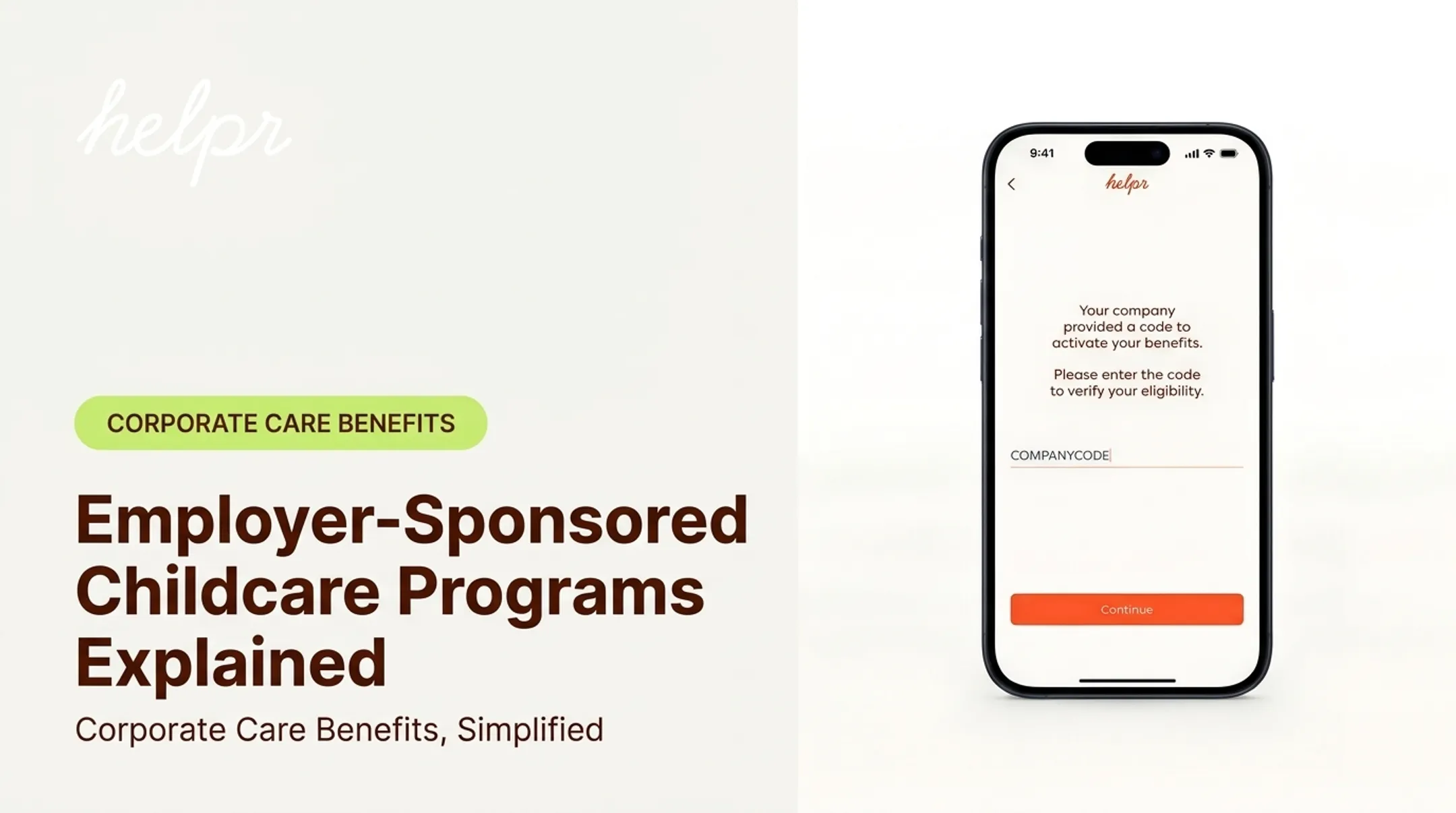
Helpr is one example of this approach. The enterprise family-care platform connects eligible employees with childcare and dependent-care support through a flexible, use-based model.
Employers use Helpr's patented "My Choice" technology to offer backup care, care stipends, and provider connections—with equitable access for hourly staff and executives alike.
Helpr isn't a government subsidy, and coverage varies by employer plan. If your company offers Helpr or a similar benefit, review your package before assuming a state waitlist is your only option.

Making the Most of Assistance
Getting approved for assistance is only half the job. Managing it well determines whether it actually reduces your stress.
A Comparison Framework
When comparing assistance programs or benefits, run each option through this checklist:
| Factor | Questions to Ask |
|---|---|
| Total cost | What's left after subsidy or tax credit? |
| Hours covered | Does it match your actual work schedule? |
| Provider quality | Licensed? Reviewed? |
| Copayments | Fixed or sliding scale? |
| Renewal | When and how often? |
| Income changes | Does a raise disqualify you mid-year? |
Common Mistakes to Avoid
A strong comparison still fails if paperwork or provider fit falls through. Watch for these traps:
- Missing a renewal notice and losing coverage without warning
- Failing to report a household change, leading to repayment demands later
- Assuming a tax credit pays the provider directly (it doesn't; it reduces taxes owed)
- Choosing a provider that can't bill your subsidy program
- Overlooking an employer benefit in your HR portal, such as backup care or a DCFSA
Your Action Plan
Once you’ve shortlisted programs that fit, work this sequence:
- Check your state's official childcare assistance page for current rules
- Gather documentation before you need it, not after a deadline looms
- Apply to every program you might qualify for, not just one
- Ask your provider directly whether they accept subsidy payments
- Keep records of every application, approval letter, payment, and deadline
Frequently Asked Questions
What is the minimum income for free childcare?
There's no single national minimum-income rule for free childcare. Eligibility depends on your state, household size, how income is defined, work or education status, child age, and available funding. Check with your state's childcare agency for current thresholds.
What is the income limit for daycare assistance in NY?
New York's income limits vary by household size, locality, and current OCFS policy, with figures updated annually each June. Contact your local Department of Social Services or the OCFS Child Care Assistance Program for the exact threshold and application steps.
Do I qualify for child care assistance in California?
California evaluates income, family size, child age, work or education activity, residency, and program availability through CDSS-administered programs like CAPP. Contact your local Alternative Payment Program agency or Resource and Referral agency to confirm your eligibility.
Does Florida help pay for daycare?
Yes. Florida's School Readiness program offers financial assistance to qualifying low-income families through local Early Learning Coalitions. Eligibility, provider participation, copayments, and waitlists depend on current rules, so contact your local coalition or the Florida Office of Early Learning directly.