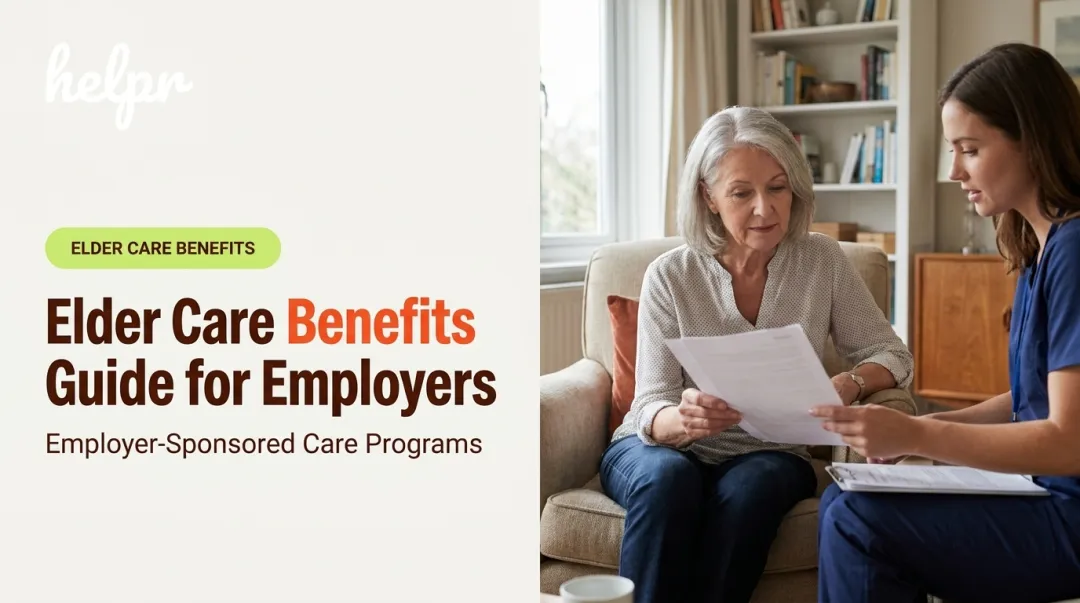

Employers often frame elder care benefits as a nice-to-have, a compassionate add-on to the benefits packet. But the real value shows up in numbers HR and finance teams already track: fewer unplanned absences, less turnover among experienced staff, and employees who can actually concentrate during their shift.
This article breaks down how to calculate that return, which business outcomes matter most, and how to build a program that reaches your whole workforce instead of just the people in headquarters.
Key Takeaways
- Elder care benefits pay off by reducing avoidable turnover, unplanned absences, and lost focus during working hours.
- Measure ROI with a mix of avoided costs, retention data, utilization, and employee feedback — never utilization alone.
- The strongest programs pair practical support (backup care, navigation) with real accessibility and equitable eligibility.
- Set a baseline before launch, then track results by role, shift, location, and caregiving need.
What Are Elder Care Benefits?
Elder care benefits are employer-sponsored resources that help employees manage responsibilities for aging parents, relatives, or other older dependents without derailing their work. They're built to solve a specific problem: care disruptions and complex decisions that can't wait until after 5 p.m.
Common forms of support include:
- Backup care for when a regular caregiving arrangement falls through
- Care navigation and referrals for sourcing and vetting providers
- Flexible work arrangements to accommodate appointments and care transitions
- Caregiver leave for intensive or crisis periods
- Emotional well-being resources, such as counseling or peer support
- Financial and legal guidance, including help understanding Medicare, Medicaid, and long-term care options
These benefits function as workforce infrastructure rather than a standalone perk. Helpr's elder care benefits, for example, combine subsidized companion care, respite, and daytime supervision with personalized care-finding services, so employees can book real help instead of spending work hours searching for it.
Key Advantages of Elder Care Benefits
The ROI here rarely shows up as a check written to the employer. It shows up as costs avoided and outcomes improved: fewer resignations, fewer gaps in coverage, and a workforce that shows up mentally present.
Lower Avoidable Turnover and Protect Experienced Talent
When care responsibilities go unresolved, employees don't just struggle quietly. They cut their hours, decline promotions, take extended leave, or quit outright.
The numbers back this up. Among working caregivers of adults, 18% moved from full-time to part-time work, 16% took a leave of absence, 9% left their jobs entirely, and 8% turned down a promotion, according to AARP and the National Alliance for Caregiving's 2025 caregiving report.
Separately, Harvard Business School's The Caring Company found that 32% of employees who left a position cited eldercare responsibilities as a reason for leaving.

Benefits like care navigation, backup care, and flexible scheduling give employees a way to absorb a care crisis without absorbing a resignation letter.
KPIs to track:
- Voluntary turnover among identified caregivers
- Retention gap between program users and non-users
- Regretted attrition and internal mobility
- Time-to-replace for affected roles
This advantage matters most for organizations with specialized roles, high replacement costs, or a large mid-career and multigenerational workforce — where losing one experienced employee costs far more than a single salary.
Reduce Absenteeism, Presenteeism, and Productivity Disruption
A last-minute care cancellation, a hospital transition, or a scramble to coordinate a doctor's visit doesn't respect the workday. It interrupts attendance or splits an employee's attention right in the middle of a shift.
SHRM's 2025 research found working caregivers report 1.2 unexpected missed workdays per month due to insufficient support, which the organization modeled at $17.5 billion in lost wages nationally per month. That's a broad, modeled figure covering all caregiver types, but it illustrates the scale of disruption employers are absorbing without realizing it.
Responsive backup care changes the math. Helpr's model allows bookings as short as one to two hours to save a full eight-hour workday, which matters enormously for anyone juggling a care emergency and a meeting schedule.
KPIs to track:
- Unscheduled absence days and missed shifts
- Short-term leave usage
- Self-reported concentration or manager-reported disruption
- Productivity proxies specific to the role
Frontline, shift-based, healthcare, manufacturing, and retail environments feel this fastest — one absence immediately creates a coverage gap someone else has to fill.
Strengthen Recruitment, Engagement, and Workforce Equity
Many employees won't identify as caregivers until a crisis forces the issue. Visible elder care support tells them help exists before they need to ask for it — which matters for engagement and for attracting talent who are quietly weighing their options.
Equity is the harder part. AARP/NAC found that salaried caregivers had significantly better access than hourly caregivers to telecommuting (58% vs. 23%), paid family leave (60% vs. 35%), and referral or EAP support (43% vs. 27%). A benefit that only reaches office-based staff will understate its own ROI and leave your frontline workforce unsupported.
KPIs to track:
- Offer acceptance rates
- Benefit awareness and participation across job levels
- Engagement or eNPS scores among caregivers vs. non-caregivers
- Manager-reported team stability
In competitive labor markets and distributed workforces, caregiving support can be the differentiator between two similar offers.
ROI Calculation Framework
A workable formula:
ROI = (Estimated value of avoided turnover + avoided absence costs + productivity gains + other measured savings − program cost) ÷ program cost
Each input needs a clear definition before you make a claim. A simplified, illustrative example:
| Input | Hypothetical Value |
|---|---|
| Employees using elder care support | 150 |
| Avoided turnover (5 retained employees × $45,000 replacement cost) | $225,000 |
| Avoided absence cost (300 avoided unscheduled absence-days × $250/day) | $75,000 |
| Annual program cost | $90,000 |
| Net ROI | ($300,000 − $90,000) ÷ $90,000 = 2.3x |
These figures are illustrative, not a promise. Your own baseline turnover, salary bands, and absence costs will change the math significantly.
Separate direct savings (turnover, absence) from indirect benefits (faster onboarding, better manager retention) and intangible outcomes like trust and peace of mind. Those won't land on a spreadsheet, but they still shape whether people stay.
What Happens When Elder Care Benefits Are Missing or Ignored
Without accessible support, employees don't stop caregiving. They just do it during work hours, quietly.
That looks like:
- Handling care administration calls between meetings
- Using unscheduled PTO or sick days instead of planned support
- Reducing availability without explaining why
- Concealing caregiving responsibilities from managers entirely
Helpr's own research on caregiver challenges identifies absenteeism, distraction, turnover, and burnout as the direct fallout employers feel when dependable care isn't accessible. Operationally, that shows up as inconsistent attendance, delayed projects, and managers stuck firefighting instead of managing. Colleagues absorb the missed work, which spreads the disruption further than the original caregiver.

The longer-term financial exposure includes avoidable turnover, replacement and training costs, and lost institutional knowledge. These costs don't appear on a benefits budget line, but they show up everywhere else.
Narrow programs create inequity of their own. If elder care support only reaches salaried or office-based employees, it excludes the hourly, shift-based, and remote workers who typically have the least flexibility to absorb a caregiving crisis on their own.
How to Get the Most Value from Elder Care Benefits
Start with a Workforce Needs Assessment
Survey employees about actual care responsibilities, preferred support types, and access barriers. Don't assume you already know who's caregiving. Pair that with existing absence, turnover, and leave data.
Segment results by role, shift pattern, location, and tenure. Protect privacy, and avoid assumptions about who's likely to be a caregiver based on age or title alone.
Build a Coordinated, Flexible Benefit Design
One solution rarely covers it. Strong programs combine backup care, navigation, flexible work, leave, and financial or legal referrals.
Navigation support matters most when employees face Medicare, Medicaid, or long-term care decisions. Medicare generally doesn't cover long-term care, and Medicaid rules vary by state, so expert guidance is essential.
Helpr is one example of a platform built around this kind of flexibility, combining elder care with childcare and other dependent-care needs in a single experience. That combination is useful for the growing share of employees managing care for both a parent and a child at once.
Make the Program Easy to Find and Use
Clear eligibility, simple enrollment, mobile access, and confidential support all drive usage. Communicate through managers, onboarding, and benefits portals, not just a single email at open enrollment.
Low utilization usually signals a design problem, not a lack of need:
- Limited awareness of the benefit's existence
- Confusing sign-up or access steps
- Eligibility rules that exclude hourly or remote staff
- Support that doesn't match actual care situations
Track Outcomes and Refine the Program
Set a baseline before launch. Then review utilization, repeat use, response times, absence trends, and retention at regular intervals (quarterly works well for most organizations).
Compare results against a control group where possible, and avoid claiming causation without solid methodology. Use a balanced scorecard that covers financial outcomes, employee experience, equity of access, and operational resilience.

Conclusion
Elder care benefits become a measurable business investment once they reduce care-related disruption and keep experienced employees in their roles. Proving that ROI takes discipline: define your costs, set a baseline, track the outcomes that matter to your workforce, and pair the numbers with real employee feedback.
Treat elder care support as an ongoing workforce strategy, not a one-time perk during open enrollment. Platforms like Helpr combine elder care and childcare access in one flexible experience, helping employers extend equitable coverage while keeping program costs proportional to actual use.
Frequently Asked Questions
What are elder care benefits?
Elder care benefits are employer-sponsored resources that help employees care for aging parents or relatives while staying engaged at work. Common examples include backup care, care navigation, flexible work, leave, and financial or well-being resources.
How do elder care benefits generate a return on investment?
Returns typically come from avoided turnover, reduced absenteeism, and less productivity loss tied to care disruptions. Employers still need to measure their own program costs and outcomes to confirm the ROI.
How should employers calculate the ROI of elder care benefits?
Use this formula: (avoided turnover + avoided absence costs + productivity gains − program cost) ÷ program cost. Include real replacement costs, absence-related savings, utilization data, and employee feedback in your calculation.
Which elder care benefits should employers offer?
Most organizations get the best results combining backup care, care navigation, flexible work, caregiver leave, and financial or legal guidance. The right mix depends on your workforce's actual caregiving needs.
How can employers measure whether elder care benefits are working?
Set a baseline before launch, then track retention, absence, engagement, utilization, and response times over time. Employee experience surveys should complement the quantitative data, not replace it.
What are the benefits of offering elder care support alongside childcare benefits?
A combined family-care strategy reaches more employees, including sandwich-generation caregivers managing both aging parents and young children. Childcare statistics shouldn't be applied directly to elder care outcomes, since the two populations face different challenges.