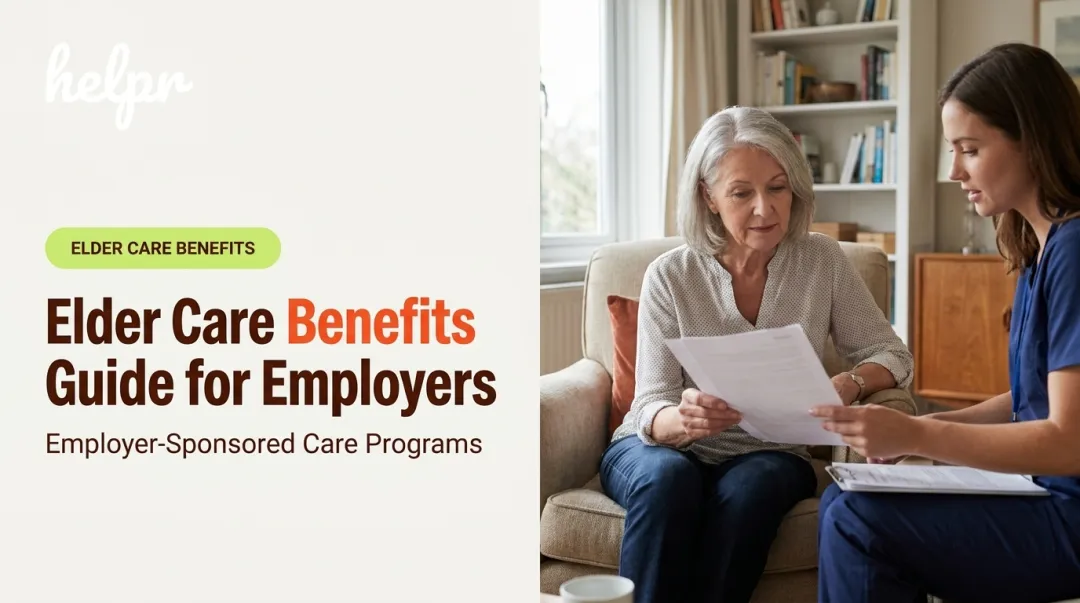

In-home care can let an aging parent stay in the house they've lived in for decades instead of moving into a facility. But finding that care is rarely simple. Families run into confusing terminology, spotty provider availability, and costs that swing wildly depending on the state and the hours needed.
That's where employers have a real role to play, not by replacing doctors, insurers, or family decision-making, but by removing the logistical and financial friction that pulls caregiving employees away from their work and, eventually, out of the workforce entirely.
Key Takeaways
- Elder-care responsibilities directly affect attendance, focus, and retention, according to current workforce research
- Separate nonmedical in-home help from skilled home health care, respite care, and long-term arrangements
- Effective benefits cover every role and work arrangement while protecting employee privacy
- Most employer programs supplement elder-care costs rather than covering them fully
Why In-Home Care for Elderly Parents Belongs in an Employee Benefits Strategy
The Hidden Cost of Unsupported Caregiving
Elder caregiving isn't a niche issue tucked away in a benefits binder.
According to a 2024 HHS ASPE issue brief, an estimated 22.5 million people — 61% of the 37 million caregivers of older adults in the U.S. — are also employed, providing an average of 64.8 hours of assistance per month.

That's roughly a part-time job stacked on top of a full-time one. Something has to give, and it's often work performance:
- 56% have gone in late, left early, or taken time off
- 18% reduced their working hours
- 16% took a leave of absence
- 9% received a performance or attendance warning
- 9% quit working altogether
What Happens Without Reliable Support
When employees can't find dependable care, they improvise. Common workarounds include:
- Unscheduled leave
- Cutbacks in working hours
- Last-minute help from siblings or neighbors
- Overnight scrambles to book a caregiver before an appointment
None of that is sustainable. Workforce research from S&P Global and AARP finds employees with heavy unpaid caregiving loads are far more likely to leave or reduce hours within a year.
Building an Equitable, Bounded Benefit
Reliable elder care access reduces that stress and keeps skilled employees in their roles rather than pushing them toward part-time work or early exit. A few design principles matter here:
- Treat elder care and childcare the same way. Employees shouldn't have to justify one type of family responsibility over another to access support.
- Design for every worker. Cover hourly and frontline staff, remote and distributed teams, and employees supporting a parent in another state.
- Know the boundaries. HR teams can offer resources, funding, navigation, and flexibility. They should not diagnose conditions, choose a caregiver on someone's behalf, or hand out individualized legal or financial advice.
Understanding In-Home Care Needs and Caregiver Types
Nonmedical Care vs. Skilled Home Health Care
Nonmedical in-home care typically covers:
- Companionship and social support
- Meal preparation and light housekeeping
- Transportation and mobility support
- Personal-care help and medication reminders
Exact duties vary by provider and by state licensing rules.
Skilled home health care is different. It's delivered by licensed professionals (nurses, physical therapists, home health aides) under a doctor-ordered plan of care.
Per Medicare's own guidance, coverage requires the beneficiary to need part-time or intermittent skilled services and be considered homebound. Medicare does not pay for 24-hour care, meal delivery, housekeeping, or standalone personal care like bathing and dressing.

The Four Caregiver Categories (Loosely Defined)
Most consumer guides group caregivers into four types, even when labels differ by source:
- Family or informal caregivers: relatives, partners, or friends providing unpaid support
- Professional nonmedical caregivers: paid help with daily activities and companionship
- Home health or skilled caregivers: licensed clinical professionals under a medical plan
- Specialized caregivers: trained for conditions like dementia or post-surgical recovery
A Simple Needs-Assessment Framework
Before employees choose a care arrangement, have them work through:
- Activities of daily living the parent can and can't manage alone
- Medication management needs
- Fall risk and general home safety
- Memory changes or cognitive decline
- Social isolation
- Transportation needs
- Overnight or weekend coverage
- The family caregiver's own need for respite
Knowing When to Refer Out
Employees should be pointed toward a physician, licensed care professional, geriatric care manager, local Area Agency on Aging, insurer, or government benefits office for anything involving diagnosis, treatment plans, or eligibility determinations. An HR administrator should never be the last stop for those questions.
How to Design an Employer-Supported In-Home Care Benefit
A strong elder-care benefit starts with clear design choices: who it covers, which model fits, what quality bar you set, and how easy it is to use day to day.
Start With a Real Assessment
Before picking a vendor, map the actual need:
- Which employee populations are affected
- Where common care gaps show up
- What geographic coverage is required
- Which barriers block use — cost, scheduling, language, or unfamiliarity with apps
Compare Benefit Models
Most employer elder-care benefits fall into a handful of categories:
- Referral and navigation services
- Subsidized backup-care hours or days
- Emergency care support
- One-on-one care consultations
- Dependent-care spending account resources
- Flexible scheduling and paid leave
- Caregiver-focused EAP resources
Helpr's eldercare and adult dependent benefit, for example, offers subsidized companion care, respite, and daytime supervision so caregiving employees aren't forced to step back from their roles.
Its My Choice technology also lets employees pay a trusted family member or friend for last-minute care — useful when a parent lives states away and the closest reliable option is a longtime neighbor, not an agency caregiver.

Set Clear Rules and Quality Standards
Eligibility and funding details need to be spelled out plainly:
- Which employee groups and dependents qualify
- Waiting periods, annual limits, and copayments
- Required documentation and cancellation policies
- What happens once someone exceeds their benefit hours
On the provider side, confirm:
- Background checks, licensing, and insurance coverage
- Caregiver matching and escalation procedures
- Continuity of care between visits
Make It Genuinely Easy to Use
A benefit nobody can access isn't a benefit. Check for:
- Mobile and web booking with transparent availability
- Multilingual support and live human assistance
- Accommodations for employees with disabilities
- A non-app path for employees who'd rather call someone
Privacy matters here too. Employers generally need enough information to administer eligibility and payment — not the details of a parent's diagnosis or care plan. That belongs between the employee and the care provider.
Finally, build in equity checks:
- Affordability for lower-wage staff
- Access for shift workers without predictable schedules
- Coverage in rural areas
- Support when parents live outside the employee's own community
Cost and Funding Considerations for Employers and Families
What Actually Drives the Price
In-home care pricing varies widely. The biggest cost drivers are:
- Local labor rates and caregiver qualifications
- Weekly hours, plus overnight or weekend coverage
- Live-in versus hourly arrangements
- Agency hire versus independent caregiver
- How much hands-on help the older adult needs
According to the 2024 Genworth/CareScout Cost of Care Survey, national medians landed at:
- Homemaker (nonmedical) services: $33/hour
- Home health aide: $34/hour
- Assisted living: $5,900/month
- Nursing home, semi-private room: $305/day
- Nursing home, private room: $350/day
Prices vary sharply by state. In practice, families often see in-home rates starting around $25/hour on the lower end, climbing well beyond that for overnight or specialized care.

Where Families Look for Funding
- Medicare — covers limited, doctor-ordered skilled home health, not custodial or homemaker care
- Medicaid Home and Community-Based Services (HCBS) — waivers vary by state and often include waiting lists
- VA Aid & Attendance — added monthly pension for qualifying veterans and survivors
- Long-term-care insurance — may cover home care, adult day care, or assisted living, depending on the policy
- Private pay — the most common fallback when other coverage falls short
Eligibility varies by state and individual circumstance, so families should confirm details with the relevant agency or insurer.
How Employers Can Help Fund It
Employers typically fund eldercare support through one or more of these options:
- Direct subsidies or stipends
- Employee reimbursement programs
- Negotiated provider rates
- Backup-care credits
- Dependent Care FSA (DCFSA) support
A use-based model, such as Helpr's, charges only for care hours actually used. That keeps a subsidized benefit from turning into an open-ended cost line.
Get tax and benefits counsel before finalizing plan design. Treatment of subsidized amounts as taxable income needs a clear determination up front.
Measuring Whether It's Working
Set a baseline before launch, then track:
- Benefit utilization
- Employee satisfaction
- Avoided care disruptions
- Absenteeism and retention trends
- Qualitative feedback from managers and employees
Report results in a way that protects individual privacy while still showing program value to leadership.
How Employers Can Implement and Measure an In-Home Care Program
A Phased Rollout Beats a Big Bang
- Define the business problem: absenteeism, turnover, or employee feedback pointing to a caregiving gap
- Consult employees and ERG leaders before finalizing design
- Set measurable objectives for the pilot
- Select a vendor or resource model
- Pilot with a defined group and gather structured feedback
- Expand based on evidence, not assumptions alone

Vendor Due Diligence Checklist
After you pick a model, pressure-test the vendor before you sign. Confirm:
- Provider screening, licensing compliance, and insurance coverage
- Geographic reach, service availability, and accessibility features
- Data security practices and privacy handling
- Support responsiveness, complaint handling, and emergency procedures
- Contractual accountability for missed or failed care
Communicate Clearly, Everywhere
Clear launch communications keep utilization from stalling. Employees need plain answers to:
- Who qualifies and what care is covered
- How to book care and what it costs them
- Cancellation rules and privacy protections
- Where to go for medical or emergency help
Share that guidance in benefits portals, onboarding, open enrollment, manager training, ERGs, and shift-worker channels. Do not rely on a single email that mainly reaches salaried inboxes.
Train Managers, Then Measure
Managers set whether people actually use the benefit. Train them to respond supportively to caregiving disclosures, offer flexibility without prying, and never penalize legitimate use.
Once the program is live, review a recurring dashboard and adjust from real results:
- Participation and repeat use
- Booking success and fulfillment rates
- Employee satisfaction with care experiences
- Workforce outcomes such as absenteeism and retention
Build a safety and escalation process at the same time. Cover at least:
- Missed care shifts
- Suspected abuse or neglect
- Medical emergencies and caregiver incidents
- Cases that require adult protective services
Frequently Asked Questions
How much does in-home care cost in California?
California in-home care costs run well above national averages. 2024 data put homemaker services near $86,944 a year (about $7,245/month), with home health aide rates slightly higher. Skilled home health costs more than nonmedical care, and rates vary by county and provider.
How much does it cost to put an elderly person in a care home?
National 2024 medians put assisted living around $5,900/month and a nursing home semi-private room near $305/day. In-home care is often cheaper for lower-hour needs but can exceed facility costs once around-the-clock support is required.
What are the four types of caregivers?
The four common types are family or informal caregivers, professional nonmedical caregivers, skilled home health caregivers, and specialized caregivers (for example, dementia-trained). Roles and licensing rules differ by state and provider.
Can employers help pay for in-home care for elderly parents?
Yes. Employers can use subsidies, backup-care benefits, care navigation, flexible work policies, and Dependent Care FSA support where eligibility allows. Confirm current tax treatment and plan rules with benefits counsel before finalizing offerings.
What elder-care benefits can employers offer?
Common options include care navigation, subsidized backup-care access, provider referrals, one-on-one consultations, paid or flexible leave, caregiver support resources, and direct financial assistance.
How can an employer support employees who care for aging parents?
Pair practical care access with manager training, flexible scheduling, and clear communication. Add strong privacy protections and track usage so you know the benefit is used and valued.