Introduction
38.2 million Americans provided unpaid care to someone 65 or older in 2023–2024, according to the Bureau of Labor Statistics. Of those, 18.4 million worked full time. That's not a niche workforce concern — it's a mainstream one.
Most employer benefits programs were designed around childcare. That made sense for decades. But the workforce has changed: today, millions of employees are managing medications, coordinating doctor's appointments, and fielding calls from home health aides — all while trying to stay productive at work.
The gap between what employees need and what employers offer is wide. SHRM's 2025 Employee Benefits Survey found only 7% of employers offered elder care services or information, and just 13% offered referral services. Meanwhile, caregiver stress, absenteeism, and turnover are climbing.
This guide covers what elder care benefits are, why they matter to business outcomes, the most effective types to offer, and how to build a program that actually works.
Key Takeaways
- Elder care benefits for employees managing aging parents, grandparents, or in-laws are now a workforce expectation
- 56% of working caregivers report arriving late, leaving early, or taking unplanned time off due to caregiving
- Effective programs combine backup care, flexible schedules, leave policies, financial tools, and mental health support
- Elder care is a DEI issue: women make up 61% of family caregivers and bear a disproportionate share of the burden
- Survey your workforce first: most caregivers won't self-identify without direct employer encouragement
What Are Elder Care Benefits for Employees?
Elder care employee benefits are employer-sponsored programs that help employees manage the emotional, logistical, and financial demands of caring for aging family members — parents, grandparents, in-laws, or other elderly dependents.
The range of support is broader than most HR teams realize:
- Backup care — vetted short-term providers when usual arrangements fall through
- Flexible scheduling — remote work, adjusted hours, or compressed weeks
- Financial tools — pre-tax dependent care accounts and employer-funded stipends
- Caregiver leave — paid or unpaid time off for care coordination and emergencies
- Mental health resources — EAPs, caregiver counseling, and peer support
Understanding where government programs end helps clarify the employer's role. Medicare covers medically necessary services for people 65 and older, Medicaid supports qualifying low-income individuals, and Social Security provides income — but none of these address day-to-day caregiving coordination, backup care, or non-medical support. Those gaps fall squarely on working caregivers, and increasingly, on the employers who want to keep them.
The Workforce Impact of Elder Caregiving
The scale of working caregivers is striking. According to AARP/NAC's Caregiving in the U.S. 2025 report, 60% of all family caregivers are employed, and among working-age caregivers, 70% hold paying jobs — with 61% working 40 or more hours per week.
What Caregiving Does to Work Performance
The same study documents a clear pattern of work disruption:
- 56% went in late, left early, or took unplanned time off
- 18% shifted from full-time to part-time or reduced hours
- 16% took a formal leave of absence
- 9% stopped working entirely
- 8% declined a promotion
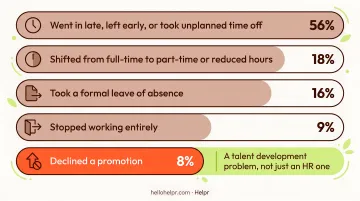
That last figure deserves attention. Employees are turning down advancement opportunities — not because they lack ambition, but because caregiving makes an already-demanding role feel impossible. That's a talent development problem, not just an HR one.
Stress, Burnout Risk, and Retention
64% of working caregivers report moderate-to-high emotional stress, and 45% report significant physical strain. Sustained stress at that level doesn't stay contained — it bleeds into work performance, team dynamics, and eventually exit decisions.
That disengagement carries a direct financial cost. SHRM puts employee replacement at 50% to 200% of annual salary depending on the role. When caregivers leave, that expense lands squarely on the organization — making caregiver support one of the more cost-effective retention investments available.
The Gender Equity Dimension
Women represent 61% of family caregivers in AARP/NAC's 2025 data. The career impact follows directly: more interruptions, more reduced-hours arrangements, more promotions declined. Elder care benefits are a gender equity issue. Organizations that ignore the caregiving gap are, in effect, making it harder for women to advance.
Types of Elder Care Benefits Employers Can Offer
Backup Care
Backup care is employer-sponsored access to vetted, short-term care providers that activate when an employee's usual arrangement breaks down — a home health aide cancels, a facility closes unexpectedly, a family member can't cover a shift.
The business case is direct: backup care converts a potential absence into a productive workday. Platforms like Helpr enable employers to offer backup care covering both elder care and childcare through a single platform, so employees can access vetted providers on demand without the employer managing logistics.
For employees in the "sandwich generation" juggling both an aging parent and young children, a unified platform removes the need to navigate separate systems during an already stressful moment.
Helpr also offers a bring-your-own-caregiver option, so employees can bring an existing trusted home aide or family member into the platform — important for elder care situations where a familiar face reduces confusion and anxiety.
Flexible Work Arrangements
Flexibility is often the highest-impact, lowest-direct-cost benefit for caregivers. Options include:
- Remote or hybrid work
- Adjustable start and end times
- Compressed workweeks
- Temporary part-time arrangements
Elder care doesn't run on a 9-to-5 schedule. Medical appointments happen mid-morning. Home health aide shifts change. Facilities call at inconvenient times. Scheduling flexibility lets employees handle these realities without choosing between their job and their family.
Financial tools can extend that flexibility further — helping employees offset the real cost of care when flexibility alone isn't enough.
Pre-Tax Dependent Care Accounts
Pre-tax dependent care accounts allow employees to set aside pre-tax dollars for qualifying elder care expenses. For 2026, the IRS annual household limit is $7,500 (or $3,750 for married filing separately) — a shared cap that covers both childcare and elder care costs under a single plan.
Employers can choose to match contributions, increasing the benefit's value. For employees paying for in-home care or adult day services, pre-tax savings on that scale are meaningful.
Caregiver Leave Policies
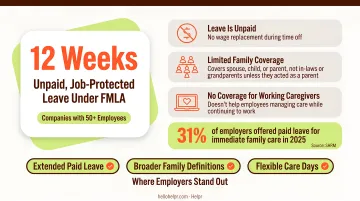
FMLA provides up to 12 weeks of unpaid, job-protected leave for employees at companies with 50 or more workers. But it has notable limitations:
- Leave is unpaid
- Coverage applies to a spouse, child, or parent — not in-laws or grandparents (unless they stood in loco parentis (acted as a parent))
- It doesn't cover employees who manage care while continuing to work
Only 31% of employers offered paid leave to care for immediate family in 2025, per SHRM. Employers who extend paid leave, broaden family definitions, or create flexible "care days" for ongoing coordination stand out significantly.
Mental Health and Emotional Well-being Support
Caregiving is emotionally exhausting in a way that's hard to see from the outside. 64% of working caregivers report significant emotional stress — and that stress doesn't switch off at the start of a workday.
Practical benefits help employees find care. Emotional support helps them sustain it. Essential complements include:
- Employee Assistance Programs with caregiver-specific counseling
- Peer support groups for working caregivers
- Access to mental health professionals familiar with caregiver burnout
The Business Case for Offering Elder Care Benefits
Retention and Competitive Position
SHRM data shows that replacing an employee costs 50% to 200% of their annual salary. Working caregivers are predominantly mid-career employees — often the most experienced and hardest to replace. AARP/S&P Global found 67% of working caregivers struggle to balance work and care, and 27% have already shifted to reduced hours.
With only 7% of employers offering elder care services and 13% offering referrals, organizations that build real programs differentiate meaningfully. The talent they're most at risk of losing — experienced, mid-career employees — is exactly the segment competitors want.
Productivity and Absenteeism
Unplanned absences from caregiving disruptions are, by nature, hard to predict and expensive to absorb. Backup care solves this directly: when an employee's care arrangement fails, a platform like Helpr gives them a path to resolution without missing work. The disruption becomes a 15-minute booking instead of a full day out.
Flexible scheduling works the same way. Employees who can adjust their hours around a care appointment don't need to burn PTO or call out — they just shift their schedule.
Equity and Inclusion Signals
Organizations that support caregivers of all types send a clear signal: we value employees at every life stage. That matters for culture, for engagement, and for candidates evaluating a job offer from the outside.
Elder care benefits also carry specific weight for gender equity. Women carry the majority of caregiving responsibilities, which means these programs have a direct impact on:
- Retaining women in mid-career and senior roles
- Reducing the hidden attrition that doesn't show up until an exit interview
- Signaling genuine investment in advancement, not just policy language
How to Build an Elder Care Benefits Program
Step 1 — Assess Your Workforce's Actual Needs
Don't design benefits based on assumptions. Start with an anonymous employee survey. BLS data shows adults 55–64 are most likely to be caregivers (24%), followed by ages 45–54 (19%) — so workforce age demographics are a useful starting point.
Survey questions worth asking:
- How many hours per week do you currently spend on caregiving?
- Do you also care for children under 18?
- Has caregiving affected your work schedule or attendance in the past year?
- What type of elder care support would be most useful to you?
Most caregivers won't self-identify without direct encouragement, so frame the survey as part of a genuine effort to improve benefits — not an HR audit.
Step 2 — Choose a Benefit Structure That Fits
Two main approaches:
| Structure | Best For | Trade-offs |
|---|---|---|
| Standalone elder care benefits | Workforce with high caregiver concentration | Requires separate administration |
| Bundled family care / LSA | Mixed workforce with varied care needs | Higher utilization; funds go to most pressing need |
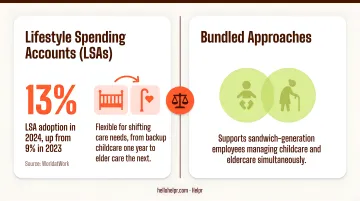
Lifestyle Spending Accounts (LSAs) are gaining traction — WorldatWork reports LSA adoption rose from 9% in 2023 to 13% in 2024. Their flexibility makes them well-suited for employees whose care needs shift — this year it's backup childcare, next year it's elder care. Bundled approaches also work naturally for sandwich-generation employees managing both simultaneously.
Step 3 — Launch, Communicate, and Iterate
Once the structure is set, rollout determines whether employees actually use it. Benefits buried in a portal don't get used. Communicate proactively:
- Include elder care options in onboarding and open enrollment materials
- Train managers to recognize and refer caregiving employees
- Send targeted communications to employees in the 45–64 age range
- Make it easy to access — one app, not three different vendor portals
Platforms like Helpr handle both elder care and childcare backup care through a single use-based model, so employers pay only for what's actually used rather than funding a benefit that sits idle.
After launch, revisit utilization data and survey employees annually. The mix of who needs what — and when — shifts over time, so build in a formal review each year to adjust coverage levels, vendors, or structure before gaps quietly erode the program's value.
Frequently Asked Questions
What are US government benefits for seniors over 65?
Seniors 65 and older may qualify for Medicare, Medicaid, Social Security retirement income, and VA benefits for eligible veterans. These programs cover significant ground but leave gaps — particularly in non-medical caregiving and daily coordination support, which employer benefits are well-positioned to fill.
How much do elder care benefits typically cost employers?
Costs vary by benefit type. Flexible work arrangements carry minimal direct cost. Backup care platforms and pre-tax dependent care account employer contributions represent a more tangible investment, though use-based models like Helpr's mean employers pay for care actually utilized. For context, SHRM puts turnover costs at 50%–200% of salary — structured elder care benefits are typically far less expensive than losing a mid-career employee.
Are elder care employee benefits tax-advantaged?
Pre-tax dependent care accounts let employees use pre-tax dollars for qualifying elder care expenses up to the IRS limit ($7,500 for 2026). Employer contributions may be tax-deductible, while broader stipends and LSAs are generally taxable income to employees. Consult a benefits advisor for organization-specific treatment.
What is backup care for elder care, and how does it work?
Elder care backup care is employer-sponsored access to vetted, short-term care providers that employees can call on when their regular care arrangement falls through. Through a platform like Helpr, employees request care through a single app — covering both elder care and childcare — without the employer managing provider logistics directly.
How do I know if my employees need elder care support?
Start with an anonymous benefits survey and review your workforce age data — employees between 45 and 64 are statistically most likely to have elder care responsibilities. Many caregivers won't disclose their situation without direct employer encouragement, so make the survey a visible part of a genuine listening effort.
Do elder care benefits cover sandwich generation employees?
Yes — and they should. AARP/NAC found 29% of family caregivers simultaneously care for an adult and a child under 18. Bundled family care platforms that cover both elder care and childcare — like Helpr's all-in-one solution — are the most practical fit for this segment, covering both needs through a single program.