
Introduction
Most HR leaders already know they should offer childcare benefits. The harder question is which ones will actually matter to their workforce — and why.
Childcare challenges aren't uniform. One employee can't find a spot at a licensed facility. Another can't afford the one they found. A third has care lined up until their provider calls out sick at 7 a.m. on a Tuesday. Each problem requires a different solution.
The stakes are real: the infant-toddler childcare crisis costs U.S. employers an estimated $23 billion annually in lost productivity. Yet only 13% of private-industry workers currently have access to employer-sponsored childcare benefits — a number that drops to 8% at smaller employers.
That gap matters strategically. Employers who close it gain a meaningful edge in recruiting and retention — and give employees a reason to stay.
This guide breaks down the most common childcare benefit types, what each one solves, and a practical framework for comparing options based on your workforce's actual needs.
Key Takeaways
- Childcare benefits span multiple distinct types — pre-tax dependent care accounts, subsidies, backup care, and flexible scheduling — each designed to solve a different problem
- The right benefit depends on whether employees struggle to find care, afford care, or manage disruptions when existing care falls through
- Backup care is among the highest-ROI options because it directly prevents lost workdays on specific, measurable days
- Evaluation should weigh workforce demographics, tax implications, administrative burden, and remote or global accessibility
- Benefits that are hard to access or poorly communicated will see low utilization — and deliver no ROI no matter how well-designed
What Are Childcare Benefits for Employees?
Childcare benefits are employer-provided programs, financial tools, and structural policies that help working parents find, afford, and manage care during working hours. The category spans pre-tax savings accounts, cash subsidies, emergency caregiver networks, on-site facilities, and schedule flexibility.
Despite that range of options, access remains low. Just 13% of private-industry workers can access employer-sponsored childcare — and the supply side isn't helping. An estimated 46% of U.S. children under age 6 live in a licensed childcare desert, defined as an area with more than three children per licensed slot.
Start by diagnosing which problem is most acute in your workforce. Most childcare challenges fall into three categories:
- Access barriers — employees can't find available, licensed care near home or work
- Affordability gaps — care exists but exceeds what the household budget can absorb
- Disruption failures — employees have care arranged, but last-minute breakdowns pull them off the job
The right benefit targets the specific failure mode costing your organization the most — whether that's absenteeism, turnover, or lost productivity.
Types of Childcare Benefits Employers Can Offer
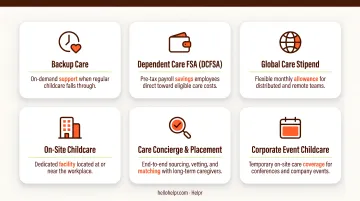
Choosing the right benefit starts with understanding what each type is built to solve. Here's a comparison of the main options:
| Benefit Type | Primary Problem Solved | Employer Cost | Tax Treatment |
|---|---|---|---|
| Pre-tax dependent care account | Affordability | Low/none | Pre-tax for employees |
| Childcare Subsidy/Stipend | Affordability | Variable | Taxable to employees |
| Backup Care | Disruptions | Use-based | Varies by structure |
| On-Site/Near-Site Daycare | Access + Affordability | High | 45F credit available |
| Paid Family Leave | Transition to parenthood | High | Varies |
| Flexible Scheduling | Logistics friction | Zero | N/A |
Pre-Tax Dependent Care Accounts
A pre-tax dependent care account lets employees set aside pre-tax dollars for eligible childcare expenses. For 2025, the household contribution limit is $5,000 ($2,500 if married filing separately). Starting in 2026, that limit rises to $7,500 under the One Big Beautiful Bill Act.
The use-it-or-lose-it rule applies — unused balances are forfeited at plan year end, though employers can add a grace period of up to 2 months and 15 days. Participation rates tell the real story here: only 5% of eligible employees actively participate, contributing an average of $3,220.
These accounts work well for employees with predictable, recurring care expenses. They're less effective for lower-income or hourly workers who can't absorb upfront costs before reimbursement, or for employees whose care situations are irregular.
Childcare Subsidies and Stipends
Where FSAs help employees manage known costs, subsidies address a different gap: access. Employer-funded subsidies provide direct financial support — structured as reimbursements, direct payments, or negotiated provider discounts — and don't require employees to front costs, making them more accessible for hourly and frontline workers.
Employers who fund on-site childcare or resource and referral services may also qualify for the Section 45F Employer-Provided Childcare Tax Credit. For 2025 and earlier, the credit covers 25% of qualified childcare expenditures, up to $150,000 annually. Starting in 2026, that cap increases to $500,000 (or $600,000 for eligible small businesses), and the credit rate rises to 40%, which meaningfully changes the ROI calculation for employers evaluating whether to build or expand childcare programs.
One important note: childcare stipends are generally taxable income to employees, which reduces their net value compared to pre-tax account contributions.
Backup Care
Backup care gives employees on-demand access to vetted caregivers when their regular arrangements fall through — school closures, sick children, provider cancellations. It's the only benefit specifically designed to prevent absenteeism on discrete, identifiable workdays.
This makes it particularly high-value for shift-based, customer-facing, or on-site roles where an absent employee creates immediate operational problems. BCG's analysis across five companies found that one employer avoided 16 lost workdays per participating employee annually through backup care — and that retaining just 1% of eligible employees could cover the cost of the benefit for the entire eligible workforce.
Platforms like Helpr operationalize this through on-demand booking — employees can secure a vetted caregiver in as little as three hours, across childcare, eldercare, and special needs care in 150+ countries. Caregivers pass a seven-point screening process covering criminal background checks, CPR certification, virtual interviews, and reference verification. Helpr's use-based pricing means employers pay only for care actually used, so spend tracks directly to utilization.
On-Site or Near-Site Daycare
On-site daycare addresses both access and affordability simultaneously — full-day care within or near the workplace. The attendance impact is measurable: BCG's case study of a near-site program found participants averaged 13 avoided absence days per year.
The tradeoff is cost and complexity. On-site facilities require capital investment, ongoing management, and enough employee density to justify the overhead. This benefit works best for large employers with concentrated, on-site workforces — and it's inaccessible for remote or distributed teams.
Flexible Work Arrangements
Schedule flexibility — remote work, hybrid schedules, staggered hours — costs nothing to implement and meaningfully reduces the logistics pressure of drop-offs, pickups, and unexpected care gaps. For many working parents, that logistical relief matters as much as any financial benefit.
The catch: flexibility only works as a childcare benefit when it's supported by explicit policy, not just informal tolerance. Without clear guidelines, flexible arrangements tend to be unevenly applied — accessible to salaried professionals but unavailable to hourly or customer-facing roles, which is where the need is often greatest.
How to Compare Childcare Benefit Options
The most useful comparison framework starts with your workforce, not the benefits catalog. Don't benchmark against competitors and copy their offerings — diagnose which childcare challenge is generating the most friction for your employees, then select the benefit that addresses that specific root cause.
Start With the Employee Challenge
Map your benefit choice to one of the three core problems:
- Can't find care → On-site daycare, near-site partnerships, or backup care with broad network coverage
- Can't afford care → pre-tax dependent care accounts, subsidies, stipends, or enhanced paid family leave
- Can't manage disruptions → Backup care (this is the primary use case, and it's the only benefit purpose-built for it)
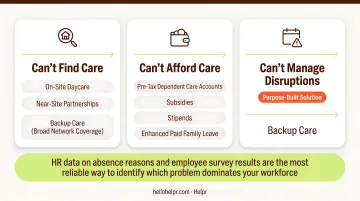
HR data on absence reasons and employee survey results are the most reliable way to identify which problem dominates your workforce.
Evaluate Workforce Demographics and Role Types
Benefit fit depends heavily on who your employees are and how they work.
- On-site daycare serves concentrated, facility-based workforces well — but it's invisible to remote employees
- Pre-tax dependent care accounts require active enrollment and front-loaded financial planning, which makes them less practical for hourly workers or lower-income earners
- Subsidies with upfront payment remove the reimbursement burden that makes FSAs inaccessible to frontline workers
- Backup care platforms reach every employee type regardless of role, location, or schedule
Benefit equity matters here. Childcare challenges disproportionately affect lower-income workers, women, and employees in rural or underserved areas — and a benefit that only practically helps salaried professionals isn't a workforce benefit, it's a perk.
That equity lens applies directly to cost decisions, too — which is where tax treatment becomes a meaningful differentiator.
Understand Tax Treatment and Cost Structure
Key variables to evaluate:
- Pre-tax account contributions reduce employer FICA obligations — a real cost saving with no direct spend
- The Section 45F credit offsets costs for employers who fund facilities or resource/referral services (40% starting in 2026)
- Stipend reimbursements are typically taxable income to employees, which reduces their net value
- Use-based backup care models generate no employer cost unless the benefit is actually used — predictable spend that CFOs appreciate
Factor in Utilization and Measurable Impact
High availability doesn't equal high impact. A benefit that's hard to book, poorly communicated, or misaligned to actual needs delivers no return — and at just 5% participation among eligible employees, the pre-tax dependent care account is a standing reminder of how even decades-old tax advantages fail to drive utilization without the right design.
Track proxies for effectiveness:
- Absenteeism rates among parents before and after benefit launch
- Return-from-leave rates for new parents
- Retention rates for employees with dependents
- Employee survey data on benefit awareness and satisfaction
These metrics tie the benefit directly to business outcomes — which matters when justifying program costs to finance leadership.
Consider Administrative Complexity
Implementation burden is a real factor, especially for lean HR teams.
| Benefit | Admin Complexity |
|---|---|
| On-site daycare | High — facility management, licensing, staffing |
| Pre-tax dependent care account | Medium — requires benefits administrator and open enrollment |
| Backup care (app-based) | Low — self-service booking, no HR involvement per use |
| Flexible scheduling | Low — policy creation, manager training |
App-based backup care platforms minimize HR overhead per transaction because employees book care directly. Helpr's mobile-first design lets employees place a care request, review caregiver profiles, and confirm a booking without HR involvement — and employees can even upload their own trusted providers into the platform if they prefer to use someone they already know.
The Business Case for Childcare Benefits
BCG's 2024 analysis across five companies found modeled returns ranging from 90% to 425%, driven primarily by avoided turnover costs and reduced absenteeism. Replacement costs run from 0.2 to 2 times salary — meaning retaining even a few working parents can offset the cost of a childcare benefit for the entire eligible population.
That ROI picture extends into recruiting and retention. A 2024 industry survey found that 20% of workers have already left a job because of inadequate care benefits — and another 20% say they'd switch employers for better care support. In a market where most employers still offer nothing, a meaningful benefit creates real competitive distance.
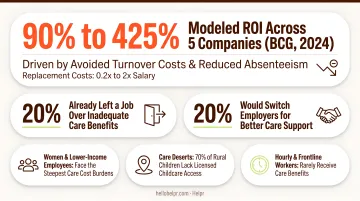
There's also an equity case worth making explicitly. Childcare challenges fall hardest on the workforce segments most vulnerable to attrition:
- Women and lower-income employees, who face the steepest care cost burdens
- Workers in care deserts — 70% of children in remote rural areas have no access to licensed childcare
- Hourly and frontline workers, who rarely receive care benefits at all
Employers who design accessible, inclusive benefits aren't just checking a DEI box. They're directly addressing the groups most likely to leave when care breaks down.
How Helpr Supports Employers with Childcare Benefits
Helpr is a global backup care platform built to solve the most acute and measurable childcare problem employers face: the last-minute care failure that pulls an employee off the job with no warning.
Through its patented My Choice technology, Helpr connects employees with vetted caregivers on demand — via a mobile app, in as little as three hours' notice, across 150+ countries. Caregivers pass a seven-point screening process before joining the network, and employees can upload their own trusted providers if they prefer.
The platform covers all dependent care needs under a single employer benefit program:
- Childcare (on-demand and recurring)
- Eldercare
- Care for dependents with special needs
For HR and finance teams evaluating the business case, Helpr's use-based pricing model means organizations only pay for care that's actually used — no wasted spend on benefits sitting idle. Unlike flat per-employee fees or facility investments that generate cost regardless of utilization, employers are only billed when the benefit is actually activated.
That cost structure has appealed to a wide range of employers. Helpr is trusted by organizations including Snap, DraftKings, Lionsgate, Total Wine, Crocs, Skanska, and Ibotta — spanning retail, entertainment, technology, healthcare, and financial services. Helpr is also WBENC-certified as a women-owned business, which matters for employers with supplier diversity programs.
Helpr isn't a replacement for pre-tax accounts or subsidies — it's the layer that activates when every other care plan fails. When a parent's daycare provider cancels at 6 a.m., Helpr is what keeps that employee at work — the one benefit gap most care packages never address.
Frequently Asked Questions
Can an employer pay for daycare?
Yes. Employers can pay for daycare through direct subsidies, reimbursement stipends, or on-site/near-site facilities. The Section 45F Employer-Provided Childcare Tax Credit allows eligible employers to offset a portion of those costs — up to 40% of qualified expenditures starting in 2026, with an annual cap of $500,000.
What is the most cost-effective childcare benefit for small or mid-size employers?
Pre-tax dependent care accounts carry no direct employer cost and reduce FICA obligations, making them a practical starting point. Backup care through a use-based platform like Helpr delivers strong ROI relative to spend by preventing absenteeism without requiring upfront investment or ongoing facility management.
Are employer-provided childcare benefits taxable to employees?
Pre-tax account contributions are not taxable to employees; childcare stipends and reimbursements are generally treated as taxable income. Consult a tax advisor before structuring any reimbursement program.
Can childcare benefits be offered to remote or global employees?
Yes. Pre-tax dependent care accounts, stipends, and backup care platforms with broad networks can all reach remote or distributed employees. Employers should verify that their chosen vendor supports the employee's location — particularly for international teams where coverage varies by region.
What is backup care, and how is it different from a childcare subsidy?
Backup care provides on-demand emergency care when regular arrangements fail — it's designed to prevent specific lost workdays. Subsidies provide ongoing financial support to offset recurring care costs. They address different challenges and work best in combination.
How do I know which childcare benefit my employees actually need?
Start with your data: analyze absence reasons, survey working parents, and review leave patterns to identify whether the primary challenge is finding care, affording care, or managing disruptions. The answer tells you which benefit to prioritize.