
Introduction
When a school closes unexpectedly or a nanny calls in sick, the fallout lands squarely on the employer. According to SHRM, after-school care lapses alone can cost working parents up to eight workdays per year — and that lost time transfers directly to missed deadlines, scrambled coverage, and strained teams.
For HR decision-makers, the stakes extend beyond individual absences. Offering no emergency childcare benefit drives absenteeism, accelerates attrition among working parents, and creates visible inequity between employees who can absorb care disruptions and those who can't. Choosing the wrong program produces the same outcomes, just more expensively.
This guide defines what emergency childcare benefits actually are, maps the main program types, and gives HR leaders six concrete criteria for comparing their options — so the decision is grounded in workforce outcomes, not vendor marketing.
Key Takeaways
- Emergency childcare (also called backup care) is an employer-funded benefit that helps employees find care when their regular arrangements fail unexpectedly.
- Program types vary widely — caregiver networks, on-site centers, EAP referrals, and stipends — each with different tradeoffs.
- Compare options across six dimensions: coverage scope, delivery model, cost structure, caregiver quality, equity, and reach.
- Only 13% of private-industry workers have any employer-provided childcare benefit — a significant gap and a real competitive advantage.
- Use-based pricing and mobile-first access consistently produce the highest utilization rates.
What Is Emergency Childcare as an Employee Benefit?
Emergency childcare — also called backup care — is employer-supported access to care when an employee's primary childcare arrangement fails without warning. That could mean a daycare closed due to illness, a nanny who can't make it, or a school shut down by weather. The benefit bridges that gap so employees can stay at work rather than scrambling to solve a personal crisis at 7 a.m.
This is distinct from everyday childcare subsidies or permanent on-site daycare, though there's some overlap. The defining feature is on-demand access in unexpected situations, not routine care planning.
Employers deliver this benefit in several ways:
- Funding care directly through a subsidized caregiver network
- Providing access to vetted provider networks through a technology platform
- Offering tax-advantaged accounts that employees use to pay for care themselves
- Some combination of all three
The Bureau of Labor Statistics reports that as of March 2025, only 13% of private-industry workers had access to any employer-provided childcare benefit. For employers willing to offer it, that gap is also an opportunity — particularly in competitive hiring markets where working parents are evaluating total rewards packages.
Types of Emergency Childcare Benefit Programs
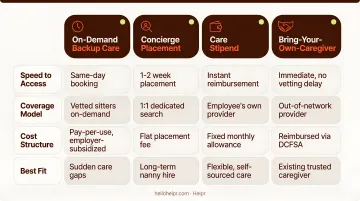
Emergency childcare isn't a single benefit — it's a category. The delivery model an employer chooses shapes everything: who gets served, how quickly, and at what cost. Here's how the main models compare.
On-Site or Near-Site Childcare Centers
The employer reserves emergency spots at a physical childcare facility at or near the workplace. Employees drop children off on-site when their usual care falls through.
Advantages: High perceived value, visible culture signal, potential tax efficiency under IRS Section 129 (up to $7,500 in 2026 may be excluded from an employee's taxable income for qualifying dependent care assistance).
Limitations: This model has real constraints:
- Requires physical proximity — remote and shift workers are excluded by default
- Age restrictions often limit coverage to specific child age bands
- Fixed infrastructure costs apply whether or not employees use the benefit
- GAO data found only 169–278 corporate returns per year claimed the employer childcare facility credit during 2016–2018, suggesting low adoption in part due to cost and complexity
Backup Care Networks and Platforms
Employers partner with a technology platform that connects employees with vetted caregivers on demand — either in-home or center-based. Employees book through an app, often on the same day care is needed.
This model works for remote, distributed, and multinational teams in a way that on-site programs simply can't. Platforms like Helpr operate across 150+ countries, making this practical for organizations with employees in multiple locations.
The "My Choice" feature takes flexibility further — employees can upload their own trusted caregiver (a neighbor, family friend, or existing nanny) and process payment through the platform, which expands access in areas where in-network providers may be sparse.
EAP-Linked Referral Services
Some Employee Assistance Programs include a childcare referral component. A counselor helps the employee identify emergency care providers in their area — but the employee is responsible for vetting, booking, and paying for care independently.
This is the lowest-cost option for employers — and also the lowest-support. Without financial subsidy or frictionless access, utilization tends to be low. Employees facing a care emergency at 6 a.m. need a solution, not a referral list.
Pre-Tax Dependent Care Accounts and Financial Stipends
Financial-first models give employees spending flexibility through pre-tax accounts or direct stipends. The IRS Section 129 pre-tax dependent care account limit increased from $5,000 in 2025 to $7,500 in 2026 — a meaningful jump that makes this tool more valuable.
The limitation: FSAs and stipends solve the cost problem but not the access problem. An employee who can't find a caregiver at short notice doesn't benefit from having funds available. These tools work best when paired with a care network.
Hybrid and Combined Approaches
Because no single model solves every problem, leading employers combine them. Pairing a backup care network with a pre-tax dependent care account addresses both access and affordability — and serves employees at different income levels and work settings more equitably than either tool alone.
Key Factors to Compare Emergency Childcare Benefits
Once you understand the program types, the next step is evaluating them against consistent criteria. These factors connect benefit design decisions to measurable workforce outcomes.
Coverage Scope: Who Is Actually Served?
A benefit that only works for full-time office workers in a single city may leave your largest employee populations behind. Before selecting a program, ask vendors:
- What ages of children are covered?
- What hours is care available — including nights and weekends for shift workers?
- Does coverage extend to part-time, hourly, and remote employees?
- Does the benefit include elder care and other dependent care needs?
Helpr, for instance, covers both childcare and elder care under its platform — relevant for organizations where a meaningful share of employees are also caring for aging parents.
Delivery Model: On-Demand vs. Pre-Scheduled Access
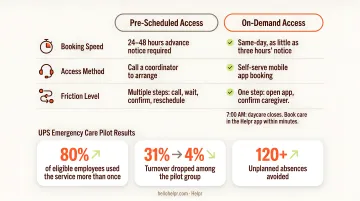
A benefit requiring 24–48 hours' advance notice is not, functionally, an emergency benefit. Compare programs by:
- Booking speed: Same-day vs. advance notice required
- Access method: Self-serve mobile app vs. calling a coordinator
- Friction level: How many steps does it take from need to confirmed caregiver?
Helpr's platform allows employees to book care with as little as three hours' notice through a mobile app. That matters when a parent finds out at 7 a.m. that daycare is closed. UPS's emergency care pilot illustrates what low-friction access can produce: 80% of eligible employees used the service more than once, turnover among the pilot group dropped from 31% to 4%, and more than 120 unplanned absences were avoided.
Cost Structure: Fixed vs. Use-Based Pricing
Two pricing models dominate the market:
| Model | How It Works | Best For |
|---|---|---|
| Fixed/per-seat fee | Employer pays flat annual cost regardless of usage | Predictable budgets, high-utilization programs |
| Use-based pricing | Employer pays only for care actually utilized | Variable workforces, seasonal patterns, budget-conscious HR teams |
Use-based pricing tends to favor employers with distributed or shift-based workforces where care needs are unpredictable. It also reduces the risk of paying for a benefit that employees aren't using.
Caregiver Quality and Vetting Standards
Employees won't use a benefit they don't trust. Caregiver quality is the single biggest driver of adoption, and it's the hardest thing to evaluate from a vendor brochure.
Ask vendors specifically:
- What background checks are conducted, and how recently?
- Are caregivers verified in person or only digitally?
- What happens if a caregiver underperforms after placement?
- Are CPR certification and reference checks required?
Helpr's vetting process applies consistent standards across its global network, including:
- Virtual interviews and identity verification
- Real-time criminal background checks and fraud screening
- CPR certification requirements and reference checks
- Social media review
Equity and Accessibility Across the Workforce
A benefit concentrated among corporate or high-earning employees creates visible inequity and limits organizational ROI. The most effective programs are accessible regardless of role, income level, tenure, or work location.
Ask vendors whether their benefit is designed for, and actually used by, frontline, hourly, and remote workers. Helpr's platform includes subsidized care options that reduce out-of-pocket costs across income levels. Its use-based pricing model also accommodates shift-based schedules without penalizing irregular usage.
Geographic and Global Reach
For multi-site or multinational organizations, geographic coverage determines whether all employees receive equal support. A program limited to one city or country creates a tiered experience: some employees get real backup care, others get nothing.
When evaluating vendors, ask:
- Does your caregiver network cover every country or region where our employees are based?
- Is the platform and booking experience the same for employees in every location?
For globally distributed teams, this typically narrows the field to a handful of vendors.
The Business Case for Emergency Childcare Benefits
The cost of inaction is quantifiable. Research from the Center for American Progress found that more than 2 million parents of children age 5 or younger — roughly 9% — quit a job, declined a job offer, or made a substantial job change because of childcare problems in each year from 2016 through 2018. That's turnover driven by a solvable problem.
The UPS pilot program is the strongest available data point on what direct intervention can do:
- Turnover dropped from 31% to 4% among the pilot group
- More than 120 unplanned absences were avoided
- 80% of eligible employees used the benefit again
These results translate directly to avoided recruiting costs, retained institutional knowledge, and more reliable workforce coverage.
That calculus is only getting sharper. CAP's 2025 analysis found that 46% of U.S. children under age 6 live in a licensed childcare desert. As available care slots shrink, employees grow more dependent on employer support to bridge gaps. Organizations that offer backup care gain a concrete recruiting edge over those that don't.
Tax Efficiency for Employers
The employer-provided childcare tax credit (IRS Form 8882, Section 45F) underwent significant expansion for 2026:
| 2025 and Earlier | 2026 and Later | |
|---|---|---|
| Qualified childcare expenditure credit | 25% | 40% (50% for eligible small businesses) |
| Annual credit cap | $150,000 | $500,000 ($600,000 for eligible small businesses) |
| Resource-and-referral credit | 10% | 10% |
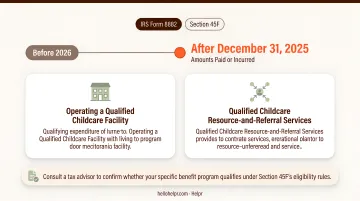
These changes apply to amounts paid or incurred after December 31, 2025. Qualifying expenditures include costs related to operating a qualified childcare facility and qualified childcare resource-and-referral services. Consult a tax advisor to confirm whether your specific benefit program qualifies under Section 45F's eligibility rules.
How Helpr Can Help
Helpr is a global backup care platform built for enterprises that need emergency childcare benefits that actually work for every employee — not just those based at headquarters. The platform is WBENC-certified and serves organizations across retail, healthcare, finance, entertainment, technology, and nonprofit sectors, including companies like Lionsgate, Snap, Crocs, DraftKings, and the Jeremiah Program.
What makes Helpr's model practical for HR teams comparing options:
- Use-based pricing — organizations pay only for care that is actually used, keeping costs tied directly to utilization
- Patented "My Choice" technology — employees can access care through the vetted Helpr network or upload their own trusted caregiver and process payment through the platform
- 150+ country coverage — the same benefit experience for employees in New York, London, or a smaller regional office, with local currency payment processing included
- Mobile-first booking — employees can confirm a caregiver with as little as three hours' notice through the app
- Advanced analytics — HR teams get utilization dashboards showing which employee segments use care most, making it easier to quantify ROI for leadership
Beyond the feature set, a few structural choices set Helpr apart from standard backup care vendors:
- Covers both childcare and elder/adult care needs under one platform
- Subsidized care options reduce out-of-pocket costs across income levels
- Designed for equitable access — hourly, frontline, and remote workers get the same experience as corporate staff
- Bring-your-own-caregiver option through the "My Choice" feature keeps trusted relationships intact
Frequently Asked Questions
What is emergency childcare (emergency daycare)?
Emergency childcare — also called backup care — is care arranged on short notice when a parent's regular arrangement unexpectedly fails due to illness, school closure, or caregiver unavailability. Employer benefit programs can cover some or all of the cost, making care accessible without out-of-pocket burden on the employee.
Is childcare an employee benefit?
Yes. Employers can offer childcare in several forms — backup care networks, pre-tax dependent care accounts, on-site centers, and financial stipends. It remains a minority benefit, but adoption is growing as organizations compete to retain working parents.
What is the employer-provided childcare tax credit for 2026?
For 2026, the Section 45F credit covers 40% of qualified childcare facility expenditures (up from 25%), with an annual cap of $500,000 (up from $150,000). Eligible small businesses may receive a 50% credit capped at $600,000. Employers claim this credit using IRS Form 8882. Consult a tax advisor to confirm your program qualifies.
Can a family member (like my mom) be paid to provide childcare through an employer benefit?
Under IRS Publication 503, payments to a parent can qualify for pre-tax dependent care account purposes if that parent isn't your dependent and the care enables you to work. Payments to a spouse or your own child under 19 do not qualify. Consult a tax advisor for your specific situation.
What's the difference between backup care and emergency childcare?
The terms are used interchangeably in the benefits industry. Both refer to short-notice care that fills gaps when primary arrangements fail. "Backup care" often signals an ongoing, structured benefit program, while "emergency childcare" tends to emphasize the reactive, last-minute nature of the need.
How do employers measure the ROI of an emergency childcare benefit?
Key metrics include reduction in unplanned absences, improvement in retention rates among working parents, benefit utilization rates, and employee satisfaction scores. Platforms like Helpr provide utilization reporting and ROI tracking through their advanced analytics feature, so HR teams can quantify impact and present concrete numbers to leadership.