
Introduction
Childcare costs are squeezing working parents harder than ever. According to Child Care Aware of America's 2025 report, the national average annual childcare price hit $13,184 — a figure that rivals rent in many markets. For employees, that pressure translates directly into workforce decisions: a 2024 benefits survey found that 29% of employees who switched jobs cited missing childcare benefits as the primary reason.
Small business owners feel this differently. It shows up as the employee who calls out Monday morning because their sitter canceled, the star performer who quietly starts job hunting, or the candidate who accepts a competitor's offer because they offer "something for families."
That competitive pressure is exactly why the assumption that childcare benefits belong only to large corporations is worth dropping. Scalable, affordable options exist — and federal tax credits can offset up to 25% of the cost for qualifying small businesses.
Here's how to make it work for a small business budget.
Key Takeaways
- Childcare gaps cost U.S. employers an estimated $23 billion annually in lost productivity and turnover
- Small businesses have options beyond on-site daycare: subsidies, backup care, pre-tax dependent care accounts, flexible scheduling, and referral services
- Claim up to $150,000/year via the IRS Employer-Provided Childcare Credit (Form 8882); limits increase significantly starting in 2026
- A use-based backup care model is often the most budget-friendly starting point for leaner organizations
- Offering childcare benefits reduces absenteeism and strengthens retention — without requiring a large benefits budget
The Business Case: Why Small Businesses Should Care
The numbers are harder to ignore than many owners expect.
ReadyNation's 2023 analysis estimated that infant-toddler childcare gaps cost employers $23 billion annually in lost productivity and revenue. That's the business-only slice — the figure often cited at $122 billion includes family earnings losses and lost tax revenue as well.
The Talent Angle
Childcare benefits have moved from "nice to have" to an active factor in job selection — especially for younger workers. The 2024 benefits survey found:
- 27% of Gen Z and 25% of Millennials would switch jobs for childcare benefits
- 82% of employers offering childcare benefits reported a positive impact on productivity
- 81% reported improved recruitment outcomes
- 80% saw better retention
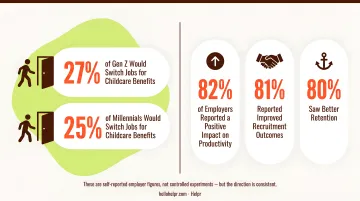
These are self-reported employer figures, not controlled experiments — but the direction is consistent. Working parents are making employment decisions with childcare access as a real variable.
The Gender Equity Dimension
The same survey also found:
- 44% of women anticipated needing a job change to balance work and childcare
- 35% of mothers said they might stop working altogether without financial help
Employers who offer childcare benefits reduce exit risk for a significant share of their workforce — and send a clear signal to candidates that support for working parents goes beyond policy language.
What Reliable Care Does for Productivity
Employees dealing with unstable care arrangements aren't fully present at work. A BCG and Moms First analysis of five employers — including Etsy, UPS, and Synchrony — estimated ROI ranging from 90% to 425% across different benefit designs. UPS alone reported avoiding an average of three employee absences per day through an on-site emergency care pilot.
For a small business with a 10-person team, one unplanned absence represents 10% of daily capacity. The math on reliable care hits harder at smaller scale, not less.
Types of Childcare Benefits Small Businesses Can Offer
There's no single model. The right approach depends on your budget, workforce size, and how much administrative lift you can manage.
Childcare Subsidies and Stipends
The simplest form: a fixed monthly stipend that employees apply toward their existing childcare bills. No facility required, no enrollment complexity. Employers can also negotiate group discounts with local providers, which delivers value without requiring a direct cash outlay.
Stipends are taxable income unless structured through a qualifying plan, so it's worth consulting a benefits advisor on the most tax-efficient design.
Pre-Tax Dependent Care Accounts
A pre-tax dependent care account lets employees set aside pretax dollars to pay for qualifying dependent care expenses — including children under age 13.
The IRS contribution limits are:
- 2025: $5,000 per household ($2,500 if married filing separately)
- 2026: $7,500 per household ($3,750 if married filing separately)
The employer benefit here is payroll tax savings. When employees contribute pretax dollars through the account, employers don't pay FICA taxes on those amounts. At the combined 7.65% employer FICA rate, that works out to:
- $382.50 saved per employee at the 2025 maximum contribution
- $573.75 saved per employee at the 2026 maximum contribution
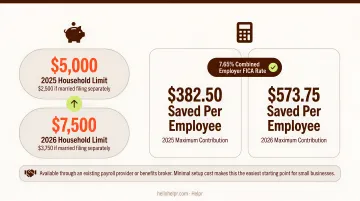
These accounts are often available through an existing payroll provider or benefits broker with minimal setup cost — making them the easiest starting point for most small businesses.
Backup Care Coverage
Backup care is employer-subsidized emergency childcare for when a regular arrangement falls through — sick child, school closure, nanny cancellation. These disruptions generate last-minute absences and are among the most disruptive care scenarios for both employees and managers.
Platforms like Helpr connect employees with vetted backup caregivers on demand through a mobile app. Depending on what a family needs, employees can:
- Book in-home care through the app
- Access local center-based options
- Upload their own trusted caregivers via Helpr's patented My Choice feature
Helpr's use-based pricing means employers pay only for care that's actually utilized — a structure well-suited to smaller organizations that can't commit to flat-fee programs.
Childcare Resource and Referral Services
Lower-cost than a stipend program, resource and referral services connect employees with vetted local childcare options. The employer contracts with a service provider; employees get help finding, evaluating, and accessing care.
These expenditures qualify for the 10% tier of the IRS Employer-Provided Childcare Credit (Section 45F), so even this lighter-touch option comes with a federal tax benefit.
On-Site or Consortium Childcare
On-site care delivers the strongest retention ROI and qualifies for the largest Section 45F credits, but it requires state licensing, physical space, and sustained employee demand to be financially viable.
A more accessible version for small businesses: joining a consortium with neighboring employers to share costs and utilization. If your business is located in a commercial park or shared building, it's worth exploring whether other tenants would co-invest in a shared facility.
Tax Incentives and Financial Benefits for Employers
The Employer-Provided Childcare Credit (Section 45F)
This federal tax credit, claimed on Form 8882, is one of the most underused incentives available to employers of any size. The structure:
| Tax Period | Qualified Facility Rate | Resource/Referral Rate | Annual Cap |
|---|---|---|---|
| Through 2025 | 25% | 10% | $150,000 |
| 2026 and later (general) | 40% | 10% | $500,000 |
| 2026 and later (eligible small business) | 50% | 10% | $600,000 |
The 2026 expansion, enacted through the One Big Beautiful Bill Act, raises the small business credit rate to 50% and nearly quadruples the annual cap. Small businesses that previously couldn't justify a contracted or shared facility arrangement may now find the numbers work in their favor. Confirm your eligibility and current figures directly at IRS.gov's Section 45F page.
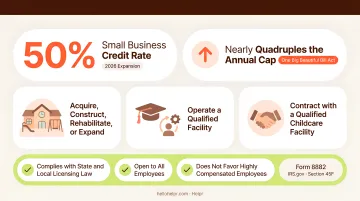
What qualifies as a "qualified childcare expenditure":
- Costs to acquire, construct, rehabilitate, or expand property used as a childcare facility
- Costs to operate a qualified facility (including employee training and scholarship programs)
- Amounts paid to contract with a qualified childcare facility to provide care to employees
The facility must comply with state and local licensing law, be open to the employer's employees, and not favor highly compensated employees.
The "No Double Benefit" Rule
These employer-side credits come with one important employee-facing caveat: employees cannot claim the same childcare expenses for both an employer-provided benefit and the personal Child and Dependent Care Credit. HR teams should communicate this clearly during open enrollment and direct employees to a personal tax advisor to sort out what applies to their situation.
State-Level Incentives
Several states offer employer-specific childcare tax credits that stack on top of federal benefits. Alabama, Georgia, Kansas, and Louisiana each have active programs with different eligibility criteria, credit rates, and caps. Consult a tax professional or your state's department of revenue for details specific to your location.
How to Get Started on a Small Business Budget
You don't need to launch everything at once. A staged approach is more manageable and more likely to stick.
Phase 1: Low Cost, Fast to Launch
- Set up a pre-tax dependent care account through your existing payroll provider (often at no additional cost)
- Add a backup care benefit through a use-based platform like Helpr — no facility investment required
Phase 2: Add Direct Financial Support
- Begin offering a modest monthly childcare stipend to employees with dependents
- Negotiate a discount arrangement with one or two local daycare providers
Once those basics are in place, you can evaluate whether to expand further based on actual employee demand.
Phase 3: Scale If Demand Warrants
- Explore consortium arrangements with neighboring businesses
- Evaluate contracted facility agreements that may qualify for the expanded Section 45F credit
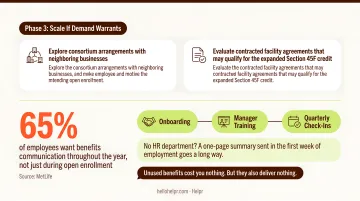
A final note on communication: unused benefits cost you nothing — but they also deliver nothing. MetLife's research found 65% of employees want benefits communication throughout the year, not just during open enrollment. Promote childcare benefits during onboarding and in manager training, and revisit them at least quarterly. No HR department? A one-page summary sent in the first week of employment goes a long way.
Building a Parent-Friendly Workplace Culture
Financial benefits matter, but culture either reinforces or undermines them. A few lower-cost moves that make a real difference:
Predictable Scheduling
A peer-reviewed study of 3,653 retail and food-service parents found that on-call work and last-minute schedule changes were directly associated with more childcare arrangements and greater reliance on informal care. Employers that destabilize parents' schedules with unpredictable shift changes — even while offering a backup care benefit — leave the core disruption unresolved.
Advance scheduling notice and minimizing last-minute changes costs nothing. For hourly workers especially, it may be the most meaningful thing an employer can do.
Working Parents' Support Groups
An employee resource group for parents can surface needs that are otherwise invisible to leadership. It requires minimal time to organize and creates internal advocates who can help shape future benefits decisions.
Manager Training
Cultural commitments only stick if managers model them. Equip managers to accommodate school pickups, sick-child days, and care-related schedule adjustments without treating them as performance red flags. Practical steps that help:
- Set clear guidance on flexible scheduling requests so managers respond consistently
- Include family-friendly accommodations in manager onboarding and annual training
- Recognize managers who model these behaviors — it signals what leadership actually values
Employees notice quickly whether stated values match how their manager actually behaves. That gap — or the absence of it — is often what determines whether a working parent stays or starts looking elsewhere.
Frequently Asked Questions
Can my business pay for childcare?
Yes. Employers can subsidize employee childcare through direct stipends, backup care programs, on-site facilities, or pre-tax account contributions. Doing so may qualify the business for federal tax credits under Section 45F of the Internal Revenue Code, claimed via Form 8882.
What is the maximum tax write-off for childcare?
The Employer-Provided Childcare Credit caps at $150,000 per tax year through 2025 (25% of qualified facility costs plus 10% of referral costs). Starting in 2026, eligible small businesses can claim up to $600,000. Confirm current figures at IRS.gov.
Is an employer required to offer childcare benefits?
No federal law requires employers to offer childcare benefits. Participation is voluntary. However, doing so may qualify the business for substantial tax credits and is a proven tool for attracting and retaining employees in competitive labor markets.
What is a pre-tax dependent care account and how does it work?
A pre-tax dependent care account lets employees set aside pretax dollars — up to $5,000 in 2025 and $7,500 in 2026 — to cover qualifying dependent care costs, including children under age 13. Contributions reduce employees' taxable income and also reduce the employer's FICA payroll tax obligation on those amounts.
Can childcare benefits be offered to remote or part-time employees?
Yes. Benefits like pre-tax dependent care accounts, backup care subsidies, and childcare stipends can be extended to remote and part-time workers. Doing so promotes equity across the workforce and helps retain employees who might otherwise be left out of benefits designed for full-time, on-site staff.