Against that backdrop, employer-sponsored childcare has moved from a nice-to-have to a genuine talent strategy. On-site daycare is the most visible option — but it's also the least common, and for good reason. Before committing significant capital, HR leaders need a clear-eyed look at the real tradeoffs.
This post walks through the actual pros, actual cons, and the specific organizational factors that determine whether an on-site center is worth pursuing — or whether a different approach better fits your workforce.
Key Takeaways
- On-site daycare has documented benefits for recruitment and retention, with 86% of childcare benefit users more likely to stay at their employer
- Startup costs typically run $3.5M–$5M for a 100-child center, with ongoing operational costs that rarely break even
- The benefit inherently excludes remote, hybrid, and satellite-office employees — creating a two-tier experience
- Alternatives like backup care and childcare subsidies can serve distributed workforces more equitably
- The right solution depends on workforce concentration, financial commitment capacity, and long-term operational stability
What Is On-Site Daycare for Employees?
On-site (or near-site) daycare is a licensed childcare center that an employer builds, leases, or contracts on or adjacent to its workplace. Some companies operate the center themselves; others bring in third-party childcare operators to manage day-to-day operations.
How Common Is It?
According to IFEBP's 2024 Employee Benefits Survey, just 6% of U.S. organizations offer on-site or near-site childcare — making it rare even among large employers. Prevalence increases with employer size — 9% of employers with 500+ workers offer it, rising to 13% among those with 5,000+ employees.
Who Typically Offers It?
On-site care clusters in specific settings:
- Healthcare systems — Community Hospital in Grand Junction built a 7,500-square-foot, 100-child center for its staff
- Higher education institutions like Cal State Long Beach operate dedicated centers serving both employees and students
- Manufacturing — Tyson Foods invested $3.5M in an on-site facility for its Humboldt, Tennessee workforce
- Public agencies, including GSA-managed federal centers that serve employees across major government facilities
The common thread: large, co-located workforces where employees have limited flexibility to leave during the day and where concentrated demand justifies a dedicated facility.
The Pros of On-Site Daycare
Advantages for Employers
BCG's 2024 analysis of roughly 1,000 childcare benefit users found that Recruitment and retention numbers are hard to ignore. BCG's 2024 analysis of roughly 1,000 childcare benefit users found that 82% said childcare benefits mattered when deciding to join an employer, and 86% said the benefit made them more likely to stay. Across five companies analyzed, modeled ROI ranged from 90% to 425%.
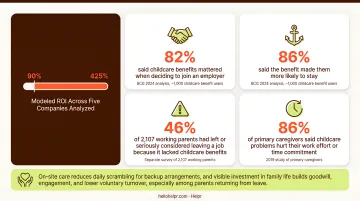
The attrition risk is equally clear. A separate survey of 2,107 working parents found that 46% had left or seriously considered leaving a job because it lacked childcare benefits.
Absenteeism drops when care logistics stop being a daily struggle. A 2019 study found that 86% of primary caregivers said childcare problems hurt their work effort or time commitment. On-site care directly reduces the friction of managing care logistics — employees aren't scrambling for backup arrangements when their regular provider calls out sick.
When an employer makes a visible, substantial investment in an employee's family life, it generates goodwill that cash alone can't match. Employees feel seen. That translates to stronger engagement and lower voluntary turnover — particularly among working parents returning from parental leave.
Advantages for Employees
Employees can commute with their child, check in during lunch, and respond quickly to minor emergencies without leaving the building. The separation anxiety many working parents feel drops meaningfully when the care site is steps away.
The cost relief can be substantial. Center-based infant care averaged more than $14,000 annually in 2023. Employer-subsidized on-site programs can cut that dramatically. A California brief documented that The Wonderful Company covered 90% of care costs at its employee preschools, and Santa Clara University set tuition at 80–90% of market rate. For employees in high-cost metro areas, that subsidy can represent tens of thousands of dollars per year.
The Cons of On-Site Daycare
Disadvantages for Employers
The capital commitment is substantial. Community Hospital in Grand Junction invested approximately $5M for a 7,500-square-foot, 100-child center. Tyson's Humboldt facility required a $3.5M investment. Development timelines are long — IFEBP cites a 15-month buildout for Steamboat Ski Resort's center. And ongoing operating costs? Tuition revenue rarely covers them. Most centers require continuous employer subsidies, free or discounted occupancy, and absorbed maintenance costs to stay operational.
The equity gap is fundamental, not fixable. On-site daycare benefits exactly one segment of your workforce: employees who work at that specific location, on a schedule compatible with the center's hours. That excludes a significant share of most modern workforces:
- Remote and hybrid employees working fewer than five days on-site
- Satellite office staff and field employees
- Internationally based workers on global teams
For organizations with distributed teams, this creates a visible two-tier system where some employees receive a benefit worth tens of thousands of dollars annually while others receive nothing comparable.
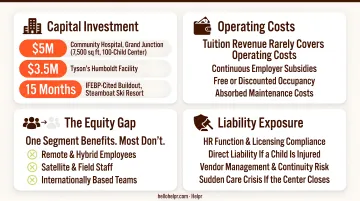
Operational and liability exposure is ongoing. Employers who run their own center take on a separate HR function, state licensing compliance, and direct liability if a child is injured. Those who outsource to a third-party operator still carry vendor management risk, contract negotiation complexity, and business continuity exposure. If the center closes for renovation or funding shortfalls — even temporarily — employees who depend on it face a sudden care crisis with little warning.
Disadvantages for Employees
Subsidized care can become golden handcuffs. An employee paying below-market rates for care they could not otherwise afford faces a genuinely difficult decision if they want to leave. Leaving means losing both their income and their childcare simultaneously. That's not retention. It's financial dependency — and it tends to erode engagement over time, even when headcount stays stable.
When Cal State Long Beach closed its Child and Family Center for repairs in 2023, the risk of that dependency became concrete. Affected parents scrambled for alternatives while the university navigated a years-long renovation process — the center ultimately did not reopen until May 2026. Employees who have arranged their entire childcare situation around an employer-provided center have no realistic fallback when that center closes — whether due to budget cuts, enrollment drops, or facility issues.
Is On-Site Daycare Right for Your Organization?
Most employers considering on-site care underestimate how specific the conditions need to be for it to work well. The Employer-Based Child Care Feasibility & Assessment Guide from EPIC provides a useful framework: plan for slots equal to 10–15% of total employees, roughly 100 square feet of facility space per child, and a 15–30 month development timeline before opening.
Use these criteria to assess fit before committing resources.
On-site care makes a strong case when:
- Your workforce is large (500+ employees) and consistently co-located at one site
- Shift schedules are nontraditional — healthcare, manufacturing, or public safety — and commercial centers can't accommodate them
- You're located in a childcare desert — about 46% of U.S. children under 6 live in areas where there are more than three children per licensed slot
- You can commit to long-term operational and financial support, including a contingency fund if enrollment drops or facility repairs arise
On-site care carries disproportionate risk when:
- More than a quarter of your workforce is remote, hybrid, or distributed across multiple locations
- You can't guarantee multi-year operational continuity without dependency on grants or changing budgets
- Your workforce spans multiple cities or countries, limiting who the benefit actually reaches
- The benefit would reach fewer than 10–15% of your total employee population
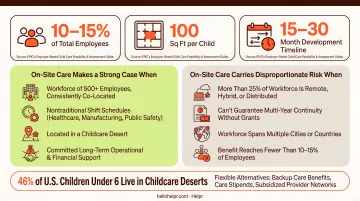
For most organizations — particularly those with distributed or global workforces — on-site care reaches too few employees to justify the cost and operational complexity. Flexible alternatives like backup care benefits, care stipends, or subsidized provider networks tend to deliver broader, more equitable coverage.
Alternatives and Complements to On-Site Daycare
Employers don't have to choose between a $5M facility and doing nothing. Several alternatives deliver real value at a fraction of the cost and complexity.
Childcare subsidies are the most flexible employer option. Rather than operating a facility, employers provide a monthly stipend or reimbursement that employees can apply at any licensed provider. It works for remote workers, preserves employee autonomy, and eliminates facility closure risk. In 2024, 8% of U.S. organizations offered childcare subsidies — a number that has room to grow given how broadly applicable the model is.
Backup care addresses the most acute problem: what happens when regular care falls through. More than one-third of large employers now offer backup care as part of their 2025 benefits strategy. Platforms like Helpr provide enterprise-level backup care across 150+ countries, covering employees regardless of role, location, or work arrangement.
For companies with distributed teams, such as Skanska's globally mobile construction workforce or Snap's internationally based staff, backup care is practically the only childcare benefit that works equitably at scale.
Layered strategies are where leading organizations are heading. The model looks like this:
- Subsidize regular care costs through a monthly stipend
- Provide backup care access for when regular arrangements fail
- Maintain on-site care only at select, high-density locations where it's financially justifiable
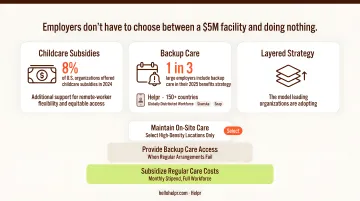
This approach reaches the full workforce rather than concentrating benefits in one location — which is both more equitable and more defensible from a DEI perspective.
Frequently Asked Questions
Does my employer have to work around my childcare?
No federal law currently requires employers to adjust schedules specifically for childcare reasons. Some states have right-to-request policies — San Francisco requires employers with 20+ employees to consider flexible scheduling requests, and Vermont employees can formally request flexible arrangements — but neither guarantees approval. Employer-sponsored care benefits and flexible scheduling policies are the more common voluntary accommodations.
How much does it cost to set up an on-site daycare for employees?
Costs vary significantly by scope and location. Community Hospital's 100-child Grand Junction center required approximately $5M in investment; Tyson's comparable facility cost $3.5M. Neither figure includes ongoing operational subsidies, which most centers require indefinitely.
What are the alternatives to on-site daycare for employers?
The main options include childcare subsidies or reimbursements, backup care benefits (like Helpr's enterprise platform), pre-tax dependent care account contributions, and community childcare provider partnerships. These alternatives serve distributed and remote workforces that on-site care structurally cannot reach.
Which industries are most likely to offer on-site daycare?
Healthcare, higher education, large corporate headquarters, and manufacturing or public safety sectors with shift-based schedules are the most common. These industries share consistent co-location requirements and workforces large enough to sustain enrollment.
Can on-site daycare help reduce employee turnover?
Research supports a link between employer-sponsored childcare and improved retention: 86% of benefit users in BCG's study said the benefit made them more likely to stay. The effect is strongest when the benefit reaches a significant portion of the workforce, not a narrow subset of co-located employees.
Is on-site daycare a good benefit for remote or hybrid workers?
No — it provides no direct benefit to employees who aren't physically present at the facility. Organizations with remote or hybrid workforces typically get better equity and reach from portable solutions like childcare subsidies or backup care platforms that follow employees wherever they work.