
Introduction
Childcare alone often runs families $10,000–$15,000 a year in many U.S. metros, and adult dependent care can push household costs even higher. When a daycare closes unexpectedly or a caregiver calls in sick, the ripple effect on someone's ability to show up for work is immediate.
A dependent care flexible spending account (DCFSA) is an employer-sponsored benefit that lets eligible employees set aside pre-tax income for qualifying, work-related dependent care expenses. It's one tool for managing those costs, not a cure-all.
This guide covers whether daycare qualifies, who can use a DCFSA, how contributions and reimbursement actually work, how a DCFSA compares to a healthcare FSA and the Child and Dependent Care Tax Credit, and when it's genuinely worth using.
A quick note: DCFSA rules, annual limits, grace periods, and tax treatment change from year to year. Confirm current details with the IRS, your employer, your plan administrator, or a qualified tax professional before making decisions.
Key Takeaways
- A DCFSA covers eligible work-related care for qualifying children or adults, not tuition or general household costs.
- Contributions come from pre-tax payroll deductions, but unused funds can be forfeited.
- Daycare, preschool, after-school care, and day camps often qualify—not tutoring or overnight camps.
- You can't claim the Child and Dependent Care Tax Credit on expenses already reimbursed by a DCFSA.
- Pair a DCFSA with backup care and family-care benefits rather than using it as a standalone solution.
What Is a Dependent Care FSA and How Does It Work?
A DCFSA goes by several names: dependent care assistance program (DCAP), child care FSA, or dependent care spending account. They all describe the same thing: an employer-sponsored account funded with pre-tax dollars for work-related dependent care.
How Enrollment and Contributions Work
Your employer has to offer the benefit first. From there, you elect a contribution amount during open enrollment or after a qualifying life event, like a new child or a change in employment status. Payroll deductions come out before applicable taxes, which lowers your taxable income.
The Claim Reimbursement Process
The reimbursement cycle typically follows four steps:
- Pay the provider for eligible care, or incur the eligible expense directly.
- Submit a claim through your plan's process, usually with documentation attached.
- Wait for verification: the administrator checks the expense and provider details.
- Receive reimbursement, limited to what you've actually contributed and what's available at the time of the claim.

That last point matters. Unlike a healthcare FSA, a DCFSA generally doesn't front you the full annual election on day one. You're typically reimbursed only up to what has already accumulated in the account from your payroll cycle.
That makes clean records essential. Helpr's My Choice technology ties DCFSA-eligible care spending to payment and receipt tracking in one flow, so families who book care through the app can pull claim documentation without hunting through old email confirmations.
Documentation You'll Need
Funds are tied to expenses that let you — and your spouse, if you're married and filing jointly — work, look for work, or attend school full time. Keep these records for every claim:
- The dependent's name
- Provider's name and identifying information (SSN or EIN)
- Dates of care provided
- Type of service
- Amount paid
- Proof of payment
Which Childcare and Dependent Care Expenses Qualify?
Not every caregiving expense counts, and the IRS is fairly specific about who and what qualifies.
Who Counts as a Qualifying Person
Under current IRS guidance, a qualifying person is generally:
- A dependent child under age 13 when the care was provided
- A spouse who is physically or mentally unable to care for themselves and lived with you more than half the year
- Another dependent, unable to care for themselves, who lived with you more than half the year
Eligible Care Expenses
According to IRS Publication 503, expenses that may qualify — when work-related and permitted by your plan — include:
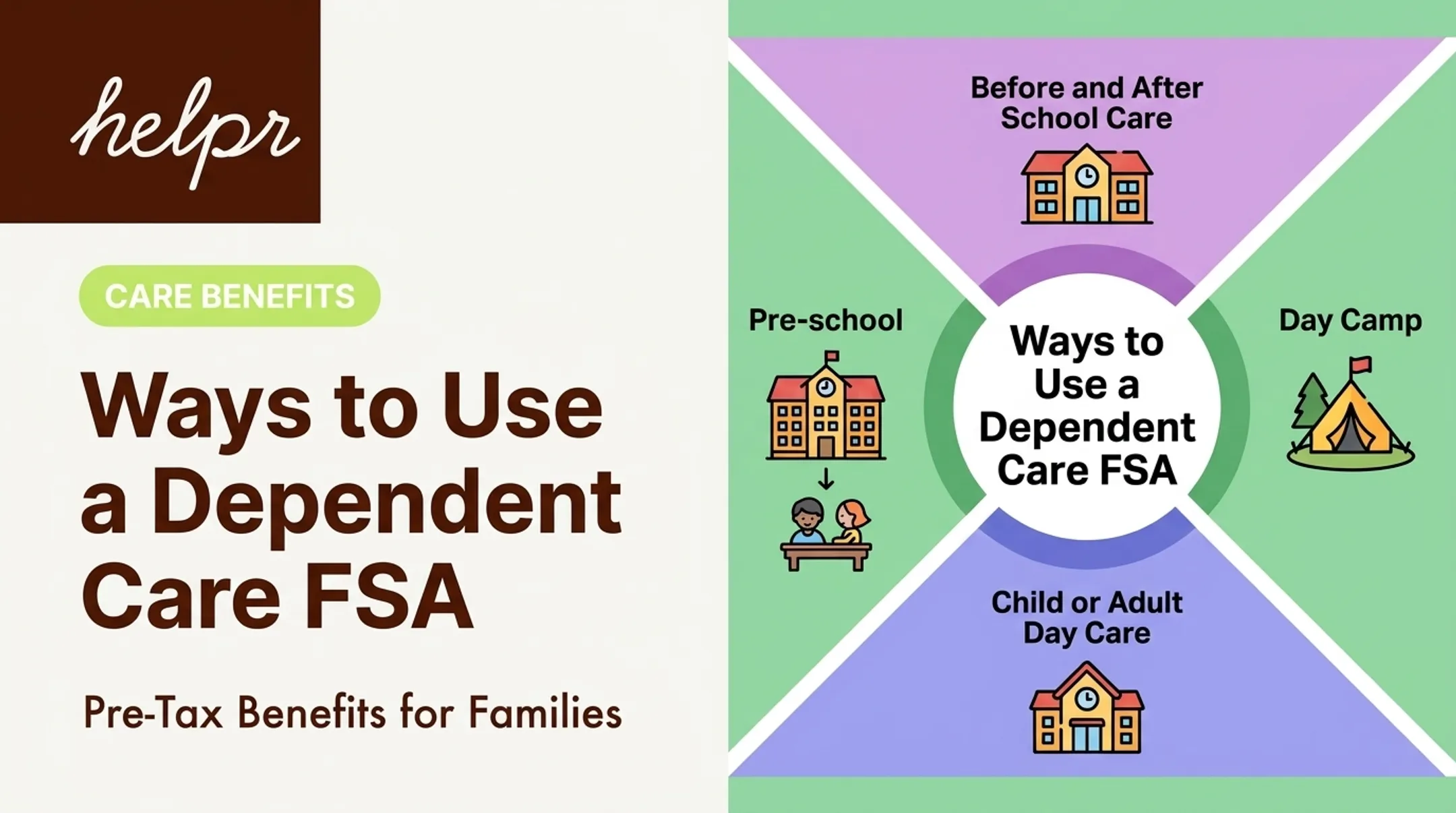
- Daycare, child care centers, nursery school, and qualifying preschool care
- Before- and after-school care
- Summer day camps and similar daytime supervision
- Babysitting, nanny, au pair, adult day care, elder care, or care for a disabled dependent The test is simple: the service must provide care or supervision. It cannot be primarily education, entertainment, medical treatment, or overnight lodging.
What's Not Covered
Several categories are commonly ineligible or restricted:
- Private-school tuition and tutoring
- Language, music, or hobby lessons
- Sports classes and field trips
- Overnight camps
- Child support and food costs
- Nursing-home costs unrelated to work-enabling care
- Care that isn't needed for work reasons
Provider and Payment Rules
You'll need the provider's identifying information for Form 2441. Payments to these relatives are generally disallowed:
- Your spouse
- Your dependent
- Your child under age 19
- The parent of a qualifying child under 13 Payments to a relative who isn't your tax dependent can still qualify if you have their Social Security number or tax ID on file. Example: A weekday daycare bill that lets a parent work typically qualifies. A weekend enrichment class or two-week overnight camp usually does not. Confirm each expense against your plan document before you submit it.
DCFSA Rules, Tax Savings, and Alternatives
The rules around limits, eligibility, and deadlines are where most DCFSA confusion happens.
2026 Contribution Limits
For 2026, IRS Publication 15-B sets the exclusion limit at $7,500 for a single filer or a married couple filing jointly, and $3,750 for a married individual filing separately. That's up from the 2025 limit of $5,000 (or $2,500 if married filing separately). The cap applies per household for joint filers, not per person, and your employer's plan may set a lower maximum — so confirm the current-year figure with your plan administrator before you enroll.
Earned-Income Requirements
Both you and your spouse (if filing jointly) generally need earned income for the care to qualify. Exceptions exist:
- A spouse who's a full-time student for at least five months of the year is treated as having earned income
- A spouse unable to care for themselves due to disability gets the same treatment
- The IRS assumes a deemed monthly income of at least $250 for one qualifying person, or $500 for two or more, in these cases The excludable amount is capped at the smallest of benefits received, qualified expenses, your earned income, your spouse's earned income, or the plan maximum.
Avoiding the Use-It-or-Lose-It Trap
This is the biggest risk with a DCFSA. A cafeteria plan may allow a grace period of up to 2 months and 15 days after the plan year ends, but ordinary DCAP carryover generally isn't permitted the way it sometimes is for healthcare FSAs. Estimate conservatively, track your balance, and know your plan's exact claim-submission deadline.
DCFSA or the Child and Dependent Care Tax Credit?
You can't double-dip. The same expense can't be reimbursed through a DCFSA and also claimed for the credit. Form 2441 reconciles this directly by reducing your available credit base by whatever you excluded through the DCFSA. Which option wins depends on income, filing status, and how many qualifying dependents you have:
- Higher earners often gain more from the FSA's payroll-tax savings
- Lower earners sometimes come out ahead with the credit (up to 35% of qualifying expenses)
- No universal answer — run the numbers for your situation, or try the WEX FSA calculator Plan rules also matter if your job changes. Ask your administrator what happens to the account after termination: some plans stop reimbursement immediately, while others still allow claims for expenses incurred before your last day. When you do use DCFSA funds, platforms like Helpr that support pre-tax benefit payments can simplify paying eligible childcare providers from your account.

What Is the Difference Between a Dependent Care FSA and a Regular FSA?
When people say "regular FSA," they usually mean a healthcare FSA: a completely different account from a DCFSA, despite the shared acronym.
| Feature | Dependent Care FSA | Healthcare FSA |
|---|---|---|
| Eligible expenses | Work-related care and supervision (daycare, elder care, day camps) | Medical, dental, vision, and related healthcare costs |
| Qualifying people | Children under 13; incapacitated spouse or dependent | Anyone covered under the plan for medical expenses |
| Fund availability | Only as contributions accumulate through payroll | Full annual election available upfront, regardless of contributions so far |
| Unused funds | Generally forfeited; limited grace period possible | Grace period or limited carryover, depending on plan design |
If your employer offers both, you can generally participate in each. Contributions and claims stay separate, and you can't use one account's card to pay for the other's expenses.
A DCFSA also isn't the same as a broader backup-care program. A DCFSA is a tax-advantaged way to pay for care you've already arranged. A service like Helpr's Global Backup Care helps you find that care in the first place, whether it's an emergency nanny or an elder care provider abroad.
Whether a specific Helpr booking is DCFSA-eligible depends on your plan. Check with your administrator before assuming.
Is a Dependent Care FSA Worth It?
The honest answer: it depends on your care situation.
A DCFSA tends to make sense when:
- You have predictable, recurring care expenses (daycare, after-school programs)
- Your employer's plan is easy to use and well-administered
- The expected tax savings clearly outweigh the paperwork
- You're confident you'll spend the full election before the deadline
Proceed with caution when:
- Your care costs are irregular or seasonal
- Your employment situation might change mid-year
- Your spouse is a student or between jobs, affecting earned-income rules
- You're not sure you'll use the full contribution amount
Before locking in an election, compare the DCFSA against the Child and Dependent Care Tax Credit using your actual numbers. Income, filing status, and expected expenses all shift the math.
The Employer Side of the Equation
For employers, dependent care support isn't just a nice-to-have. According to SHRM, U.S. businesses lose an estimated $23 billion annually in productivity tied to childcare disruptions. In the same report, 80% of HR executives surveyed said childcare benefits improve productivity, and 78% said they help with recruitment and retention.
This is where a DCFSA and backup care work together rather than compete. A DCFSA helps employees pay for planned care tax-efficiently. Backup care, like Helpr's offering, steps in when the usual arrangement falls apart: a sick nanny, a closed daycare, or a last-minute business trip.
Helpr's My Choice technology extends that coverage across 150+ countries, and companies using its care-benefits program have reported a 5.14x ROI, according to Helpr's internal data. Whether a given Helpr service qualifies for DCFSA reimbursement depends on your plan design, so confirm with your administrator.
Action Checklist
If you're ready to decide on an election, run through this quick checklist:
- Review your employer's plan document for specific rules and deadlines
- Estimate your eligible annual care expenses conservatively
- Confirm you can get complete provider documentation (name, address, tax ID)
- Check the current-year IRS contribution limit
- Compare the DCFSA against the Child and Dependent Care Tax Credit for your situation
- Set calendar reminders for claim submission and spending deadlines

Frequently Asked Questions
Can I use a dependent care FSA for daycare expenses?
Yes. Daycare qualifies when it cares for a qualifying dependent so you (or your spouse) can work, look for work, or attend school full time. Your plan's specific rules still apply.
What is the difference between a dependent care FSA and a regular FSA?
A DCFSA covers work-related dependent care, while a "regular" or healthcare FSA covers eligible medical expenses. They're separate accounts, and some employees can participate in both.
Is it worth using a dependent care FSA?
It depends on whether you have predictable eligible expenses, your tax situation, and how comfortable you are with the risk of forfeiting unused funds. Compare it against the Child and Dependent Care Tax Credit before deciding.
What expenses are eligible for a dependent care FSA?
Common examples include daycare, preschool, before- and after-school care, qualifying day camps, and certain adult or elder care. Eligibility always depends on the work-related requirement and your plan's specific terms.
What happens to unused dependent care FSA funds?
Unused funds typically don't roll over automatically, so you forfeit them at year-end. Some plans offer a grace period of up to 2 months and 15 days—confirm your plan's exact deadline.