
Many employees assume the IRS ceiling is automatically available to them. It isn't. Three separate limits interact: the annual statutory contribution cap, your earned-income limitation, and your employer's Section 129 nondiscrimination requirements.
Highly compensated employees (HCEs) often run into that third limit. They can usually enroll, but if their employer's plan fails testing, some of their "tax-free" benefit can become taxable income after the fact.
This guide breaks down each limit and what happens when they collide. Because tax rules change yearly and individual situations vary, verify current figures with a qualified benefits or tax professional before making elections.
Key Takeaways
- IRS contribution ceilings, earned-income rules, and plan terms each independently cap your tax-free dependent care benefit.
- HCE status does not block enrollment, but failed testing can change tax treatment later.
- Employers should test elections before open enrollment closes, not wait until W-2 season to discover a problem.
- Backup care and family care benefits complement a DCFSA but don't replace Section 129 compliance.
Dependent Care FSA Limits and Income Rules
A dependent care FSA operates under Section 125 (cafeteria plans) and Section 129 (dependent care assistance programs) of the tax code. Employees elect a set amount, deducted from paychecks before taxes, and get reimbursed for eligible care that lets them work or look for work.
The Statutory Contribution Limit
Under IRC Section 129, the amount excludable from income for dependent care assistance is capped annually. For the 2026 tax year, the limits are:
- $7,500 for single filers
- $7,500 for married couples filing jointly
- $3,750 for married individuals filing separately
Here's a detail people often miss: employer contributions and employee salary reductions count toward the same cap. If your employer chips in $1,000 toward dependent care on top of your FSA election, that $1,000 reduces how much of your own election can be excluded tax-free.
The Earned-Income Limitation
Two earned-income caps sit on top of the statutory limit:
- Unmarried employees: Your excludable amount can't exceed your own earned income for the year.
- Married employees: Your excludable amount can't exceed the lower of your earned income or your spouse's — not the combined total.
That second rule trips people up constantly. If one spouse earns $80,000 and the other earns $4,000 from a part-time job, the household exclusion is capped at $4,000, regardless of the $7,500 statutory limit.
Student or incapable-of-self-care spouse: The IRS treats that spouse as earning $250 per month (one qualifying dependent) or $500 per month (two or more). Confirm current substantiation rules in IRS Publication 503 before you rely on the deemed-income amounts.
How the Current Limit Affects Employee Elections
Don't assume the $7,500 ceiling is what you'll actually get to use tax-free. Estimate your qualifying expenses and your household's earned-income picture before electing the max.
Example: A married couple elects $7,500 through one spouse's plan. The lower-earning spouse makes $6,200 after a mid-year job change.
- Household exclusion caps at $6,200 (the lower earned income)
- The extra $1,300 is taxable wages, even though it is under the $7,500 statutory limit

Coordinate before you elect:
- Dual-employer households: If both spouses have a DCFSA, keep combined elections within the household limit
- Plan document rules: Confirm election-change windows, grace periods, claim deadlines, and year-end treatment of unused funds
What Is a Highly Compensated Employee for Dependent Care FSA?
HCE status for dependent care FSA testing isn't defined by the DCFSA rules themselves. Section 129(d)(2) borrows its definition from Section 414(q), the same provision used for retirement plan testing.
For 2026, an employee is generally an HCE if they meet either test:
- Was a 5% owner at any time during 2026 or 2025, or
- Received more than $160,000 in compensation during 2025 (the preceding year)
Employers can also apply an optional top-paid-group election, limiting HCE status to the top 20% of earners by compensation. Don't assume a threshold from another benefit plan automatically applies here — always confirm the current-year figure against IRS guidance.
HCE vs. Key Employee
These two classifications get confused often, but they're not interchangeable:
- HCE applies broadly across nondiscrimination testing for benefits like DCFSAs and cafeteria plans.
- Key employee is a narrower category (typically officers and larger owners) used in separate testing contexts, such as concentration tests for certain benefits.
A single employee can be an HCE without being a key employee, or vice versa, depending on ownership stake and title.
HCE classification doesn't block enrollment or cap your election at sign-up. You can still elect up to $7,500. Any consequence shows up later — through plan design choices or after nondiscrimination testing results come in.
Employers also need to correctly identify HCEs across controlled groups, affiliated service groups, and related employers before testing begins. Missing related-entity relationships is one of the most common testing errors, and it directly skews the average benefits comparison below.
How HCE Status Connects to the 55% Average Benefits Test
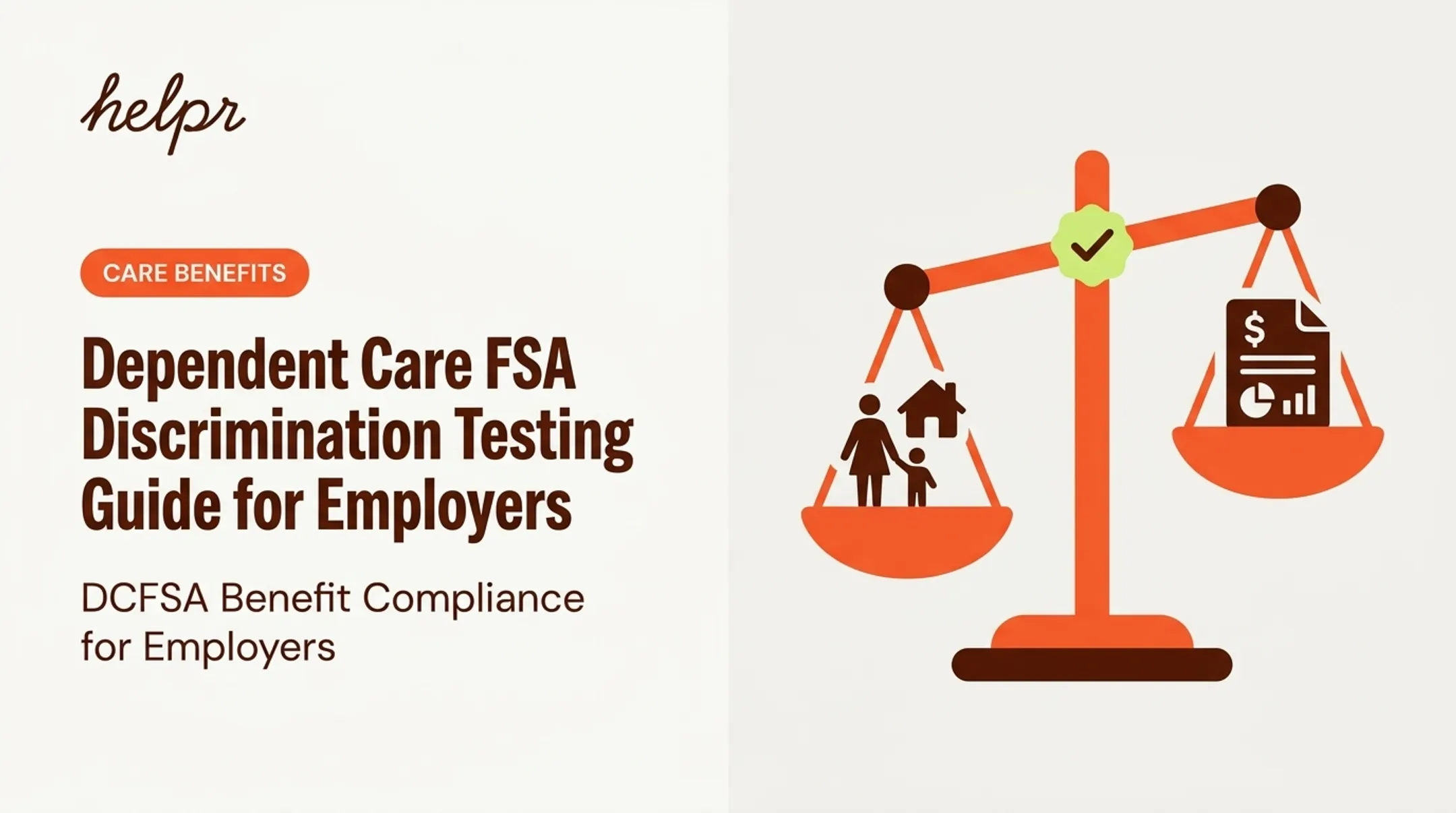
Section 129 requires that average benefits provided to non-HCEs equal at least 55% of average benefits provided to HCEs. This is the core nondiscrimination check for dependent care plans. Verify the current statutory language directly with IRC Section 129 or qualified plan-administration guidance before applying it to a specific plan year.
A simplified hypothetical shows how fast the ratio breaks:
- 20 HCEs enroll, each electing the full $7,500 → average HCE benefit: $7,500
- 100 non-HCEs are eligible, but only 15 enroll, averaging $2,000 each → average non-HCE benefit: roughly $300 across the full eligible group
That ratio falls well short of 55%, and the plan would likely fail. Low non-HCE participation combined with maxed-out HCE elections is the classic failure pattern.

A few testing distinctions matter here:
- Eligibility testing — who's allowed to participate
- Benefits/contribution testing — the 55% average benefits comparison
- Nondiscriminatory availability — whether the benefit is offered under a classification that doesn't favor HCEs
Passing one doesn't mean the plan is compliant overall. Each test evaluates something different, and the average benefits test looks at benefits actually provided, not just amounts initially elected.
Run preliminary testing on projected elections before or during open enrollment, then confirm with final testing once real plan-year data comes in.
Eligibility and Employee-Level Consequences
Before any of the limits above apply, the expense itself has to qualify. IRS Publication 503 defines a "qualifying person" as:
- A dependent child under age 13 when care was provided
- A spouse physically or mentally unable to care for themselves, who lived with the employee more than half the year
- Another dependent unable to care for themselves, meeting the same residency and dependency rules
The expense must also be work-related — meaning it allows the employee (and spouse, if married filing jointly) to work or actively look for work.
Commonly eligible:
- Daycare and preschool
- Before- and after-school care
- Summer day camps (day only)
- Qualifying adult day care
Commonly ineligible:
- Overnight camps
- Private school tuition
- Enrichment classes (music lessons, tutoring) unrelated to work
- Date-night or weekend babysitting
What Happens When Limits Are Exceeded
If a participant's benefits exceed their earned-income limit, or if the employer's plan fails nondiscrimination testing, excess amounts can lose tax-free status. Those amounts — often concentrated among HCEs — are treated as taxable wages.
That change typically appears on:
- Form W-2: Dependent care assistance is reported in Box 10; any amount that can't be excluded also gets added to Boxes 1, 3, and 5.
- Form 2441: Employees use this to calculate the excludable amount. If line 26 shows an amount above zero, that figure carries over as taxable income on Form 1040.
Employees with excess benefits or unusual filing situations should confirm the taxable amount with a tax adviser before filing.
Employer Compliance and Plan-Design Strategy
Testing surprises are avoidable. A practical pre-enrollment checklist helps:
- Review the plan document — confirm current limits, election rules, and grace period terms.
- Identify HCEs and non-HCEs accurately, accounting for controlled groups and related employers.
- Analyze prior test results to spot recurring patterns.
- Examine participation and election trends by compensation tier.
- Confirm current-year legal limits before communicating anything to employees.

Run preliminary testing on projected elections. If HCEs cluster near the max while non-HCE participation lags, you still have time to adjust before payroll deductions start.
Plan-design options worth discussing with benefits counsel:
- Setting a lower plan-specific limit below the statutory cap
- Limiting HCE participation where legally and operationally feasible
- Structuring employer contributions to encourage broader non-HCE enrollment
Each option has legal and operational trade-offs, so review it with counsel before you implement.
Employee education matters too. Non-HCEs often skip DCFSA enrollment because they don't see the tax savings. Clear, accurate communication can raise participation without overselling the benefit or promising guaranteed savings.
For HCEs specifically, be direct:
- Their election may be subject to testing.
- Some portion of their benefit could lose tax-free treatment.
- The employer may need to adjust elections or issue corrected tax reporting under the plan's procedures.
Finally, document everything: testing methodology, assumptions, employee classifications, notices sent, corrections made, and any plan amendments. If the IRS or a participant questions the outcome, that paper trail matters.
Pairing DCFSA Compliance with Backup Care Access
Compliance protects the tax benefit. Care access determines whether employees can use it when plans fall apart—a sick child, a closed daycare, or an unexpected late shift.
That is a coverage gap, not a testing failure, and it calls for an operational benefit alongside the DCFSA.
Helpr is an employer-sponsored backup care platform that connects employees with vetted childcare, elder care, and other dependent-care support when regular arrangements break down. Helpr does not change DCFSA contribution limits or satisfy Section 129 nondiscrimination testing; those stay separate compliance requirements.
It does extend care access across roles and locations, including remote and hybrid teams, so support is not limited to higher earners with more schedule flexibility.
When you design the full family-care package, review DCFSA participation, care-access gaps, employee feedback, and nondiscrimination results together. They measure different parts of the same equity problem.
This article is educational and not tax or legal advice. IRS rules, plan documents, and individual circumstances all affect outcomes. Review specifics with qualified benefits counsel or a tax adviser.
Frequently Asked Questions
What are the maximum contributions I can make to my FSA for dependent care?
For 2026, the statutory limit is $7,500 for single filers and married couples filing jointly, or $3,750 for married filing separately. Earned-income rules, employer contributions, your plan's own limit, and nondiscrimination testing can all reduce the amount that stays tax-free.
What is considered a highly compensated employee for dependent care FSA?
HCE status generally applies to 5% owners or employees who earned more than $160,000 in the preceding year, based on current IRS thresholds. Always verify the applicable year's figure and your specific plan's definition.
What qualifies as dependent care for an FSA?
You need a qualifying person — a dependent under 13 or someone unable to care for themselves — and work-related care expenses that let you work or look for work. Your employer's plan must offer a DCFSA, and you'll need to retain provider and expense documentation.
Can a highly compensated employee contribute to a dependent care FSA?
Generally yes, if the employer's plan permits it. However, an HCE's benefits may be limited, reduced, or made taxable depending on plan design and the results of nondiscrimination testing.
What happens if a dependent care FSA fails nondiscrimination testing?
Affected HCE benefits can lose their tax-free treatment, requiring correction and adjusted W-2 reporting. Employers should follow their plan document's correction procedures and consult benefits counsel promptly.