Introduction
Working parents aren't a niche group — they're your workforce. According to the Bureau of Labor Statistics, 91.6% of US families with children had at least one employed parent in 2025, and both parents worked in 66.3% of married-couple families with children. That's the scale of the audience employers must serve.
The cost of ignoring their needs is real. A Bipartisan Policy Center survey found that 60% of caregivers reported childcare access difficulties caused someone in their household to miss work, reduce hours, or change jobs in the prior year. And according to 2024 industry research, 80% of employers reported that childcare benefits improved retention outcomes.
Most benefits packages still don't reflect that reality. This guide covers the highest-impact benefits for working parents — paid parental leave, flexible scheduling, backup care, and financial assistance — and how HR teams can translate them into measurable retention and productivity gains.
Key Takeaways
- 91.6% of US families with children have at least one employed parent — working parent benefits are mainstream workforce infrastructure, not a niche perk.
- Family and childcare support motivates 35% of working parents to stay with their employer, nearly matching doubled compensation at 36%.
- Backup care prevents unplanned absences when regular care falls through — and remains one of the highest-ROI benefits most employers still haven't fully deployed.
- Equity matters: benefits accessible only to salaried or corporate staff quietly exclude the frontline workers who need them most.
- Start with high-impact, lower-cost investments like flexible scheduling, pre-tax dependent care accounts, and backup care before scaling to costlier options.
Why Working Parent Benefits Are a Business Priority
The Productivity and Retention Stakes
When employees can't secure reliable care, work suffers. The impact shows up as missed shifts, reduced hours, and eventually resignations. For HR leaders tracking turnover costs, this isn't an abstract problem.
A 2022 industry study found that family and childcare support motivated 35% of working parents to stay with their current employer — essentially tied with the 36% who cited doubled compensation. Schedule flexibility compounds this further: in a 2023 study of 27,000 employees, 38% of mothers with young children said that without workplace flexibility, they would have left their company or reduced their hours.
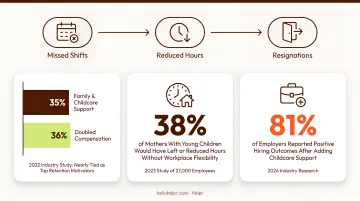
Childcare benefits also move the needle on recruitment. Industry research from 2024 found 81% of employers reported positive hiring outcomes after adding childcare support to their benefits package.
The Equity Dimension
Working parent benefits aren't just a retention play — they're a workforce equity issue. Childcare burdens fall unevenly:
- Mothers are 40% more likely than fathers to report negative career effects from childcare problems (Center for American Progress)
- Single parents face a disproportionate cost burden — the 2025 national average annual childcare price of $13,184 represents 33% of median single-parent income versus 10% for two-parent households
- Hourly and frontline workers are least likely to have access to formal care benefits, yet most likely to face scheduling unpredictability
Organizations that treat working parent benefits as a DEI investment — not an optional perk — tend to build broader internal support and see faster adoption across leadership, HR, and finance.
Top Employee Benefits for Working Parents
These five benefit categories represent the highest-impact areas where employers can meaningfully support working parents, reduce absenteeism, and build lasting workforce loyalty.
Paid Parental Leave
Effective paid parental leave covers all parents — regardless of gender, family structure (biological, adoptive, same-sex), or role as primary or secondary caregiver. Policies that only cover maternity leave exclude most of the workforce and signal that caregiving is a woman's responsibility.
Leading programs set a high standard. Etsy offers 26 weeks of fully paid leave for birth or adoption, regardless of gender or country. Novartis provides a minimum of 14 weeks fully paid for all new parents globally — both exceed the 12-week threshold that signals genuine organizational commitment.
McKinsey has observed that employees returning from leave — particularly women after longer leaves — show elevated attrition risk. Investing in leave policy directly protects institutional knowledge and reduces early-tenure turnover among a population that's expensive to replace.
Flexible Work Arrangements
Schedule control is often worth more to working parents than a pay increase. The range of flexibility options includes:
- Remote and hybrid work reduces commute burden and creates natural caregiving overlap during the day
- Compressed workweeks (4×10 schedules) give parents a full weekday without cutting their paycheck
- Flexible start and end times accommodate school drop-off, pickup, and medical appointments
- Shift swapping and self-scheduling serve hourly and frontline workers who can't log in from home
That last point matters. SHRM reports that only 12% of hourly workers preferred a traditional 9-to-5 schedule, and parents in that group were nearly five times as likely to prefer flexible arrangements. Equitable flexibility policy must account for frontline and shift-based workers — not just knowledge workers with laptops.
Childcare and Backup Care Support
Childcare support spans a spectrum of solutions, and not every option fits every employer:
| Benefit Type | Best For | Cost Complexity |
|---|---|---|
| On-site or near-site daycare | Large employers with physical campuses | High |
| Childcare subsidies or stipends | Mid-size to large employers | Medium |
| Pre-tax dependent care account | All employers | Low |
| Childcare search assistance | All employers | Low |
| Backup care programs | All employers | Low-to-medium |
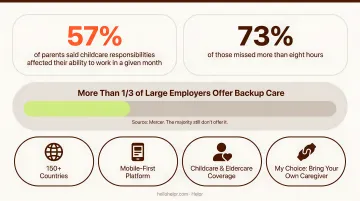
Backup care deserves special attention. When a child's regular caregiver is unavailable — illness, school closure, schedule change — parents face an immediate crisis. Without an employer solution, the result is often an unplanned absence or a distracted, ineffective workday. A BPC survey found 57% of parents said childcare responsibilities affected their ability to work in a given month, and 73% of those missed more than eight hours.
Backup care programs provide on-demand access to vetted care providers to bridge these gaps. Mercer reports that more than one-third of large employers now offer backup care — meaning the majority still don't, creating a clear differentiation opportunity.
Helpr's backup care platform is built for this use case. It connects employees with vetted care providers across 150+ countries through a mobile-first app, covers both childcare and elder care, and includes a "bring-your-own-caregiver" option through its patented My Choice technology — letting employees subsidize trusted personal networks like family members or neighbors.
Organizations only pay for care that's actually used, making it cost-effective across company sizes. The platform is designed to serve hourly and frontline workers alongside corporate staff, with subsidized options that reduce out-of-pocket costs across income levels.
Pre-Tax Dependent Care Accounts and Financial Support
A pre-tax dependent care account lets employees set aside pre-tax dollars to cover qualified childcare and elder care expenses, reducing their taxable income. The 2025 IRS contribution limit is $5,000 ($2,500 for married taxpayers filing separately), and employers can also contribute.
SHRM's 2025 benefits survey found 54% of surveyed organizations offered a pre-tax dependent care account — solid adoption, but still leaving nearly half of employers without this accessible, low-cost benefit.
Complementary financial tools worth considering:
- 529 college savings contributions — some states, including Colorado, offer employer tax credits of up to 20% on direct contributions to employee accounts
- Student loan repayment assistance — employers can provide up to $5,250 per employee tax-free through 2025 under Section 127
- Childcare stipends — direct, flexible financial help that doesn't require account administration infrastructure
Mental Health and Wellness Benefits
Working parents carry compounded stress. The 2024 US Surgeon General advisory found that 33% of parents experienced high stress in the prior month versus 20% of other adults, and 48% of parents said their stress was completely overwhelming on most days.
Standard EAPs exist to address this — but they're underused. Research shows historical clinical utilization rates hovering around 5-7.6 users per 100 covered employees. The problem isn't the benefit; it's friction and awareness.
Practical steps HR teams can take:
- Actively promote EAP access through managers and internal communications, not just open enrollment packets
- Offer health and wellness stipends covering therapy, fitness, meal delivery, or recovery services
- Add lactation support programs for returning parents — often low-cost, high-signal
- Consider parenting-specific counseling or coaching as a complement to general mental health coverage
Benefits That Go Above and Beyond
Return-to-Work Programs
The transition back from parental leave is a high-attrition window. Return-to-work programs reduce that risk — but how they're structured matters as much as whether they exist at all.
Common approaches include:
- Phased return schedules: employees ramp back to full hours over 4–8 weeks instead of returning all at once
- Returnship programs: structured re-entry with mentorship for employees coming back from extended leave
- Temporary part-time arrangements: a bridge period between leave and full-time re-engagement
These programs give parents time to rebuild routines without facing an all-or-nothing return — a pressure point that pushes many talented employees out the door entirely.
Fertility and Adoption Assistance
Family-forming benefits have expanded significantly among large employers. Mercer's 2024 survey found 47% of employers with 500+ employees covered IVF, rising to 70% among employers with 20,000+ employees. SHRM reported that 20% of employers offered financial assistance for adoption in 2024.
These benefits reach employees who don't enter parenthood through a traditional newborn path — and they send a clear message that the organization recognizes every route to becoming a family.
Elder Care Support
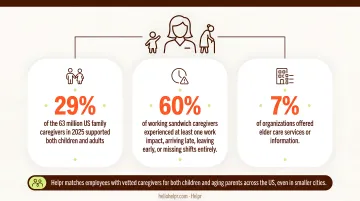
Many employees are "sandwich generation" caregivers managing both child and aging parent responsibilities at the same time. AARP and the National Alliance for Caregiving found that 29% of the 63 million US family caregivers in 2025 supported both children and adults. NAC research found 60% of working sandwich caregivers experienced at least one work impact — arriving late, leaving early, or missing shifts entirely.
Despite the scale of this challenge, elder care remains one of the most underserved benefit categories. SHRM's 2025 survey found only 7% of organizations offered elder care services or information.
Backup care platforms that cover both child and adult care — including matching employees with vetted caregivers for elderly family members, even in smaller cities — address this gap directly. Helpr's platform extends that coverage across the US, expanding the definition of family benefits well beyond childcare alone.
How to Choose the Right Benefits Mix for Working Parents
Start With Your Workforce Data
The right benefits package depends on who your workforce actually is. Survey employees before designing a portfolio:
- Distribution of parents by age of dependents
- Household structure (single parent, dual income, sandwich caregiver)
- Work model (remote, hybrid, in-person, shift-based)
- Geographic distribution and access to formal care markets
Assumptions about what corporate-level staff need often produce packages that miss the employees who need support most.
Apply the Equity Test
A working parent benefits strategy only succeeds if it reaches the whole workforce. Ask:
- Can hourly and part-time employees access the same core benefits as salaried staff?
- Do benefits require desktop access, during-business-hours calls, or paperwork that frontline workers can't complete on shift?
- Do financial assistance tools (FSAs, stipends) actually reduce cost for lower-wage employees, or do they primarily benefit higher earners with more disposable income?
Benefits that only reach certain job levels send a clear message about whose family life the organization actually prioritizes.
Use a Prioritization Framework
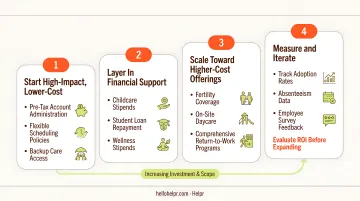
Once you've identified what equity requires, the next step is sequencing. Not every employer can launch on-site childcare on day one — but a phased approach keeps progress moving:
- Start high-impact, lower-cost — pre-tax account administration, flexible scheduling policies, backup care access
- Layer in financial support — childcare stipends, student loan repayment, wellness stipends
- Scale toward higher-cost offerings — fertility coverage, on-site daycare, comprehensive return-to-work programs
- Measure and iterate — track adoption rates, absenteeism data, and employee survey feedback to evaluate ROI before expanding
Conclusion
Working parent benefits function as workforce infrastructure, not a nice-to-have perk category. Employers who provide reliable, equitable support for caregiving reduce absenteeism, improve retention, and build the kind of workforce loyalty that outlasts compensation packages.
Organizations of every size can build a meaningful working parent strategy. Start with high-impact, accessible benefits like backup care, flexible scheduling, and financial assistance tools. Measure what works, then expand from there.
For HR teams ready to take that first step, Helpr provides on-demand, scalable backup care to employees across 150+ countries — from corporate headquarters to frontline and distributed teams. Explore Helpr to see how your organization can get started.
Frequently Asked Questions
What benefits can working parents claim?
Employer-sponsored benefits for working parents typically include paid parental leave, pre-tax dependent care accounts, childcare assistance, flexible work arrangements, and health and wellness benefits. Available benefits vary by employer, so reviewing your company's benefits guide or speaking with HR is the best starting point.
What federal tax benefits are available to working parents in the US?
The Child and Dependent Care Tax Credit (CDCTC) allows eligible parents to claim up to 35% of qualifying childcare expenses — up to $3,000 for one child or $6,000 for two or more. Employer-sponsored pre-tax dependent care accounts offer an additional pre-tax savings vehicle, and the two can be used together to maximize your household's care-related tax relief.
What is backup care and how does it work as an employee benefit?
Backup care is an employer-sponsored benefit that provides on-demand access to vetted childcare or elder care providers when a parent's regular care arrangement falls through — due to illness, school closures, or schedule changes. It prevents unplanned absences by connecting employees with qualified care.
How do employee benefits for working parents reduce turnover?
When care arrangements fall apart, working parents face a difficult choice: miss work or leave the job. Benefits that address scheduling flexibility, childcare access, and financial relief reduce that daily friction — particularly for mothers returning from parental leave and single parents managing unpredictable care schedules.
What is a pre-tax dependent care account and how much can employees contribute?
A pre-tax dependent care account lets employees pay for eligible childcare and elder care expenses with pre-tax dollars, reducing their taxable income. The 2025 IRS contribution limit is $5,000 per household ($2,500 for married filing separately), and employers may also contribute to employee accounts.