
Introduction
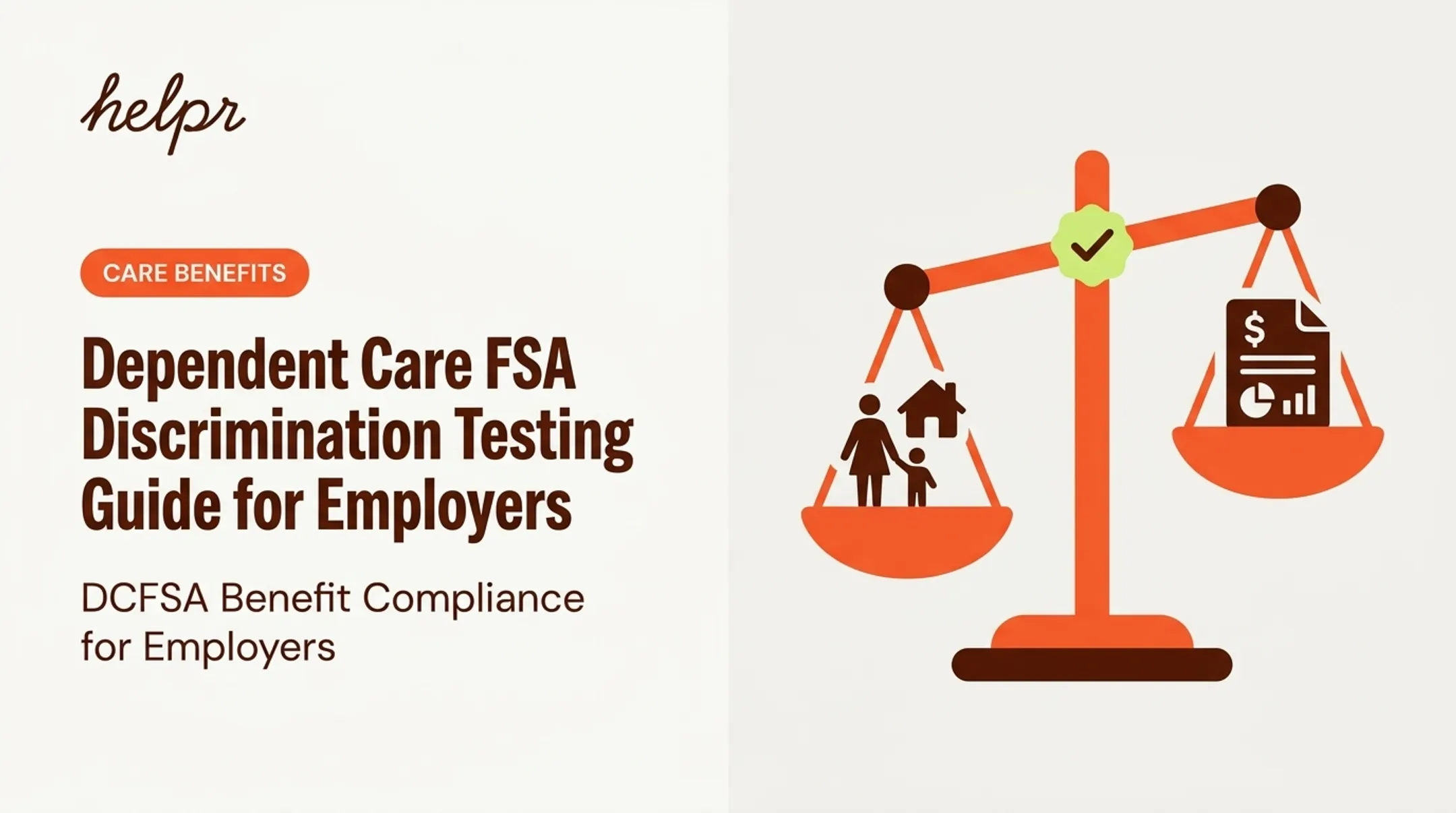
Nondiscrimination testing for a dependent care FSA checks whether the plan favors highly compensated employees or certain owners—and whether benefits stay tax-favored under IRS rules. This guide is for U.S. employers, HR and benefits teams, payroll professionals, brokers, and plan administrators who run or advise these plans.
The rules get referenced constantly in benefits meetings, yet the operational mechanics trip up even experienced teams. Compensation gets misclassified. Ownership records go stale. Vendors calculate averages differently than expected.
You’ll see how the testing process works, what data drives the outcome, when to run it, and what typically happens if a test fails.
Key Takeaways
- Dependent care FSAs must meet nondiscrimination rules under IRC Section 129 and related cafeteria-plan requirements.
- The 55% Average Benefits Test is usually the hardest to pass because HCE and NHCE participation rarely mirrors each other.
- Test early enough to fix data errors and adjust elections before your plan year closes.
- A failure typically taxes affected HCEs rather than disqualifying the whole plan.
What Is Nondiscrimination Testing for a Dependent Care FSA—and Why Does It Matter?
A dependent care FSA, also called a dependent care assistance program (DCAP), lets employees set aside pre-tax dollars, or receive employer contributions, for eligible childcare and dependent-care expenses. Nondiscrimination testing exists to confirm the plan's eligibility rules, contributions, and actual benefits don't disproportionately favor highly compensated employees (HCEs), key employees, or owners.
Put simply: the test asks whether rank-and-file employees are getting a fair share of the benefit, not just theoretical access to it.
DCFSA Testing vs. Health FSA Testing
These are separate compliance frameworks. A DCFSA is governed by IRC Section 129, which imposes four distinct nondiscrimination tests. A health FSA typically runs under Section 105(h) for self-insured plans, plus Section 125 rules if it's offered through a cafeteria plan.
| Item | Health FSA | Dependent Care FSA |
|---|---|---|
| Governing rule | IRC 105(b) and 105(h) | IRC 129(d) |
| Eligible expenses | Medical care for employee, spouse, dependents | Employment-related dependent-care services |
| Nondiscrimination framework | Eligibility and benefits test under 105(h); Section 125 test if cafeteria-plan funded | Four Section 129 tests, plus Section 125 rules for salary-reduction plans |
Testing is also distinct from an employee's individual determination of whether a specific expense qualifies for reimbursement. That's a claims-substantiation question, not a plan-level compliance question.
Key Terms You'll Need
Throughout this process, you'll work with several employee categories:
- HCEs — highly compensated employees, generally defined under IRC Section 414(q)
- NHCEs — everyone who isn't classified as an HCE
- Key employees — a Section 125 concept tied to IRC Section 416(i)
- More-than-5% owners — owners (or their spouse or dependent) holding more than 5% of stock or profits interest on any day of the year
- Eligible employees — anyone entitled to participate under plan terms
- Participating employees — those actually enrolled or receiving benefits
These categories matter because contribution limits, participation patterns, and compensation demographics all shift results year to year.
Congress recently changed the DCFSA contribution ceiling. Public Law 119-21 raises the statutory exclusion to $7,500 (or $3,750 for married individuals filing separately) for taxable years beginning after December 31, 2025. Before that, the limit sits at $5,000.
Confirm which figure applies to your plan year before you model results.
How Dependent Care FSA Nondiscrimination Testing Works
Testing follows a clear sequence: build a clean data file, run the Section 129 tests, then act on the results before year-end locks elections in place.

Step 1: Gather and Validate Testing Data
Your testing file typically needs:
- The plan document and any amendments
- A full employee census, including terminated and part-year employees
- Ownership records (who owns what, and when)
- Compensation data for HCE determination
- Eligibility dates and employment status
- Elections, contributions, and benefits actually provided
- Payroll records tying elections to actual deductions Inaccurate compensation figures, missing employees, or stale ownership records can quietly skew every downstream test. A single misclassified owner can flip an owner-concentration result from pass to fail.
Step 2: Apply the Applicable Nondiscrimination Tests
Section 129 sets up four separate tests:
- Eligibility test — checks whether the classification of who can join the plan discriminates in favor of HCEs
- Contributions-and-benefits test — checks whether contributions or benefits themselves favor HCEs
- Owner concentration test — limits benefits flowing to more-than-5% owners to 25% of total dependent-care assistance paid
- 55% Average Benefits Test — compares the average benefit NHCEs receive against the average benefit HCEs receive The 55% test is where most plans stumble. Average NHCE benefits must equal at least 55% of average HCE benefits. HCEs often defer more through the plan while lower-wage employees opt out, so the averages drift apart quickly. Newer proposed IRS guidance would set each group's average by dividing total dependent-care assistance by non-excluded employees who received more than zero dollars—dropping zero-benefit employees from the denominator. Practitioner guidance on the 55% test has long flagged this math as the source of most surprise failures. Small shifts in who counts as "excluded" change the result in a meaningful way. Ask your testing vendor how they define the denominator and which exclusions they apply. Methodology differences between vendors are common, and the gap matters more than most employers expect.
Step 3: Review Results and Determine Next Actions
Run a preliminary test mid-year or during open enrollment, then a final test as of your plan year-end. The earlier test buys you time to act before elections lock in. If results show a failure, options generally include:
- Correcting data errors before finalizing
- Applying valid, documented exclusions
- Boosting NHCE participation through communication and plan design
- Reducing HCE elections prospectively
- Including excess benefits in affected HCEs' taxable income where corrections allow it Confirm correction deadlines, payroll treatment, and Form W-2 reporting with your benefits counsel before you finalize any fix. Recently proposed IRS regulations speak to parts of this process, but they are still proposed—not final. Verify their current status before you rely on them.
Where Dependent Care FSA Testing Is Applied and How Employers Use the Results
Most employers run this test annually as of the plan year-end, but that's rarely the only time it happens. Benefits teams also model results during open enrollment and rerun the test when elections, employee classifications, or workforce demographics shift mid-year.
Who Owns Each Piece
Responsibility typically splits across several roles:
- HR/benefits team — maintains eligibility rules and communicates plan terms
- Payroll — tracks actual deductions and contributions
- FSA administrator — runs the calculations and applies exclusions
- Broker or consultant — advises on plan design adjustments
- Legal or tax counsel — reviews correction strategies and documentation

Test results typically drive:
- HCE election limits
- Payroll deduction changes
- Participant communications
- Plan-document amendments
- Year-end W-2 reporting
An Illustrative Risk Scenario
Consider a simplified 200-person company: 20 HCEs elect the DCFSA maximum, but only 15 of 180 NHCEs participate at all. Average HCE benefits will likely run far above average NHCE benefits, putting the 55% test at real risk—even though the plan is offered on identical terms to everyone.
This is the core lesson: equal access doesn't guarantee a passing result. Utilization gaps between HCEs and NHCEs create discrimination risk that plan design alone can't fix.
Where Backup Care Fits Alongside DCFSA Administration
A benefit like Helpr's backup care doesn't replace nondiscrimination testing. It can still help with a related problem: short-term childcare or eldercare gaps that pull employees out of work.
Employees may pay for that backup care with pre-tax DCFSA dollars, which ties care payments to the same account employers already administer. Employers must still test and run the DCFSA under applicable IRS rules, regardless of which backup-care benefits sit alongside it.
Key Factors, Common Errors, and When the Process May Not Be Appropriate
What Actually Moves the Numbers
Results hinge on a handful of inputs:
- HCE and NHCE classifications
- Owner status and ownership percentages
- Compensation accuracy
- Eligibility rules and participation rates
- Election amounts and benefits actually provided
- Plan-year timing
- Controlled-group or affiliated-employer relationships
Common Mistakes Worth Avoiding
- Testing only employees who elected the benefit when the method requires a broader population
- Omitting former or part-year employees when the rules require their inclusion
- Misclassifying HCEs using outdated compensation thresholds
- Applying exclusions retroactively instead of following documented plan terms
- Assuming a vendor's default calculation automatically matches current guidance
A plan offered on identical terms on paper can still fail a utilization-based test. Plan design may be sound; employee behavior can still produce a discriminatory result. Don't confuse the two when deciding how to respond.
Resist the Default Fix
Reducing HCE caps, excluding HCEs outright, or adding NHCE incentives can feel like the obvious move after a failure. Those changes still need prospective adoption, plan-document updates, and legal review before you implement them. Treat them as deliberate decisions, not automatic reactions.
When to Call in a Specialist
Get expert review rather than self-service calculation when you're dealing with:
- Controlled groups or affiliated service groups
- Collective bargaining units
- Complex or layered ownership structures
- Mergers, acquisitions, or plan mergers
- Inconsistent plan documents across entities
- Proposed regulatory changes that haven't finalized
- A result sitting close to the 55% threshold either way
Conclusion
DCFSA nondiscrimination testing is a structured review of eligibility, benefit availability, owner concentration, contributions, and actual utilization. The 55% Average Benefits Test usually demands the most attention.
Strong results come from preparation, not year-end recovery:
- Accurate data and a documented methodology
- Early testing before problems compound
- Tight coordination between benefits, payroll, and your FSA administrator
This article is educational and not legal or tax advice. Confirm current IRS requirements and consult qualified benefits, tax, or legal professionals before changing plan design or treating any employee benefit as taxable income.
Frequently Asked Questions
What happens if you fail nondiscrimination testing for a dependent care FSA?
A failure generally affects the tax treatment of benefits for highly compensated employees (HCEs) rather than disqualifying the plan for everyone. Timely corrective action may preserve some tax-favored treatment, but confirm current correction and reporting rules with your advisor.
Is nondiscrimination testing required for dependent care FSAs?
Yes. Dependent care FSAs and DCAPs are subject to nondiscrimination requirements under IRC Section 129. Exact tests and procedures depend on your plan structure and current IRS rules.
What are the nondiscrimination tests for dependent care FSAs?
The four core tests are the eligibility test, the contributions-and-benefits test, the owner-concentration test, and the 55% Average Benefits Test. Confirm current regulatory terminology and thresholds before applying them.
What's the difference between a health FSA and a dependent care FSA?
A health FSA reimburses medical expenses under IRC Section 105(b), while a dependent care FSA reimburses employment-related dependent-care costs under Section 129. Each has separate eligible-expense rules, tax treatment, and nondiscrimination requirements.