
For HR leaders, this is where dependent care benefits enter the picture — not as a checkbox on a compliance list, but as a genuine workforce strategy.
This guide covers the four main types of dependent care benefits (pre-tax dependent care accounts, tax credits, backup care programs, and paid leave), who qualifies, what expenses are covered, and the steps to build an effective program.
Key Takeaways
- Dependent care benefits include pre-tax dependent care accounts, the child and dependent care tax credit, employer-sponsored backup care, and paid family leave
- Qualifying dependents include children under 13, disabled spouses, and incapacitated adults who reside with the employee
- Employer pre-tax account contributions reduce FICA payroll tax liability, delivering a direct financial return
- A strong dependent care strategy reduces absenteeism, improves retention, and signals a people-first culture
What Are Dependent Care Benefits?
Dependent care benefits are employer-supported programs — financial, logistical, or both — that help employees manage the cost of caring for qualifying dependents. That includes children, disabled spouses, and other incapacitated adults who rely on the employee for daily support.
Two terms that often get confused:
- Dependent care benefits — employer-offered programs governed by IRC Section 129
- The child and dependent care tax credit — a personal tax return benefit filed by the employee
Both fall under IRS rules and often work together, but they're distinct. The credit is claimed on Form 1040; employer-offered benefits are administered through a written plan.
How Employer Benefits Are Reported
Employers report all dependent care assistance — both employee salary reductions and any employer contributions — in Box 10 of Form W-2. The IRS uses this figure to verify the employee stays within the annual exclusion limit.
Types of Dependent Care Benefits Employers Can Offer
Pre-Tax Dependent Care Accounts
A pre-tax dependent care account lets employees set aside pre-tax dollars during open enrollment to pay for eligible care expenses throughout the year. Contributions are deducted from each paycheck; employees pay for care out of pocket, then submit for reimbursement (or use a plan debit card).
One key distinction from healthcare flexible spending accounts: funds in these accounts are only available as contributions accumulate. Employees can't front-load reimbursements against future payroll deductions.
2026 contribution limits (per IRS Publication 15-B):
| Filing Status | Annual Maximum |
|---|---|
| Single or head of household | $7,500 |
| Married filing jointly | $7,500 |
| Married filing separately | $3,750 |
These limits apply to the combined total of employee salary reductions and any employer contributions. If an employer contributes $2,000, the employee can only elect up to $5,500 (for MFJ filers) without exceeding the cap.
For employees with care costs that exceed their account balance — or who skip the account entirely — a separate federal tax credit is also available.
The Child and Dependent Care Tax Credit
Employees may claim this credit on their personal tax return.
For 2025 returns, the credit covers:
- Up to $3,000 in qualifying expenses for one person
- Up to $6,000 for two or more qualifying persons
- At a rate of 20% to 35% depending on adjusted gross income
Critical point for HR communications: Employees cannot claim the credit for expenses already reimbursed through their pre-tax dependent care account. Form 2441 automatically reduces the expense ceiling by any excluded pre-tax dependent care benefits — double-dipping isn't possible, and attempting it creates IRS problems.
Employer-Sponsored Backup Care
Backup care programs address a different problem than FSAs or tax credits: the logistics of care, not just the cost. Employees get on-demand access to vetted caregivers when their regular arrangement falls through — the nanny calls in sick, school closes unexpectedly, the usual elder care provider cancels.
Platforms like Helpr connect employees with screened childcare and elder care providers, with employer subsidies keeping employee out-of-pocket costs manageable. Helpr's model includes a flat $5/hour copay for network providers and up to $15 toward a preferred provider — structured so care access is consistent across all employee levels, not just those at the top of the org chart. The platform operates across 150+ countries, covering employers with globally distributed teams.
Unlike a pre-tax dependent care account, backup care solves the logistics problem, not just the financial one.
Paid Family and Medical Leave
Federal FMLA provides up to 12 weeks of unpaid, job-protected leave for qualifying family and medical reasons, with continued group health benefits. It doesn't pay employees — it just protects their job.
A growing number of states have gone further with mandatory paid programs. Per NCSL's current inventory, the following jurisdictions have active or enacted paid family leave laws:
| Jurisdiction | Benefits Active or Scheduled |
|---|---|
| California | Since 2004 |
| New Jersey | Since 2009 |
| Rhode Island | Since 2014 |
| New York | Since 2018 |
| Washington, DC | Since 2020 |
| Washington State | Since 2020 |
| Massachusetts | Since 2021 |
| Connecticut | Since 2022 |
| Oregon | Since 2023 |
| Colorado | Since 2024 |
| Delaware | January 2026 |
| Maine | May 2026 |
| Minnesota | 2026 |
| Maryland | Enacted; benefits begin 2028 |
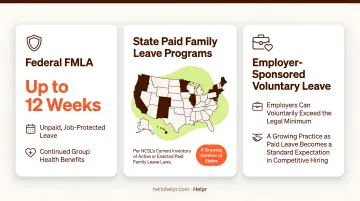
Employers can also voluntarily exceed the legal minimum — a growing practice as paid leave becomes a standard expectation in competitive hiring.
Who Qualifies for Dependent Care Benefits?
IRS-Qualifying Dependents
Under IRS rules, qualifying dependents for a pre-tax dependent care account and the dependent care tax credit include:
- Children under age 13 at the time care is provided
- A spouse who is physically or mentally unable to self-care and lived with the employee for more than half the year
- Any other tax-dependent adult who meets the same incapacity and residency requirements
The Work-Related Test
This requirement causes the most claim rejections. The care must enable the employee, and their spouse if applicable, to work, actively seek employment, or attend school full-time. If care doesn't serve that purpose, it doesn't qualify.
Expenses that do not meet the threshold:
- Overnight summer camps
- Private school tuition (kindergarten and above)
- Enrichment programs, tutoring, or summer school
- Child support payments
Documentation Requirements
Employees must report the care provider's name, address, and EIN or SSN on IRS Form 2441, which is filed with their Form 1040. HR teams should reinforce this requirement during open enrollment. Employees often overlook it until tax season, creating unnecessary delays.
What Do Dependent Care Benefits Cover?
Eligible Expenses
| Expense Category | IRS Treatment |
|---|---|
| Licensed daycare centers | Qualifies if work-related and state-compliant |
| In-home babysitters or nannies | Qualifies when services are for the qualifying person's care |
| Preschool / nursery school | Qualifies below kindergarten level |
| Before- and after-school programs | May qualify as care (kindergarten and above) |
| Summer day camps | Qualifies; overnight camp does not |
| Adult day programs / elder care | Qualifies when incapacity, residency, and work-related tests are met |
| Transportation to/from care | Qualifies when provided by the care provider |
| Agency or application fees | Qualifies when required to obtain eligible care |
| Nanny payroll taxes | Qualifies as part of work-related care expenses |
What's Explicitly Not Covered
Several common expenses fall outside IRS-eligible dependent care — and these are the ones employees most often assume will qualify:
- Overnight summer camps
- Private school tuition (kindergarten and above)
- Food, clothing, or lodging for the dependent
- Tutoring, enrichment, or academic programs
- Medical or nursing care expenses (those belong in a healthcare FSA or HSA)
HR teams should communicate these distinctions proactively. Ineligible claims create extra administrative work and compliance risk, and in most cases, the employee simply wasn't told the rules up front.
The Business Case for Offering Dependent Care Benefits
Retention and Talent Acquisition
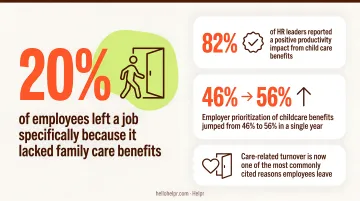
A 2024 benefits survey found that 20% of employees had left a job specifically because it lacked family care benefits. The same study showed:
- 82% of HR leaders reported a positive productivity impact from child care benefits
- Employer prioritization of childcare benefits jumped from 46% to 56% in a single year
- Care-related turnover is now one of the most commonly cited reasons employees leave
In competitive talent markets, dependent care has shifted from a differentiator to a baseline expectation for many candidates.
Absenteeism and Productivity
Eight lost workdays per parent per year adds up fast at scale. Multiply that across even a modest workforce of 500 working parents and you're looking at 4,000 workdays of disrupted productivity annually, before accounting for cascading effects on team schedules, project timelines, and manager bandwidth.
Backup care directly addresses this. When an employee's care arrangement fails at 7am, they need a working solution by 9am. A reimbursement form they can submit in two weeks doesn't help them show up today.
Employer Tax Savings
Pre-tax account contributions are exempt from FICA. For every dollar an employee redirects to the account, the employer avoids paying 7.65% in Social Security and Medicare taxes on that amount (the combined employer FICA rate below the $184,500 wage base).
Simple example: If 100 employees each elect $5,000 into a pre-tax dependent care account, the employer's FICA savings total approximately $38,250 — simply from having the plan in place. That offsets a meaningful portion of any plan administration costs.
Equity and Culture
Not all employees have equal access to care options. An employee in a major metro has more provider choices than one in a rural location. A salaried professional can absorb a bad care day differently than an hourly worker who loses income if they can't show up.
Helpr's model addresses this structurally. The same $5/hour copay applies regardless of role or salary. The Care Finder service has no copay. The platform's mobile-first design works for frontline employees who aren't sitting at a desktop. Equitable access to care has to be built into how the benefit works, not just written into a policy document.
How to Set Up a Dependent Care Benefits Program
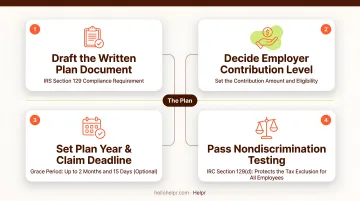
Step 1: Design and Establish the Plan
Work with a benefits broker or third-party administrator (TPA) to:
- Draft a written dependent care plan document (required for IRS Section 129 compliance)
- Decide whether the employer will contribute, and at what level
- Set the plan year, claim deadline, and grace period (optional; up to 2 months and 15 days)
- Ensure the plan passes nondiscrimination testing under IRC Section 129(d) — plans that favor highly compensated employees lose the tax exclusion for those employees
Step 2: Communicate During Open Enrollment
Employees can only elect or change these contributions during annual open enrollment or after a qualifying life event — marriage, divorce, birth or adoption, change in employment status, or loss of a care arrangement.
Many eligible employees skip these accounts simply because they don't understand how they work. HR teams that proactively explain the pre-tax savings in concrete dollar terms (not just percentages) see higher enrollment rates.
Step 3: Administer and Monitor Compliance
The plan sponsor — typically the employer or their TPA — handles reimbursements, documentation, and annual nondiscrimination testing. Unused balances are forfeited at year-end (or at the end of the grace period, if offered). Those forfeited funds stay with the plan sponsor.
Step 4: Pair the Pre-Tax Account with Backup Care
With the administrative structure in place, consider what happens when employees' regular care arrangements break down. A pre-tax dependent care account reimburses eligible care expenses — it doesn't cover a last-minute provider cancellation at 7am.
The two tools solve different problems. Pairing the account with a backup care platform like Helpr gives employees both financial coverage for predictable expenses and on-demand logistical support when their care plan fails. That combination is what makes a dependent care strategy complete.
Frequently Asked Questions
What is the meaning of dependent care?
Dependent care refers to the supervision or support provided to someone who cannot fully care for themselves — such as a child under 13, a disabled spouse, or an incapacitated adult — so the primary caregiver can work or seek employment.
What is an example of dependent care benefits?
A common example is a pre-tax dependent care account that lets an employee set aside pre-tax dollars for daycare costs. Another is an employer-sponsored backup care program: platforms like Helpr connect employees with vetted caregivers when their regular provider is unavailable.
Why do I have dependent care benefits on my W-2?
If your employer offers a pre-tax dependent care account or pays for dependent care on your behalf, the total is reported in Box 10 of your W-2. The IRS uses this figure to verify you haven't exceeded the annual exclusion limit when you file your taxes.
Can employers contribute to a pre-tax dependent care account?
Yes, if the plan document allows it. The combined employer and employee contributions cannot exceed the IRS annual maximum: $7,500 for single filers and married filing jointly, or $3,750 for married filing separately in 2026.
What is the difference between a pre-tax dependent care account and the child and dependent care tax credit?
A pre-tax dependent care account uses pre-tax payroll contributions administered by the employer. The child and dependent care tax credit is claimed on an individual's tax return. Employees cannot claim the credit for expenses already reimbursed through that account.
What happens to unused pre-tax dependent care account funds at the end of the year?
Unlike HSAs, these funds don't roll over. Unused balances are forfeited to the plan sponsor at year-end — or at the end of the grace period (up to 2.5 months), if the employer offers one.