
Introduction
A dependent care FSA can reimburse certain work-related care expenses tied to private school, but it generally does not cover private school tuition itself. That single distinction confuses more families than almost any other benefits question.
This guide is for U.S. employees, working parents, and benefits teams trying to classify private school bills correctly. Getting it wrong means denied claims, unexpected tax consequences, or funds left unused at the end of the plan year.
We'll cover the difference between education and custodial care, eligibility rules, and the documentation you'll need. You'll also see common exceptions and when another care benefit may fit better.
Key Takeaways
- Private school tuition is education, not care, and usually isn't reimbursable through a dependent care FSA.
- Before- and after-school supervision may qualify if it enables you (and your spouse) to work.
- Eligibility depends on child age, the charge's purpose, provider documentation, and plan terms.
- Ask schools to itemize tuition vs. care, then confirm gray-area costs with your plan administrator.
What Is a Dependent Care FSA?
A dependent care flexible spending account (DCFSA) is an employer-sponsored, pre-tax benefit. It lets you set aside part of your paycheck, before taxes, to pay for care expenses for a qualifying child or dependent.
It exists so you can afford the care you need to work, look for work, or attend school—not as a catch-all for every cost of raising or educating a child.
How It Differs From Other Benefits
People frequently confuse a DCFSA with other accounts. Here's the quick breakdown:
- Healthcare FSA — covers medical expenses, not childcare or dependent care
- 529 education account — built specifically for education savings and tuition
- Employer tuition assistance — some employers offer up to $5,250 pre-tax for tuition, books, fees, and supplies under educational assistance programs, separate from a DCFSA
- Child and Dependent Care Credit — a tax credit claimed on your return, not a payroll deduction, and it can't be used on the same dollars already reimbursed through your DCFSA
A DCFSA reimburses qualifying care, not every expense tied to raising, educating, or transporting a child. For private school families, that distinction decides what you can and can't claim.
Contribution Limits and Rules Change — Check Current Figures
The IRS updates dependent care limits periodically. According to IRS Publication 15-B, the annual dependent care exclusion for 2026 is $7,500 (or $3,750 if married filing separately). Don't assume last year's number still applies.
Before you elect a contribution amount, verify:
- Current annual contribution limits with your plan administrator
- Dependent definitions under your specific plan
- Whether your plan offers a carryover or grace period
- Claim submission deadlines
Plan rules vary. What your coworker's employer allows may not match yours.
How Private School Expenses Are Evaluated
Every private school charge boils down to one controlling question: is this fee primarily for supervision and care, or primarily for education, instruction, enrichment, or school attendance?
Ordinary tuition for elementary, middle, or high school is an educational expense, not care. IRS Publication 503 applies that rule to kindergarten and every grade above it, with no private-school carve-out.
Certain categories can still qualify when they're billed separately and pass the work-related-care test:
| Charge Type | Classification | Notes |
|---|---|---|
| Preschool or nursery school | Potentially care | Generally treated as care by the IRS |
| Kindergarten tuition or higher | Not care | Classified as education, regardless of provider |
| Before/after-school supervision | Potentially care | Must be separately billed and work-related |
| School-run extended-day programs | Potentially care, not automatic | Must meet care and substantiation rules |
| Care for a dependent incapable of self-care | Potentially care at any age | Different age rules apply |

Age and Dependent Status Still Matter
Even when a school-related fee looks like care, age and dependent status still gate eligibility. A qualifying child generally must be under age 13. For a dependent 13 or older, they must be physically or mentally incapable of self-care and must have lived with you for more than half the year.
The Program's Name Doesn't Decide Anything
A camp, "enrichment club," or "after-school academy" label means nothing on its own. What matters:
- What the fee actually covers (care vs. instruction)
- When the care occurs (during your work hours, not weekends only)
- Whether the child is supervised rather than taught
- Whether you need the care to work or attend school
Per IRS Publication 503, expenses qualify when they are at least partly for a qualifying person's well-being and protection so you can work. Babysitting a 9-year-old during work hours fits; a fee that mainly buys instruction or school attendance does not.
How to Use an FSA for Eligible Private School-Related Care
If you've confirmed a portion of your private school bill is genuinely custodial care, follow these steps to submit it correctly.
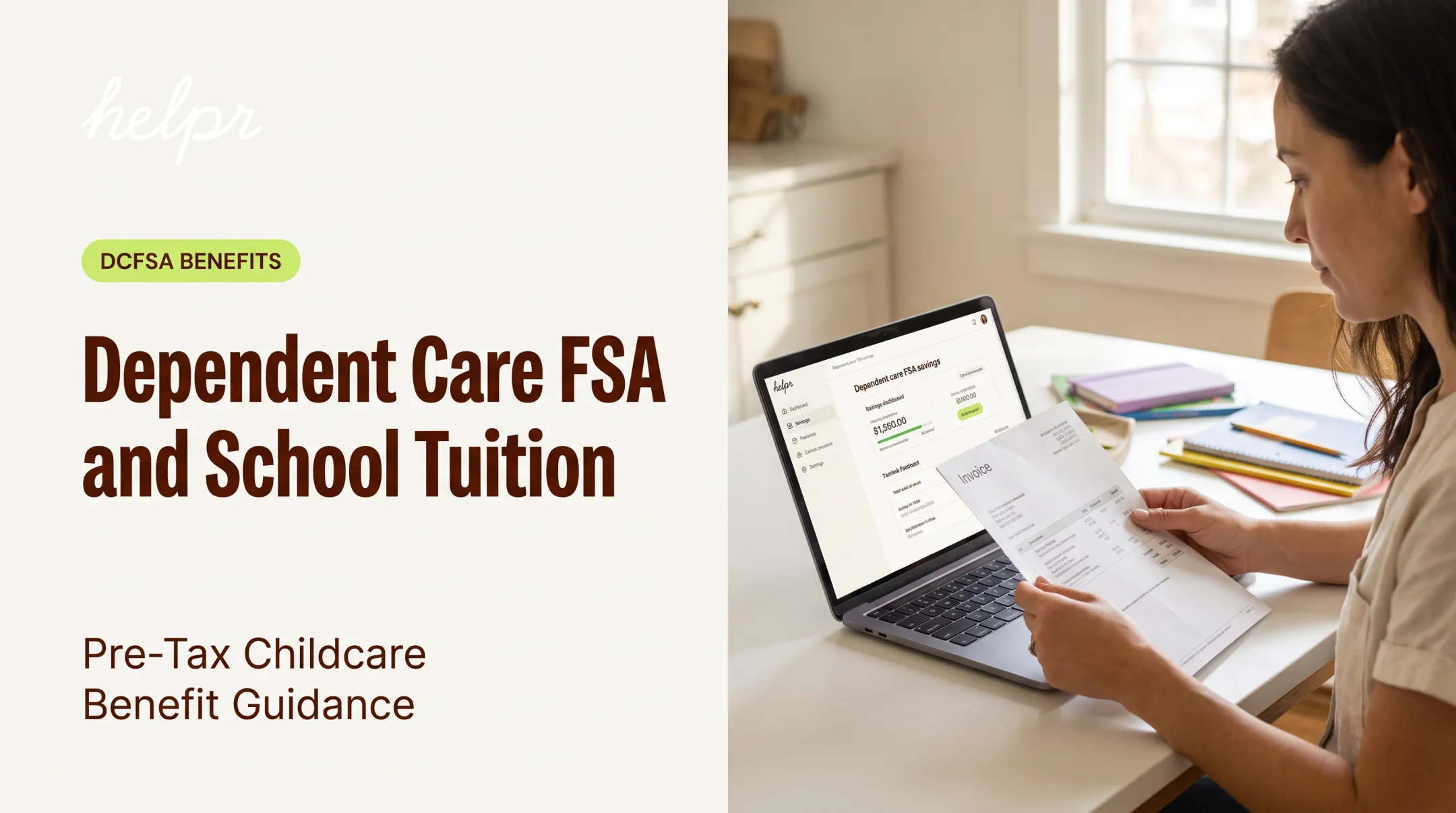
- Get an itemized invoice. Ask the school to separate tuition, registration, meals, transportation, extended-day care, and any camp fees. A single lump-sum bill is a red flag for denial.
- Confirm the provider can supply required details. Your plan administrator typically needs the provider's name, address, taxpayer ID information, dates of service, and amount charged.
- Verify the work-related timing. The care must occur during a period when you (and your spouse, if married) were working, actively job-searching, or a full-time student.
- Submit only the eligible portion. Don't claim the entire tuition invoice. Submit the care-only amount and keep every receipt, statement, and confirmation.

Handling a Combined Tuition-and-Care Bill
Many private schools bundle everything into one number. When that happens, ask the school's business office to allocate the care component separately in writing. Don't estimate or guess.
A simplified illustration: Say a private elementary school charges $18,000 in annual tuition and separately bills $2,400 for an after-school program running 3 p.m. to 6 p.m. daily. The tuition portion is education.
The $2,400 after-care fee may be eligible if it's supervisory and lines up with your work schedule. This is a hypothetical example, not an IRS ruling—confirm your situation with your plan administrator.
This gap between school pickup and the end of the workday is exactly where most eligible care charges live. Many schools end around 2 or 3 p.m., leaving working parents with a real coverage gap that after-school programs are designed to fill.
When you're juggling school invoices and other providers, Helpr's platform lets you route DCFSA-eligible receipts through the app straight to your FSA vendor—so the documentation stays organized in one place.
Key Factors and Common Misconceptions
Before you submit a private-school DCFSA claim, check these factors:
- Age and dependent status — eligibility rules differ for younger children and qualifying incapacitated dependents
- Custodial care vs. education — only care that enables work, job search, or school may qualify; pure education does not
- Timing of care — before-school, after-school, school-break, and summer arrangements are each evaluated separately
- Documentation quality — whether the invoice and provider details satisfy your specific plan and administrator
- No double-dipping — the same expense can't be reimbursed by your DCFSA and claimed for the Child and Dependent Care Credit
Two Misconceptions Worth Correcting
"If I paid it to a school, it must be eligible." Not true. Who you pay does not change what the charge is for. Tuition paid to a private school is still tuition.
"A DCFSA works like an unrestricted education account." It doesn't. Unused funds, reimbursement timing, and plan deadlines limit what you can recover. Some plans allow a grace period into the next plan year; others offer no carryover at all.
When a Dependent Care FSA May Not Be Appropriate
Some expenses sit clearly outside this benefit. Do not submit:
- Regular private school tuition
- Purely educational fees or enrichment programs
- Tutoring services
- Meals billed separately from care
- Any charge unrelated to supervision or enabling you to work
Situations That Need Extra Caution
Watch for these specific scenarios:
- Bundled invoices where the school won't separate tuition from care
- Care from an ineligible provider: payments to your spouse, or to the parent of a qualifying child under 13, don't qualify
- Periods when a spouse is available to provide care without a work or school reason for outside care
- Expenses outside your plan's claim window
DCFSA vs. Tax Credit: Talk to a Professional
The Child and Dependent Care Credit covers up to 35% of qualifying expenses, depending on income. Whether the DCFSA or the credit serves you better depends on your income, number of dependents, contribution amount, and total eligible expenses. A tax professional can run both scenarios for your household.
Where Backup Care Fits In
Even with a DCFSA or the tax credit in place, tax-advantaged accounts don't cover every care gap. School closures, teacher in-service days, and last-minute schedule changes still leave families scrambling. Helpr's backup care benefit gives employers a way to offer short-term childcare for these disruptions, separate from FSA administration. Helpr doesn't decide whether a specific expense qualifies for FSA reimbursement. That call still belongs to your plan administrator and current IRS guidance. Before paying an ambiguous charge, especially when a school can't itemize tuition and care separately, contact your plan administrator first. It's far easier to confirm eligibility upfront than to appeal a denied claim.

Conclusion
Private school tuition and dependent care aren't interchangeable. Tuition is generally an educational expense. Work-related supervision that is separately identified on an invoice may qualify under your plan's rules, but only when it clears the care test, the timing test, and your plan's documentation requirements.
Eligibility always comes down to the same variables:
- Who the dependent is
- What the charge actually pays for
- Whether the care is necessary for your work schedule
- Whether your paperwork holds up
Confirm before you submit. Don't assume every private-school-related line item is reimbursable just because it appears on a school invoice.
Frequently Asked Questions
Can a dependent care FSA be used for tuition?
Generally, no. Ordinary private school tuition pays for education, not care. A separately identified qualifying care charge, like after-school supervision, may be eligible if it meets work-related and plan requirements.
Can I use a dependent care FSA for private school after-care?
Often, yes, if the after-care is separately billed and enables you (or your spouse) to work, seek work, or attend school. The child must also meet the dependent and age requirements.
Is private kindergarten tuition eligible for a dependent care FSA?
No. Kindergarten tuition is classified as education under IRS guidance, not custodial care. Review the exact charge with your plan administrator if you're unsure how a specific fee is categorized.
What private school expenses can a dependent care FSA cover?
Before-school and after-school supervision may qualify when billed separately. Tuition, instruction, tutoring, and enrichment activities generally aren't reimbursable.
What documentation do I need to claim private school-related care?
You'll typically need:
- An itemized invoice with dates of care and amount paid
- Provider name, address, and taxpayer ID
- Any forms your FSA administrator requires
Can I claim private school care through both a dependent care FSA and a tax credit?
No. The same expense generally can't be claimed under both a dependent care FSA and the Child and Dependent Care Credit. Compare options under current IRS rules or with a tax professional.