
Introduction
There's a difference between an attendance problem and a care-access problem. When a child gets sick, a daycare closes without warning, or a babysitter cancels, an employee often has no practical way to show up for work. That's not a motivation issue.
The typical workday runs eight hours. The typical school day ends between 2 and 3 p.m. That gap alone creates a daily scramble for millions of working parents. Up to 73% of employees are also caregivers for children or elderly relatives—this is a workforce-wide issue, not a niche one.
Childcare gaps show up as unplanned absences, late arrivals, early departures, and presenteeism, especially for employees on fixed, frontline, or shift-based schedules. This article covers what causes childcare-related absenteeism, what it costs businesses, and which employer responses reduce those lost days.
Key Takeaways
- Childcare absenteeism usually stems from gaps in affordability, availability, reliability, or schedule coverage.
- Flexible work helps office employees but doesn't replace emergency, backup, or school-break care.
- Pair absence-pattern data with confidential feedback to uncover the real problem.
- Backup care improves attendance only when accessible, trusted, and matched to how employees work.
How Childcare Gaps Create Employee Absenteeism
A childcare gap happens when an employee can't secure safe, affordable, dependable care that matches both the child's needs and their own working hours. This isn't rare. It's structural.
Common disruption points include:
- Child illness, exclusion policies, school closures, holidays, and early dismissals
- Provider cancellations, staffing shortages, and temporary closures
- Long waitlists and limited availability for infants or children with additional needs
- Work schedules that start before providers open or end after they close
A single sick child can cascade into a missed shift, a canceled meeting, a late arrival, or a full day out while the employee still manages a care crisis at home.
This burden isn't distributed evenly. Single parents, lower-paid employees, shift workers, and people who relocated away from family support absorb it disproportionately. Someone with a nearby grandparent has options an employee who moved away from family simply doesn't.
The Data Behind the Disruption
That uneven burden tracks a tight care market, not isolated bad luck:
- Nearly 46% of children under age 6 live in a licensed childcare desert—at least three children per available slot, rising to 65.6% in rural areas, per a Center for American Progress analysis of 2025 licensed supply
- Average U.S. childcare prices hit $13,184 a year in 2025 (Child Care Aware of America), or about 35% of median household income for single parents
The Census Bureau's 2026 analysis of 2024 household data found that families reporting care access problems lost an average of 65.8 days of work time over the year, based on Census Bureau CPS ASEC survey data.
Punitive attendance policies don't repair a broken care market. They mainly discourage employees from saying why they're out.
The Business Impact of Childcare-Related Absences
Uncovered shifts. Missed deadlines. Overtime paid to cover a colleague's gap. Delayed customer response times. These are the direct, line-item costs of childcare-related absences, and they compound fast in operations that run on tight staffing margins.
The indirect costs are harder to spot but often more damaging:
- Stress and burnout among employees juggling unpredictable care logistics
- Disengagement when caregiving feels like it blocks career advancement
- Reduced psychological safety, since employees may hide care struggles from managers
- Retention risk as caregivers cut hours, pass on stretch work, or leave for flexibility
Absenteeism Isn't the Whole Story
An employee physically at their desk while mentally managing a childcare emergency isn't fully productive, even if they never took the day off. This presenteeism often goes untracked, so the true cost of childcare gaps runs higher than absence records show.
ReadyNation's 2026 report, based on a survey of 801 parents of children under age five, found that more than 60% of respondents had arrived late, left early, missed a full day, or been distracted at work because of a childcare issue. The model estimates business losses at $38 billion annually, or roughly $1,970 per working parent, according to ReadyNation's Cost of Child Care Crisis report. That figure reflects a national model, not a guarantee of what any single company experiences.

To estimate your own exposure, combine internal data on:
- Absence frequency and duration tied to care disruptions
- Overtime and temporary staffing costs during those absences
- Missed output or delayed projects
- Turnover among employees with caregiving responsibilities
Break the same patterns down by location, shift, and tenure to see where losses cluster—and where support will pay off first.
How to Diagnose Childcare-Related Absenteeism
Start with the data you already have. Review attendance records for patterns around school calendars, provider closures, and shift start times. Absences that spike every school holiday or every Monday morning aren't random.
Numbers alone won't tell you why. Pair attendance data with confidential listening:
- Anonymous surveys asking which care situations most often interfere with work
- Stay interviews and exit interviews probing access, affordability, and reliability
- Focus groups exploring preferred forms of support, rather than assuming one benefit fits everyone
Separating Long-Term Gaps From Short-Term Needs
Not every disruption has the same root cause. Build a root-cause map that distinguishes:
- Chronic access issues — no available slot, unaffordable tuition, long waitlists
- Short-term backup needs — a sick child, a canceled sitter, a snow day
- Adjacent factors — transportation gaps, eldercare duties, inflexible scheduling
Collect only what you need. Employees shouldn't have to disclose sensitive family details to their direct manager to get help. Communicate clearly how responses will be used, and keep individual answers confidential.
Sample non-intrusive questions for an HR survey:
- In the past six months, has a childcare disruption affected your ability to work as scheduled?
- What type of care situation most often creates conflict with your work hours?
- Would backup care, more schedule notice, or flexible hours help most?
- Do you feel comfortable telling your manager when a care issue affects your availability?
Strategies Employers Can Use to Close Childcare Gaps
Two categories of support matter most: short-notice backup care and coverage for predictable pressure points.
- Sudden disruptions: Backup care for sick-child days, caregiver cancellations, and last-minute gaps. Define eligibility, booking timelines, safety standards, and where coverage is available.
- Predictable strain points: Support for school holidays, summer breaks, early-dismissal days, and return-to-work transitions after parental leave.
Build for the Whole Workforce, Not Just Salaried Staff
A benefit that only works for remote, salaried employees leaves out the frontline and shift workers who often need it most. Review:
- Subsidies and copayments for affordability across pay levels
- Minimum notice requirements for shift workers who can't plan far ahead
- Booking procedures that don't require desktop access or business hours
Pairing childcare benefits with operational flexibility—shift swaps, predictable scheduling, paid caregiving leave, and manager training—makes both pieces more effective together than either alone.

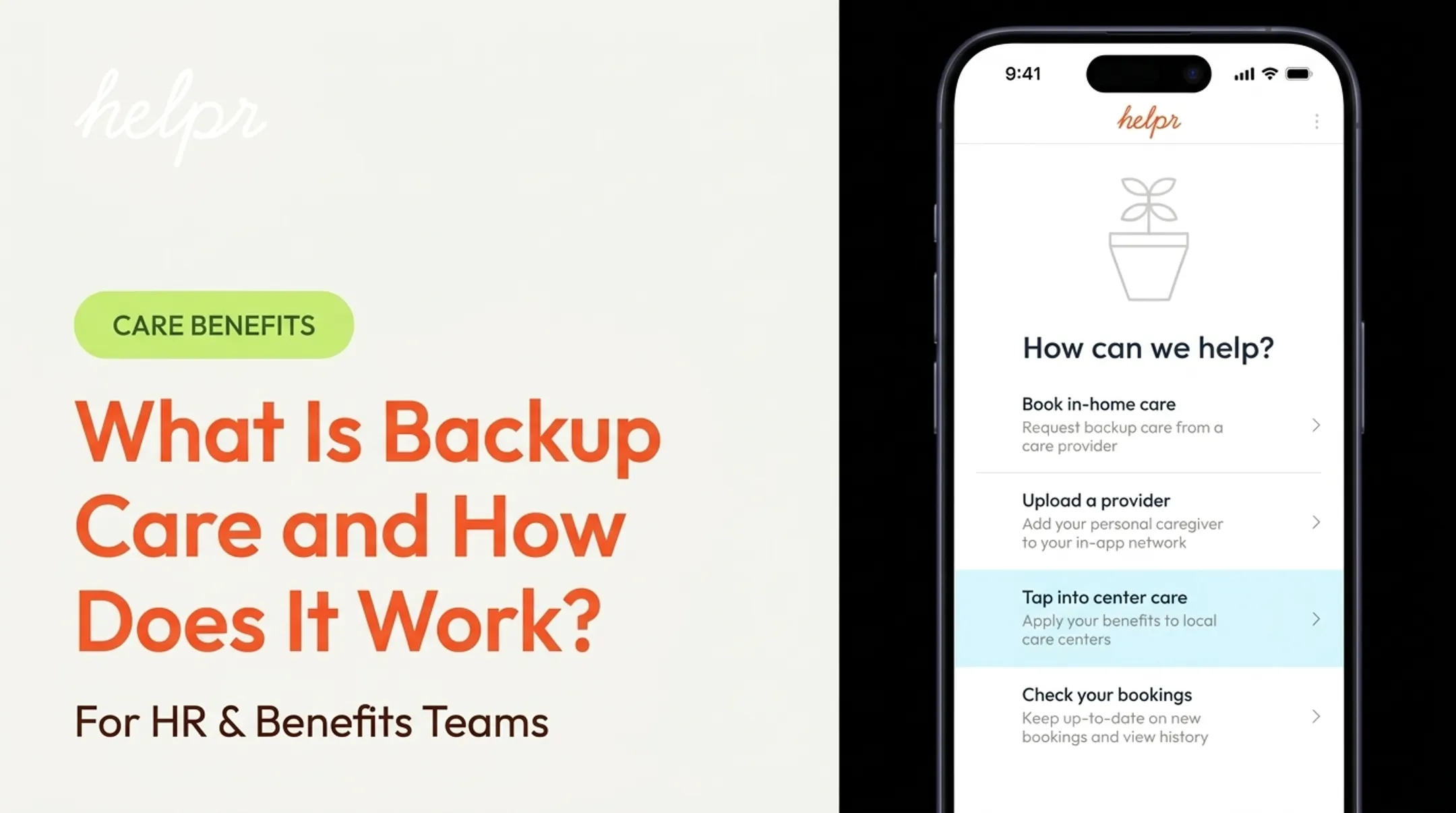
Those design choices also shape what to look for in a care platform. Helpr connects employees with backup childcare and other dependent-care options in ways that match whole-workforce needs:
- Mobile-first booking with a vetted provider network
- Patented "My Choice" technology so employees can select trusted providers, including personal caregivers
- Use-based pricing—employers pay for care delivered, not a flat allotment
Confirm coverage, pricing, and eligibility directly with Helpr, since programs vary by employer.
Does This Actually Work?
Evidence from employers already running these programs is encouraging. BCG's 2024 study of five companies—including Etsy, Synchrony, and UPS—combined financial analysis with roughly 1,000 employee survey responses.
Surveyed employees reported avoiding up to 13 work absences per year when childcare disruptions were resolved. UPS's onsite emergency childcare pilot at one Northern California facility reportedly avoided an average of three employee absences per day over three months, according to BCG's childcare benefits research.
These are survey-reported outcomes, not a randomized causal study. Still, the pattern is strong enough to test internally.
Building a Sustainable Response
Don't roll out a company-wide benefit overnight. Start with a defined pilot: pick one workforce segment or disruption type, set a baseline, and choose a review date before scaling.
Track measures that actually indicate progress:
- Benefit utilization rates
- Unplanned absence frequency before and after rollout
- Short-notice shift coverage success
- Retention among employees identified as caregivers
- Manager-reported disruption levels
Low utilization doesn't always mean low demand. It can mean employees don't know the benefit exists, the booking process is clunky, or eligibility rules are too restrictive to build trust.
Those signals should feed a standing governance group. Include HR, benefits, operations, legal, and employee representatives to review safety standards, equitable access, and vendor performance on an ongoing basis.

Keep perspective: employer-sponsored backup care is a targeted workforce benefit. It is not a substitute for adequate public childcare investment or the long-term arrangement each family ultimately prefers.
Frequently Asked Questions
Is it better for babies to be in daycare or stay at home?
There's no universal answer. It depends on the child's needs, family circumstances, care quality, affordability, and the caregivers' work situation. Both arrangements can work well when they're safe and consistent.
When should a child stop daycare?
There's no fixed stopping age. Families typically reassess around school transitions, developmental milestones, or when a care arrangement no longer fits the child's needs or the family's schedule.
How many days can a child miss in NC?
Attendance rules vary by North Carolina district, school type, and grade level, and local boards set their own policies for converting tardies to absences. Check directly with your child's school or district for current requirements.
How can employers reduce absenteeism caused by childcare gaps?
Combine backup care, predictable scheduling, caregiving leave, school-break support, and confidential tracking of care-related disruptions. No single tactic solves it alone.
Do childcare benefits actually improve employee attendance?
Yes—when the benefit is reliable, affordable, and actually covers the gap. BCG research found employers reported fewer absences after adding backup care, though results vary by program design and workforce.