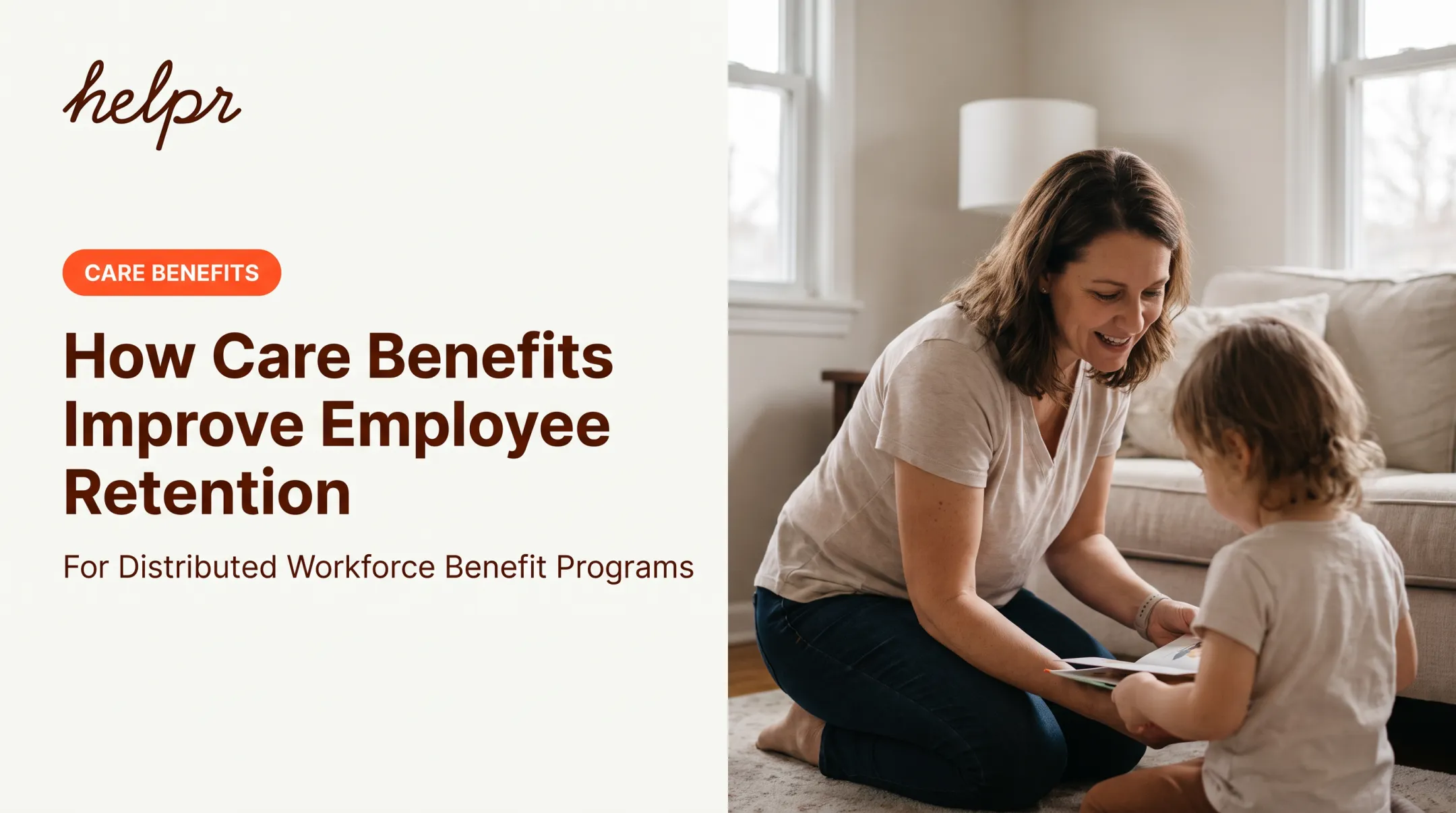

This isn't a fringe issue. 34% of working mothers cited childcare concerns as a top reason for voluntarily leaving the workforce, compared to 20% of fathers, according to McKinsey research on the childcare conundrum. Add return-to-office mandates and unpredictable school schedules, and retention becomes a daily operational challenge.
Care benefits get framed as a nice-to-have, a "people-first" initiative buried in the benefits guide. But the real value shows up in fewer preventable absences, smoother returns from leave, and employees who stay in the promotion pipeline instead of quietly stepping back.
This article covers what care benefits actually include, which ones move the retention needle, what happens when they're missing, and how to build a program that's equitable and measurable.
Key Takeaways
- Backup childcare, elder care, paid leave, and flexibility cut care disruptions that push mothers out
- Flexibility helps, but it can't replace bookable care when arrangements fall through
- Track usage with retention, absenteeism, return-to-work, and progression—not enrollment alone
- Equitable access for hourly, frontline, remote, and salaried roles makes a program credible, not symbolic
What Are Care Benefits (Brief Context)
Care benefits are employer-sponsored policies, services, or financial support that help employees manage childcare, elder care, and family-care transitions. They're not generic perks. A gym membership doesn't solve a closed daycare. A benefit only counts as a care benefit if it removes a specific caregiving barrier.
These benefits typically show up at predictable pressure points:
| Life Stage/Event | Common Care Benefit |
|---|---|
| Pregnancy and parental leave | Paid leave, lactation support |
| Return to work | Phased return, backup childcare |
| School closures or sick child | Backup care, flexible scheduling |
| Elder-care responsibility | Adult dependent care, respite support |
| Ongoing caregiving | Care stipends, DCFSA integration |
The goal is continuity when regular care falls through. A working parent who can book emergency care in an afternoon stays productive. One who has to cobble together favors from neighbors often burns PTO, misses deadlines, or quietly disengages.
Key Advantages of Care Benefits
The care benefits that matter most are the ones tied to numbers HR already tracks: turnover, attendance, engagement, and who gets promoted. Here's how each advantage plays out.
Reduce Preventable Turnover and Strengthen Retention
When regular childcare falls through and there's no backup, mothers often face an ultimatum they didn't ask for: reduce hours, decline a promotion, or leave entirely. Reliable care support removes that ultimatum.
The retention pathway is straightforward. Reliable care reduces disruption and stress, helps employees maintain consistent hours, and shows the organization is invested in keeping them.
A BCG study of five US employers found childcare-benefit ROI ranging from 90% to 425%, with up to 86% of respondents saying the benefit made them more likely to stay.

Replacing an experienced employee isn't cheap either. SHRM estimates replacement costs at 50% to 200% of annual salary, depending on seniority.
KPIs to watch:
- Voluntary turnover among working mothers
- Retention rates 6 and 12 months after parental leave
- Benefit enrollment and actual usage
- Stated intent to stay (pulse surveys)
This advantage matters most during high-risk transitions: the first months back from leave, a school schedule change, or a caregiver suddenly becoming unavailable.
Reduce Absenteeism and Protect Productivity
Flexible scheduling helps. Remote work helps. But neither one manufactures a caregiver out of thin air. If there's no one to watch a sick child, flexibility just moves the problem around the calendar.
SHRM's 2025 survey of working caregivers found that 32% had work interrupted by unpredictable care needs. Another 48% used vacation or personal days for caregiving they couldn't plan around, according to SHRM's Care and Careers report. That's PTO burned on emergencies, not rest.
Consider a school closure for a teacher planning day. Without backup care, a parent either misses work entirely or works distracted from a kitchen table while managing a bored eight-year-old. With a backup-care benefit, that same booking can take an afternoon instead of a full day.
KPIs to watch:
- Absenteeism and unscheduled leave rates
- Missed shifts (especially in frontline roles)
- Self-reported productivity and focus scores
The stakes are highest in shift-based and frontline environments: healthcare, retail, manufacturing, and hospitality. One missed shift creates an immediate coverage gap, not just a delayed email response.
Support Equitable Career Continuity and Engagement
Career penalties for parenthood aren't always explicit. They show up when a mother turns down a stretch assignment because she can't guarantee availability, or skips a conference because there's no one to cover an eldercare appointment that week.
SHRM's caregiver data shows 17% turned down business travel and 15% missed work-related training due to caregiving duties. Multiply that across a few years, and it's a visible gap in a promotion file.
Care benefits work alongside other supports to close that gap:
- Transparent promotion criteria that don't penalize leave usage
- Phased returns from parental leave
- Manager training on caregiving conversations
- Parent or caregiver employee resource groups
In BCG's study, 78% of respondents said the peace of mind from childcare benefits gave their careers a boost—more willingness to take on tough assignments, more ambition, less second-guessing.
KPIs to watch:
- Promotion rates among working mothers
- Development-program participation
- Return-to-work rates after leave
- Representation of mothers in management pipelines
Watch these closest in the first year post-leave, during promotion cycles, and whenever return-to-office policies shift expectations without warning.
What Happens When Care Benefits Are Missing or Ignored
Missing care support doesn't create one problem. It creates a chain reaction.
It usually starts small: a last-minute absence, then a pattern of schedule instability, then uneven team coverage that frustrates managers and coworkers alike. From there, employees start making trade-offs they shouldn't have to make.

SHRM's caregiver survey found that without adequate support:
- 28% reduced their working hours
- 21% reduced their workload
- 14% changed jobs entirely for more flexibility
- 47% said they'd switch jobs for better caregiving support, even if it meant a career change
Those outcomes are only half the story. Benefits can fail even when they technically exist.
If eligibility rules are confusing, managers subtly discourage usage, or hourly and frontline workers are excluded by design, the benefit becomes decoration. Employees hide caregiving struggles until they surface as a "performance issue"—which is really an access issue in disguise.
How to Get the Most Value from Care Benefits
Care benefits work best as a coordinated program, not a line item. That means understanding what employees actually need, making access simple, and reviewing outcomes regularly.
Start With Employee Needs and Equitable Eligibility
Use listening sessions, anonymous surveys, and exit interviews to find the most common care barriers. Then check the access gap directly:
- Can hourly and part-time employees use this benefit the same way salaried staff can?
- Does it reach remote and geographically distributed teams?
- Is eldercare included, or just childcare?
Prioritize based on frequency and disruption. Backup childcare and elder-care support usually rank highest.
Needs data only pays off if employees can act on it quickly.
Make Access Simple
A benefit nobody understands doesn't get used. Explain eligibility, booking steps, and reimbursement rules in plain language, before employees are in crisis mode. Build it into onboarding, parental-leave planning, and return-to-work check-ins.
This is where a centralized platform earns its keep. Helpr, for example, connects employees with backup childcare and elder-care support through its "My Choice" technology, a vetted care network with use-based payment.
Employers pay for care actually used rather than a flat, underused line item, and the same access path works for hourly, remote, and on-site staff.

Measure Usage and Business Outcomes
Set a baseline, then track:
- Benefit usage rates by role, location, and tenure
- Retention after parental leave
- Voluntary turnover and absenteeism trends
- Return-to-work rates and engagement scores
Segment carefully, but protect privacy. On small teams, thin cuts can make individual employees identifiable.
When you can, benchmark against published signals. SHRM reports that KinderCare's subsidized childcare benefit correlated with users being 30% less likely to leave, based on internal company data. Treat figures like this as directional, not proof of causation.
Build a Culture That Makes Benefits Usable
Train managers to respond to caregiving needs consistently, without assuming a caregiving employee is less ambitious. Pair the benefit with predictable flexibility, fair accommodations, and caregiver ERGs.
Keep messaging inclusive. Fathers, adoptive parents, guardians, and employees caring for aging relatives use these benefits too, even while working mothers' retention risk stays a clear priority.
Conclusion
Retaining working mothers comes down to reducing the daily friction between work and caregiving. A longer benefits list will not fix that friction on its own.
Care benefits deliver value when access is reliable, equitable across every role and location, and backed by flexible scheduling, trained managers, and fair promotion practices. None of these work in isolation.
Treat care support as an ongoing practice:
- Listen to employees about real care barriers
- Measure what actually changes after rollout
- Fix access gaps as they surface
Platforms like Helpr can handle the logistics of dependable backup care, but retention still depends on whether employees trust the benefit is there when they need it.
Frequently Asked Questions
What are the 5 C's of employee retention?
The framework typically includes commitment, compensation, career growth, culture, and communication (terminology varies by source). Care benefits, manager support, and career continuity map directly onto commitment, culture, and career growth.
What can I do if I'm struggling at work after maternity leave?
Talk to HR or your manager about a phased return, adjusted workload, lactation accommodations, and backup-care resources. Review your workplace's specific policies and applicable rights before the conversation.
Which care benefits are most effective for retaining working mothers?
Paid parental leave, backup childcare, and predictable scheduling tend to have the strongest impact, though effectiveness depends on how easy the benefit is to access. Elder-care support and return-to-work programs matter most for employees juggling multiple caregiving roles.
How can employers measure whether care benefits improve retention?
Track retention after parental leave, voluntary turnover, benefit usage, absenteeism, and engagement scores. Segment results fairly by role and location, and pair the numbers with qualitative employee feedback.
Are care benefits only for working mothers?
No. Effective programs cover fathers, adoptive parents, guardians, and employees caring for aging relatives. Working mothers still face distinct retention risks, so programs should stay attentive to that reality while remaining inclusive.