
Care needs are personal and urgent. A parent scrambling for backup care after a school closure doesn't have time to dig through a benefits portal. An employee quietly managing a parent's declining health may not even know elder care support exists. An estimated 63 million U.S. adults provided care to a family member in the past year, and half of working caregivers said it affected their attendance or focus on the job. A single open-enrollment email won't reach people at the moment they actually need help.
This article covers what care benefits communication means, why it matters, a practical 7 C's framework, the most effective delivery methods, and how to build and measure a year-round plan.
Key Takeaways
- Clear, timely care benefits messages work best when they end with one specific next step.
- Segment messaging for hourly, remote, and multilingual employees—one-size-fits-all announcements miss them.
- Year-round reminders, trained managers, and one trusted resource raise awareness and usage.
- Track activity (opens, visits) and outcomes (sign-ups, utilization, confidence) to prove communication works.
What Is Employee Benefits Communication?
Employee benefits communication is the planned process of explaining what's available, who qualifies, what it costs, and how to use it, in language people actually understand. Listing a benefit in a PDF handbook and hoping employees find it is not enough.
For care benefits specifically, that means childcare, backup care, elder care, dependent care FSAs, and caregiver support resources. These benefits carry extra weight: they're often used during stressful, time-sensitive moments, not planned ones.
The Communication Journey Employees Actually Need
Getting an employee from "I have a problem" to "I got help" requires several connected steps:
- Recognize they have a care challenge worth addressing
- Learn that employer-provided support exists for that challenge
- Confirm they're eligible and understand what it covers
- Find the exact steps to access it
- Act with enough confidence to actually follow through

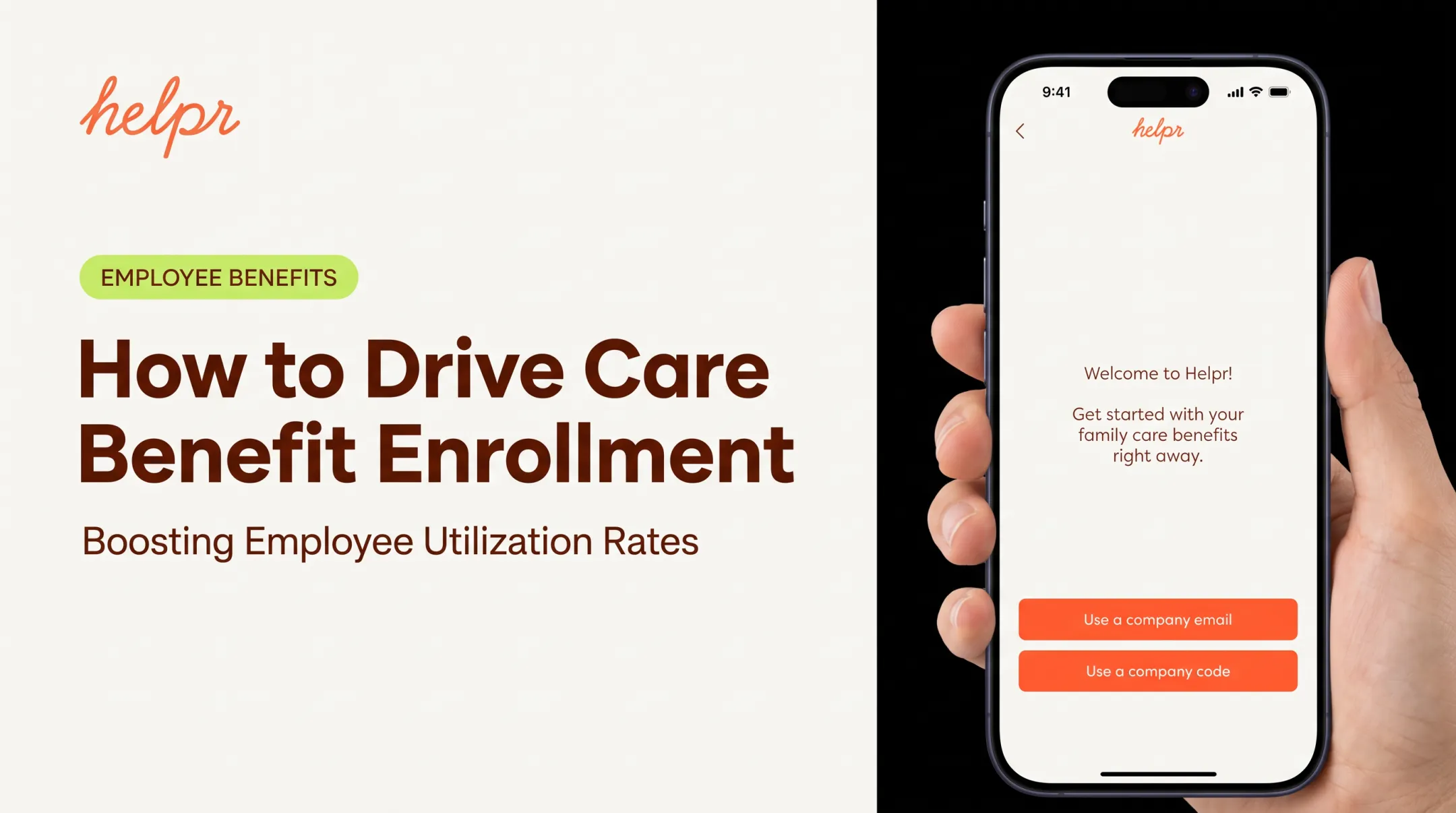
Skip any one of those steps in your messaging, and utilization drops. Helpr's onboarding flow is built around that path. It walks employees from benefit activation through booking backup care or uploading a trusted provider in a few guided steps, instead of leaving them to decode a policy document alone.
Why Communicating Care Benefits to Employees Matters
Care disruptions don't wait for a convenient time. A caregiver cancellation on a Tuesday morning becomes an attendance problem within the hour, unless the employee already knows where to turn.
The Real Cost of Care Disruptions
Half of working caregivers report attendance or focus impacts tied to caregiving responsibilities. SHRM's 2025 research on working caregivers found that in the prior year:
- 28% reduced their working hours to keep up with care demands
- 21% reduced their workload for the same reason
- 35% felt discomfort seeking caregiver resources from their employer, even when those resources existed
That discomfort gap matters as much as the benefit design itself. A benefit employees are too uneasy to ask about might as well not exist.
Trust Is Built (or Broken) in the Details
When employees can't easily find how a benefit works, they assume it doesn't apply to them or isn't worth the hassle. Many also worry it requires oversharing personal details. Good communication reverses that. It should reassure employees about privacy and never pressure anyone to disclose family circumstances just to access support.
Equity Gaps Widen Without a Deliberate Plan
Email-first communication quietly excludes large parts of the workforce. In one national survey of deskless workers, 32% said their employer communicated with them less effectively than with office staff, and 25% didn't know where to find critical information at all.
That gap hits hourly, frontline, remote, and multilingual employees hardest, exactly the groups care benefits are meant to serve. Helpr's platform is built with universal eligibility in mind, covering employees from hourly staff to executives across every location. That only pays off if communication reaches everyone equally.
The 7 C's of Communicating Care Benefits to Employees
There's no single certified industry standard for care benefits messaging, so we built this framework for communicating sensitive, time-critical care support.
Clear
Skip the benefits jargon. State plainly who the benefit is for, what type of care it covers, and how to start.
Concise
One message, one purpose, one call to action. Don't cram every care program into a single dense email.
Consistent
Give HR, managers, and internal comms the same approved talking points on eligibility, cost, and where to go for help. Mixed messages erode trust fast.
Contextual
Time messages to real moments: onboarding, school breaks, open enrollment, return from leave, or a sudden care gap. A reminder during relocation season hits differently than one buried in a January newsletter.
Convenient
Make it mobile-friendly and accessible without a company laptop. Include direct links, short instructions, and language support for non-English speakers.
Compassionate
Care challenges are stressful. Language should reassure, never imply that needing care support signals a lack of commitment to the job.
Actionable
Every message needs a next step: check eligibility, register, book care, or contact support. Information without direction gets ignored.
Most Effective Methods for Communicating Care Benefits to Employees
Knowing the 7 C's is one thing. Getting the delivery right is another.
- Use multiple channels deliberately. Email for detail, SMS or push notifications for time-sensitive reminders, manager huddles for frontline teams, and a benefits hub for anything evergreen.
- Segment your audience. New hires, parents, adult caregivers, hourly workers, and remote staff all need different messaging. Don't assume family structure or caregiving status.
- Lead with outcomes, not administration. Tell employees what the benefit helps them do, such as last-minute backup care or elder care guidance, before explaining plan mechanics.
- Use realistic scenarios. School closures, caregiver cancellations, and aging-parent needs are relatable entry points. Keep examples inclusive and never promise coverage the plan doesn't provide.
Support and reinforcement matter as much as the first message:
- Offer a real human option. FAQs can't answer everything. Live Q&A, office hours, or a dedicated support line help with questions people won't put in writing.
- Consolidate everything in one trusted place. Keep eligibility, costs, access steps, and contacts in one mobile-friendly hub. Helpr, for example, centralizes childcare, elder care, and backup care in one app, with 90% of support tickets answered within two hours.
- Repeat, don't announce once. Refresh messaging around school transitions, caregiver awareness periods, and open enrollment instead of a single kickoff email.
- Equip managers with talking points, not expertise. A short script and a clear escalation path let managers raise awareness without asking employees to explain private circumstances.
How to Build a Year-Round Care Benefits Communication Plan
A single launch email won't sustain awareness. Build a calendar instead.
- Audit what's broken first. Pull HR support-ticket themes, run a pulse survey, and check utilization data to see where confusion is concentrated.
- Map campaigns to real care moments. Give each real care moment its own touchpoint: preboarding, onboarding, open enrollment, school transitions, holidays, return from leave, and periodic "how to request support" reminders.
- Assign ownership to every campaign. Each one needs a specific audience, message, channel, owner, launch date, and follow-up date, plus a legal and accessibility review.
- Sequence each campaign in stages. Introduce the benefit, explain eligibility and value, show exactly how to access it, send a reminder, then follow up with support after employees engage.

Helpr's customer feedback tool asks employees how they first heard about the benefit: a coworker, HR, a manager, or company communication. That gives HR teams a direct read on which channels are actually landing.
How to Measure and Improve Care Benefits Communication
Reach isn't the same as understanding. Track both.
Activity metrics show whether messages are getting delivered:
- Email open and click rates
- Attendance at info sessions or webinars
- Visits to the care-benefits hub
- Completed registrations and questions submitted
Outcome metrics show whether communication is actually changing behavior:
- Benefit inquiries and care requests over time
- Utilization and repeat use
- Time between first inquiry and accessing support
- Employee-reported confidence and satisfaction
Compare results across employee groups. If utilization lags among hourly or remote staff, that's a channel or access problem, not a lack of need.

Helpr's feedback tools ask users how they first learned about the benefit and what impact it had: reduced stress, easier scheduling, or fewer missed workdays. That gives HR teams a concrete feedback loop instead of a guess.
Turn those insights into action:
- Rewrite FAQs that keep coming up
- Adjust message timing and channels by group
- Close recurring access gaps
Frequently Asked Questions
What are the most effective methods for communicating benefits to employees?
Segment your audience, use plain language, and deploy multiple channels—not just email. Repeat messages year-round, equip managers with talking points, and centralize details in one resource with a clear call to action.
What are the key principles (7 C's) for communicating care benefits to employees?
The seven principles are clear, concise, consistent, contextual, convenient, compassionate, and actionable. Together, they make care information easier for employees to trust, understand, and act on quickly.
What is employee benefits communication?
It's the planned, accurate delivery of information about available benefits, eligibility, cost, and access steps. For care benefits specifically, that includes childcare, backup care, elder care, and dependent care support.
What are the benefits of effective communication with employees?
Clear communication improves awareness, confidence, and benefit utilization. It also strengthens how supported employees feel at work when they know how to find and use care benefits.