
Here's where the confusion starts: not every expense tied to a child or dependent actually qualifies. Eligibility hinges on the dependent's status, why the care is happening, your work situation, and what your employer's specific plan allows.
This guide walks through eligible expenses, common exclusions, documentation rules, timing requirements, and how to double-check an expense before you submit a claim. Federal tax rules set the outer boundaries, but your plan document has the final say.
Key Takeaways
- Care must enable you (or your spouse) to work, look for work, or attend school full-time
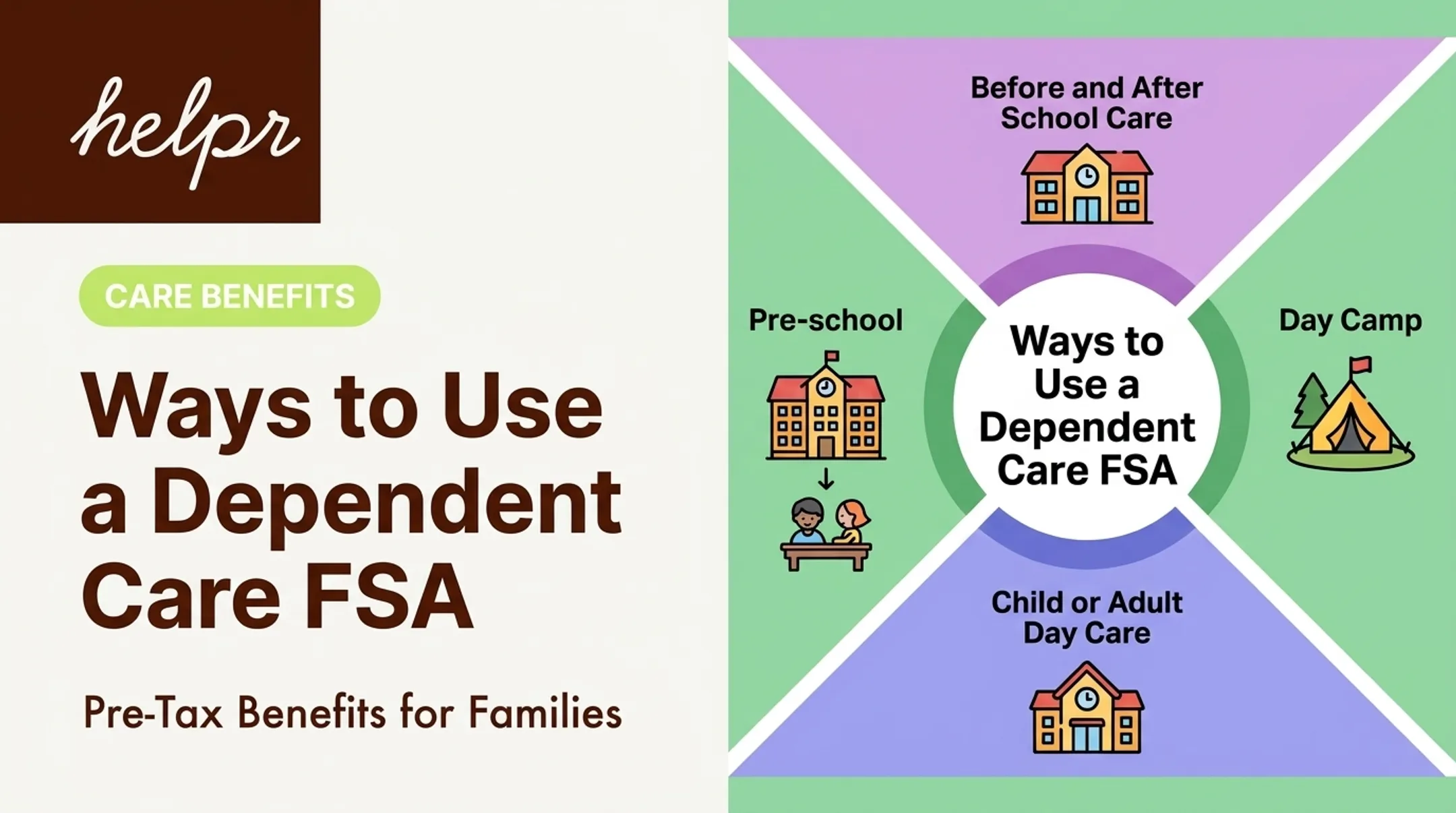
- Eligible costs include daycare, preschool, before/after-school care, babysitting, nanny care, and day camps
- The recipient must be a child under 13 or a spouse/dependent who cannot self-care
- Keep third-party records: provider name, dates, service description, and amount paid
- Employer plan rules can be stricter than federal law, so confirm before you contribute
What Can a Dependent Care FSA Be Used For?
The core eligibility test has four parts. The expense must:
- Care for the well-being of a qualifying individual
- Be work-related, meaning it enables you or your spouse to work or look for work
- Not be reimbursed through another source
- Be permitted under your specific employer's plan
According to IRS Publication 503, several categories of care commonly meet this test.
Childcare, Preschool, and Nursery School
Licensed daycare centers, preschools, and nursery school programs for kids below kindergarten age typically qualify. This holds even if the program includes incidental lunch or light educational activities, as long as those extras aren't billed separately from the care charge.
Before- and After-School Supervision
Once a child reaches kindergarten, tuition itself stops qualifying. But supervision before or after the school day (the part that lets you finish your workday) generally remains eligible, since it's treated as separate from instruction.
In-Home Care
A babysitter, nanny, or au pair can qualify when the primary purpose of their work is caring for your dependent, not housekeeping or other tasks. Keep in mind:
- Provider eligibility rules still apply
- Household-employment tax obligations may kick in if you're paying a nanny directly
- A housekeeper who also babysits a 9-year-old while you're at work generally qualifies; one who only mows the lawn does not
Day Camps
Day camps (including specialty camps focused on sports, coding, or art) are usually eligible. Overnight camp is not, regardless of the activity focus.
Adult Day Care
Adult day care can qualify for a spouse or tax dependent who can't care for themselves, as long as they meet the residency and work-related requirements covered in the next section.
The quick test: the same $200 payment to a summer program can qualify or fail depending on its primary purpose. If it's mostly supervision and care, it likely qualifies. If it's mostly instruction (like a coding bootcamp with minimal supervision) or entertainment, it probably doesn't.
How to Determine Whether an Expense Qualifies
Run any expense through this four-part check:
- Identify the qualifying individual
- Confirm the service is primarily care
- Verify it enables work
- Check your plan document

Qualifying Individuals
There are three categories:
- A dependent child under age 13 at the time care is provided
- A spouse physically or mentally unable to care for themselves
- A tax dependent of any age unable to self-care, subject to gross-income and support tests
For care provided outside the home, a qualifying adult must typically spend at least eight hours a day in your household. Custody arrangements and dependent-status details matter here. IRS Publication 503 includes specific guidance for divorced or separated parents.
Primarily Care
The expense must be primarily for the care and well-being of the qualifying individual. Daycare, babysitting, and before- or after-school care usually qualify when care is the main purpose. Private school tuition and overnight camps generally do not, because education or lodging is the primary purpose rather than care.
Work-Related Requirement
The care needs to allow you (and generally your spouse) to work or actively look for work. A spouse can also meet the requirement through an exception:
- Full-time student status (attending school full-time for part of at least five months)
- Physical or mental inability to care for themselves
Employment can be full-time, part-time, or self-employment. For part-time workers, eligibility can depend on whether care aligns with the actual days and hours worked. Volunteer work and nominal-pay jobs don't count.
Plan and Timing Requirements
Your employer's written plan governs the reimbursement process and can be narrower than federal rules allow. Two timing notes matter most:
- Expenses are "incurred" when the care is actually provided, not when you get an invoice or prepay a deposit
- You generally can't submit a claim for care that hasn't happened yet, per FSAFEDS' claims guidance
What a Dependent Care FSA Usually Cannot Cover
Expenses that are mainly education, entertainment, food, lodging, clothing, or general household help typically don't qualify, unless they're a small, inseparable part of the care charge.
Commonly excluded expenses:
- Kindergarten and later-grade tuition (before/after-school supervision may still qualify separately)
- Summer school and tutoring programs
- Separately billed music, dance, or sports lessons
- Overnight camp of any kind
- Child support payments
- Nursing-home care (adult day care is different and may qualify)
Household and transportation costs: These only qualify when they are directly tied to care for a qualifying person and allowed under your plan.
- Provider-run transport between home and the care location may count
- A separate ride-share or independent travel bill usually won't
Family caregiver payments: Reimbursement generally isn't allowed when you pay:
- Your spouse
- Someone you claim as a dependent
- Your own child who is under 19 at year-end
- The parent of your qualifying child under 13
If care was real but paid to a disqualified family member, it still usually won't reimburse—confirm payee rules with your plan before you submit.

How to Submit a Dependent Care FSA Claim
Confirm the expense is eligible under both federal rules and your plan first. Then gather documentation before filing.
Documentation Checklist
IRS substantiation rules require independent, third-party verification. Self-certification alone isn't enough. Collect:
- Dependent's name
- Provider's name and identifying details
- Date or date range of care
- Description of services provided
- Amount charged or paid
An itemized receipt, provider statement, or signed dependent-care verification form usually satisfies this requirement.
Payment and Reimbursement Process
There are typically three ways to pay:
- Pay the provider directly and file for reimbursement afterward
- Use an account-linked payment card, if your plan offers one
- Submit a claim through an online or mobile benefits portal
Reimbursement is usually capped at what's currently in your account, not your full annual election. This is a common surprise: a DCFSA doesn't front-load your yearly contribution the way some health FSAs might.

Helpr's platform builds payment into the booking flow. Families can pay with a DCFSA debit card at checkout, or pull a receipt from the app to submit to their FSA vendor without chasing paperwork later.
Deadlines and Account Balances
Every plan sets its own claim-submission deadline and run-out period — there's no single federal standard here, so check your summary plan description or ask HR directly.
Some employers add an optional grace period under IRS Notice 2005-42, extending eligible spending up to two months and 15 days into the next plan year. Without that provision, unused funds are forfeited under the standard use-or-lose rule.
Best Practices for Using a Dependent Care FSA Effectively
A few habits go a long way toward avoiding forfeited funds or denied claims.
- Estimate conservatively. Base contributions on realistic costs: school calendars, provider availability, and expected schedule or dependent-status changes. Don't max out just because you can—full-time in-home care can top $25,000 a year in some states, but the right number is what you'll actually spend.
- Track documentation as you go. Keep provider invoices, payment confirmations, and care dates in one place throughout the year rather than reconstructing records at tax time.
- Ask before paying unusual expenses. Deposits, transportation, household services, specialty camps, and care from a relative are gray areas. Check with your plan administrator first.
- Don't confuse backup care with your FSA. Employer-sponsored backup care, like the on-demand sitter and elder-care network Helpr provides for enterprise clients, can fill gaps when regular care falls through. Confirm DCFSA reimbursement with your plan administrator; it isn't automatic.
- Avoid double-dipping. If you also qualify for the Child and Dependent Care Tax Credit, the same expense generally can't be claimed under both. Check current IRS Form 2441 instructions or a tax professional before filing.
Conclusion
A dependent care FSA is built for one specific job: covering unreimbursed care that lets you work. It does not cover every cost tied to raising, educating, transporting, or supporting a dependent.
Before you spend or submit a claim, run through this checklist:
- Confirm the dependent qualifies
- Verify the service is primarily care, not education or entertainment
- Connect the expense to your work needs
- Check your plan’s specific rules
- Keep complete documentation
When an expense sits in a gray area — a specialty camp, a relative caregiver, a deposit paid months in advance — loop in HR, your FSA administrator, or a tax professional rather than guessing.
If you need care that fits these rules, Helpr can help you book eligible childcare or eldercare and manage DCFSA-friendly payments in one place.
Frequently Asked Questions
What can be claimed as dependent care expenses?
Common qualifying expenses include:
- Daycare and preschool
- Before- and after-school care
- Qualifying in-home babysitting or nanny care
- Day camps and eligible adult day care
Each expense must still meet the work-related test and your plan’s rules.
Can I cash out my dependent care FSA?
No. A DC-FSA isn’t a savings account you can withdraw from freely. Funds only reimburse eligible, already-incurred care expenses, and unused amounts are subject to forfeiture rules.
Can I use a dependent care FSA for daycare?
Yes, generally. Daycare qualifies when it cares for an eligible dependent, enables you or your spouse to work or look for work, and is permitted under your employer's specific plan.
Can I use a dependent care FSA for elder care?
Adult day care can qualify if the person is a spouse or tax dependent unable to care for themselves. Nursing-home and other residential-care expenses need closer review since they often don't meet the work-related care test.
What happens if I don't use all my dependent care FSA funds?
Unused funds are typically forfeited under the use-or-lose rule, though some employers offer an optional grace period of up to two months and 15 days. Check your specific plan document for exact deadlines.