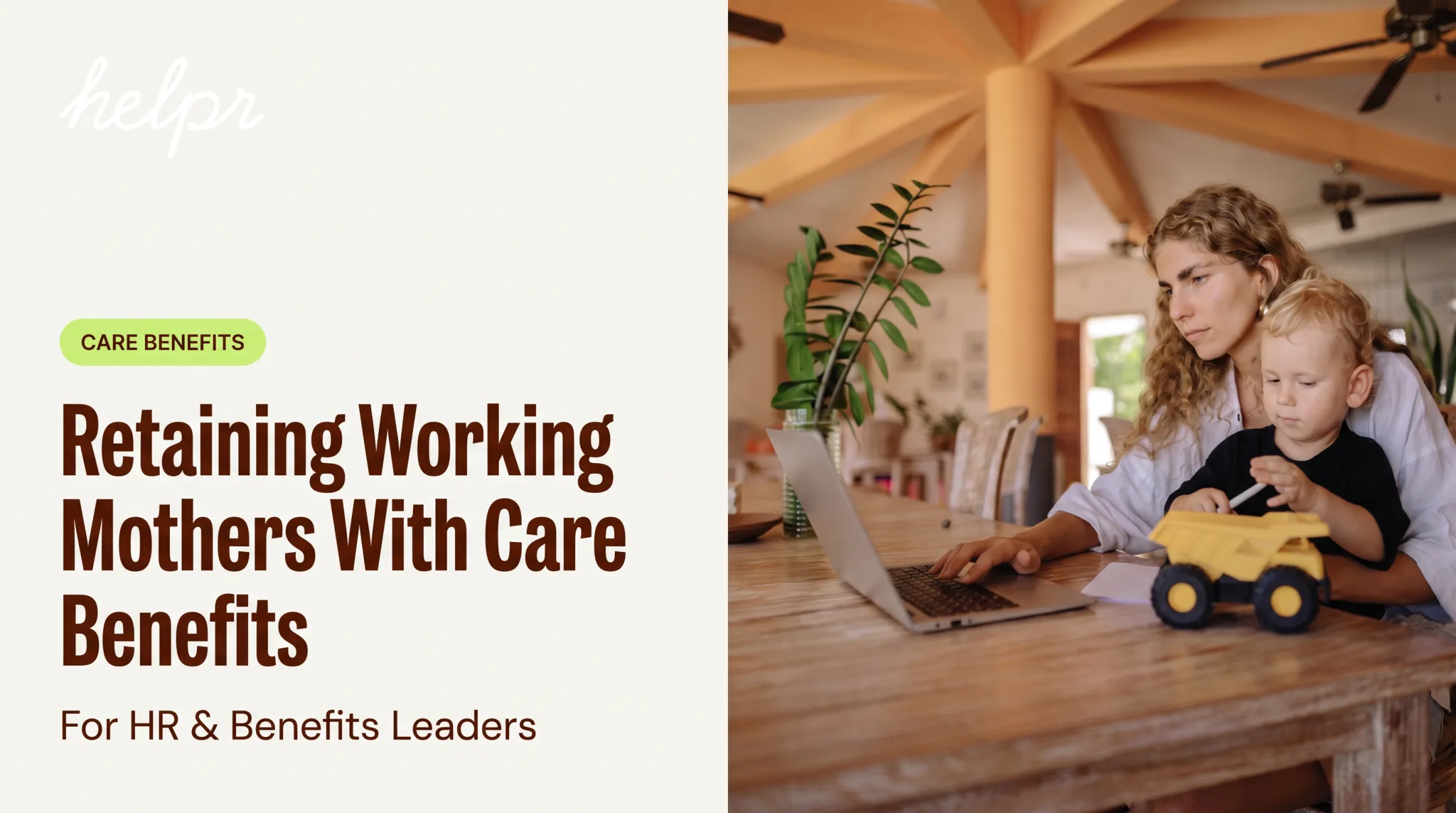

Pay still matters, obviously. But 67% of family caregivers report difficulty balancing work and caregiving responsibilities, according to a 2024 AARP and S&P Global workforce report. That difficulty shows up as missed shifts, declined promotions, and eventually, resignations.
This article breaks down how care benefits actually influence retention, what metrics to track, and how to build a program employees will use when it counts.
Key Takeaways
- Care benefits reduce caregiving-related absences, stress, and financial strain that push employees toward the exit
- Effective programs combine backup care, elder care support, care navigation, and flexible scheduling
- Track voluntary turnover, absenteeism, utilization, and satisfaction to measure real impact
- Benefits only work if they're equitable, easy to access, and backed by trained managers
What Are Care Benefits?
Care benefits are employer-sponsored programs that help employees manage childcare, elder care, and other dependent care needs. Think backup childcare when school is closed, subsidized adult day support for an aging parent, or a stipend that covers a trusted babysitter during a busy quarter.
These programs work across very different workforces:
- Office-based teams juggling meetings around daycare pickup
- Distributed and remote employees spread across time zones
- Frontline and shift workers in retail, healthcare, and manufacturing who can't simply log in late
- Global workforces operating across multiple currencies and care systems
Care benefits work best as infrastructure. They keep employees present and productive when a care emergency would otherwise pull them offline.
Helpr, for example, operates as a global backup care platform connecting employees with vetted childcare and elder care providers in more than 150 countries.
Key Advantages of Care Benefits
Care benefits only improve retention when employees can use them in a real crisis. These are the outcomes that matter most—and the metrics that show whether the benefit is working.
Reduces Care-Related Absences and Work Disruption
A sick kid, a canceled babysitter, or an elderly parent's fall doesn't check the company calendar first. When employees have no backup plan, the fallout lands on the schedule: missed shifts, late arrivals, or a manager scrambling to cover a gap.
Harvard Business School's Caring Company report found that employers most often flag unplanned absences, late arrivals, and early departures as damaging to an employee's career. HBS notes these patterns frequently trace back to caregiving obligations.
The numbers on what happens when employers act are compelling. A 21-month study cited by Harvard Business School found that employer-provided caregiving benefits reduced turnover by 1% to 7% and cut absenteeism by 10% to 50%, per HBS's caregiving research.

Backup care and caregiving leave give employees an alternative to calling out entirely. Helpr's model reflects this design: bookings can be as short as one to two hours, which is often enough to salvage a full eight-hour workday instead of losing it.
KPIs to watch:
- Unplanned absence frequency
- Missed workdays and late arrivals
- Shift coverage gaps
- Retention among employees with dependent care responsibilities
This matters most in operations where flexibility is limited by design. Frontline retail, healthcare, hospitality, and manufacturing roles don't have the option to "make up the time later." A missed shift is a missed shift.
Improves Employee Wellbeing and Strengthens Loyalty
Chronic caregiving uncertainty wears people down. The strain isn't only the missed day—it's the mental load of wondering whether today's arrangement will hold. That stress feeds presenteeism, burnout, and blurred home-work boundaries.
Employees who receive caregiving support are 30% more likely to stay with their employer, according to AARP's Caregiving Employee Resource Group Toolkit. That's a meaningful retention signal, not a soft wellness metric.
Generic wellness messaging—meditation apps, webinars—doesn't solve a childcare emergency. Real care benefits do. Helpr, for instance, connects employees with vetted providers for last-minute needs, turning "we care about you" into something usable at 6 a.m. when a sitter cancels.
KPIs to watch:
- Engagement and wellbeing survey scores
- Burnout indicators
- Voluntary turnover among caregivers specifically
Expands Equitable Access to Retention-Supporting Benefits
Caregiving doesn't discriminate by job title. Parents of toddlers, employees caring for aging relatives, and workers supporting a spouse's recovery all show up across every pay band and role type. Yet access to support often does discriminate.
Salaried and remote employees usually get better access to flexible scheduling, telecommuting, and EAPs than hourly workers do. That gap is a retention risk hiding in plain sight. The employees least able to absorb a care disruption often have the fewest tools to manage it.
Frontline and deskless workers already leave at higher rates than office-based staff. SHRM's 2025 research on deskless workers found that work-life balance and schedule satisfaction were among the top reasons employees stayed. A care benefit that only works for salaried, remote staff misses the segment that needs it most.
Equity-focused design looks like:
- Mobile-first access that works on a shift worker's phone, not just a desktop
- Subsidies or stipends instead of reimbursement-only models that require upfront cash
- Eligibility that doesn't hinge on tenure, exempt status, or full-time hours
Design choices like these determine whether hourly and deskless teams can actually use the benefit—not just whether it appears in the handbook.
KPIs to watch:
- Benefit utilization segmented by role, location, and pay type
- Adoption gaps between hourly and salaried staff
- Inclusion survey results tied to caregiving support
What Happens When Care Benefits Are Missing or Ignored
Without care support, employees are left choosing between showing up for work and showing up for their family. That's not a hypothetical. It plays out in predictable, measurable ways.
The organizational consequences stack up quickly:
- Higher voluntary turnover among employees with significant caregiving loads
- More absenteeism, presenteeism, and last-minute schedule changes
- Heavier workload spillover onto colleagues and managers covering gaps
- Loss of experienced staff and the institutional knowledge that leaves with them
- Weaker recruiting position when competitors offer more practical support
Harvard Business School's research points to hidden costs that accumulate when caregiving support is absent. Those costs include turnover, temporary hiring to backfill roles, and the productivity drag of employees who are at work but distracted, according to The Caring Company.
The same research cites earlier industry estimates from the MetLife Caregiving Cost Study, which put per-employee productivity costs from unaddressed caregiving strain at roughly $2,721 annually.

Worth being honest here: care benefits aren't a cure-all. They won't repair poor pay, unsafe working conditions, chronic understaffing, or bad management. They're one piece of a broader retention strategy, not a substitute for the rest of it.
How to Get the Most Value from Care Benefits
A care benefit only creates retention value if employees actually know it exists, can access it fast, and trust that using it won't hurt their standing. That last part matters more than most employers realize.
Apply the Benefit Consistently
Review eligibility rules, subsidy structures, and communication materials to make sure they work across every shift, role, and location, not just for the headquarters staff who wrote the policy.
- Offer childcare, elder care, and backup care options based on actual workforce composition, not a one-size-fits-all assumption
- Prefer a flexible, use-based model over a flat allotment so the benefit scales with real need
- Give frontline, shift, and remote workers the same access path as headquarters staff
Communicate the Benefit Throughout the Year
A benefit buried in a PDF from onboarding week gets forgotten. Reinforce it during open enrollment, manager training, and everyday scheduling conversations, especially in the moments employees are most likely to need it.
- Provide plain-language instructions covering eligibility, how to book care, emergency access, and cost
- Train managers to treat benefit use as supported, not as a loyalty test; that stance often decides whether someone books care or quietly suffers
- Repeat the message in channels people already use, including team chat, shift huddles, and manager 1:1s
Measure Utilization and Retention Outcomes
Data separates a working program from a line item nobody uses.
- Track utilization against turnover and absenteeism trends, keeping employee data anonymized where appropriate
- Segment findings by role, location, tenure, and work arrangement to spot adoption gaps early
- Survey users directly on whether the benefit was accessible, timely, and actually useful
- Benchmark results against published outcomes from similar backup-care programs
Bright Horizons reported that JPMorgan Chase's back-up child care program helped reduce absenteeism enough to save an estimated $800,000 in a single year of operation. Use figures like that as a reference point when building your own measurement case.

Conclusion
Care benefits improve retention by removing friction: fewer disrupted shifts, less background stress, and a clear signal that the organization values employees as whole people. None of that happens automatically. It requires equitable eligibility, benefits employees can find and use easily, and managers who don't punish people for using them.
Treat care benefits as an ongoing workforce practice, not a one-time perk rollout. Platforms like Helpr are worth evaluating for organizations looking to scale childcare and dependent care support across a distributed or hourly workforce.
Frequently Asked Questions
What are the benefits of employee retention?
Stronger retention means less recruitment disruption, better productivity from experienced staff, preserved institutional knowledge, and lower costs tied to constant rehiring and retraining.
What are the top 5 employee retention strategies?
Fair compensation, real career development paths, supportive management, flexible work arrangements, and practical care benefits are among the most effective ways to keep employees long-term.
What are the 5 C's of employee retention?
One widely cited framework from HR platform Paycor defines the five Cs as care, connect, coach, contribute, and congratulate—support, connection, development, contribution, and recognition that keep employees engaged.
What are the top 3 employee retention issues for line employees?
Unpredictable scheduling and heavy workloads top the list, followed by limited flexibility or advancement opportunities and inadequate pay or benefits. Caregiving responsibilities intensify all three, since rigid schedules leave little room to manage a sick child or an aging parent's needs.