
Introduction
A snow day doesn't just cancel classes. It can cancel your shift coverage, too.
When schools shut down for weather or another last-minute closure, employees who rely on that six-to-eight-hour window suddenly lose their childcare plan. Many scramble for backup options with almost no notice.
The impact isn't uniform. A remote worker might manage with a laptop and a patient toddler. A nurse, retail associate, or warehouse worker doesn't have that flexibility. Frontline and hourly employees often have no choice but to miss the shift entirely.
This guide walks through how employers can respond: assess the disruption, communicate fast, offer flexible options, connect employees with care, and review what worked after the fact.
Key Takeaways
- Build a documented school-closure response before an emergency hits—not during one
- Combine flexibility, leave guidance, backup care, and financial support—not a single benefit alone
- Extend support to employees caring for children, aging parents, or dependents with disabilities
- Plan coverage for employees who can't work remotely
- Confirm policies meet federal, state, and local requirements
Why School Closures Create a Workforce Challenge
Losing school-day supervision creates a ripple effect: missed shifts, reduced availability, distracted work-from-home employees, and last-minute leave requests.
According to the Federal Reserve Bank of Chicago's 2024 research on childcare and employment, 12% of usual full-time working parents missed work or worked reduced hours in the prior week due to childcare problems, up from 10% before the pandemic.
Planned vs. Unexpected Closures
Planned closures, like winter break or a scheduled teacher in-service day, give families weeks to prepare. Unexpected closures, such as a burst pipe or a snowstorm, leave hours, sometimes only minutes.
The needs differ sharply:
- Planned closures: Employees can request time off, book center-based care in advance, or coordinate with a partner
- Unexpected closures: Employees need same-day flexibility, emergency leave, or rapid backup-care access
Who Feels the Impact Most
Not every employee experiences a closure the same way:
- Remote employees may adjust schedules but still lose focus and productivity
- Office-based employees face a commute problem on top of a childcare one
- Frontline and hourly staff often can't shift their work at all, and missed shifts mean missed pay
- Shift workers (nights, rotating schedules) frequently can't find providers open during their working hours
Care availability tightens during widespread closures, too. When an entire district shuts down, every family in that ZIP code is searching for the same limited pool of sitters and centers at once.
For employers, the fallout is a staffing problem. Left unaddressed, it feeds absenteeism, reduces coverage on essential shifts, and erodes retention over time. Ignoring the gap still carries a cost.
How to Build a School-Closure Employee Support Plan
A school-closure plan shouldn't live in a manager's head. It needs an owner, a process, and a paper trail.
Assign Clear Ownership
Put HR, benefits, or a cross-functional business continuity team in charge, with defined roles:
- Managers communicate with affected employees and flag urgent cases
- Communications distributes closure alerts and updates
- Payroll handles pay treatment for leave or reduced hours
- Legal/compliance reviews policy language against current law
Build a Closure-Response Checklist
Your checklist should cover:
- Verify a closure occurred (district notice, weather alert, public health order)
- Identify affected employees
- Update schedules
- Distribute resources and support options
- Escalate urgent care or safety concerns
Set a Tiered Response
Not every closure needs the same response. Consider:
| Closure Length | Likely Support |
|---|---|
| 1 day | Schedule flexibility, shift swap |
| 2-5 days | Backup care, PTO, temporary remote work |
| 1+ weeks | Extended leave options, staffing adjustments |
Match support intensity to disruption length so a single snow day doesn't trigger the same response as a multi-week closure.

Know the Legal Landscape—Then Get a Legal Review
School closures rarely trigger federal leave protections on their own. The Department of Labor's FMLA Fact Sheet #28 confirms that eligible employees get up to 12 workweeks of unpaid, job-protected leave for specific reasons, but a routine school closure isn't one of them.
State and local rules vary widely:
- California requires most employers to provide at least 40 hours of paid sick leave annually, usable for the employee or a family member
- Illinois requires accrual of paid leave for any reason, including childcare gaps, under its Paid Leave for All Workers Act
- New York offers up to 12 weeks of Paid Family Leave at 67% of pay for family care, though eligibility criteria are specific
Policy language should distinguish company-provided benefits from legal entitlements, and every policy draft should go through legal review rather than treating this article as legal advice.
Support Options Employers Can Offer
No single benefit solves a school-closure problem. The strongest plans stack several.
Flexibility First
For short-notice or short-duration closures, flexibility often solves the problem without formal leave:
- Temporary schedule shifts or compressed hours
- Flexible start and end times
- Shift swaps among coworkers
- Reduced meeting loads for remote staff
- Results-based expectations instead of hour-tracking
Leave Options, Clearly Explained
Whatever leave options exist (paid time off, emergency leave, unpaid leave, or caregiver-specific programs), state plainly:
- Who's eligible
- How to request approval
- What documentation, if any, is required
- How pay is treated
The Bureau of Labor Statistics reports that only 27% of civilian workers have access to employer-provided paid family leave, while 90% have unpaid leave access. That gap matters: unpaid leave doesn't help an hourly employee who can't afford to miss a paycheck.
Backup Childcare Support
This is where many employers turn when flexibility and leave aren't enough. Backup care typically includes:
- In-home care with a vetted sitter
- Center-based care for a few hours or a few days
- School-break programs
- Emergency placements
- Care navigation support to help employees find local providers
Screening, safeguarding, geographic coverage, and provider availability all need verification before rolling this out at scale.
Helpr is one example of an enterprise backup care platform built for this need. Employees request care through an app, and requests go out to vetted in-home providers in their area. Bookings can be placed anywhere from three hours to three months in advance.
Helpr's "My Choice" technology lets employees use benefit dollars for in-home care, partner care centers, or a trusted friend or family member, so teams aren't locked into one care format.
Financial Assistance
Options here include:
- Childcare subsidies or reimbursements
- Direct provider payments
- Dependent-care FSAs (pre-tax accounts)
- Negotiated discounts with care providers
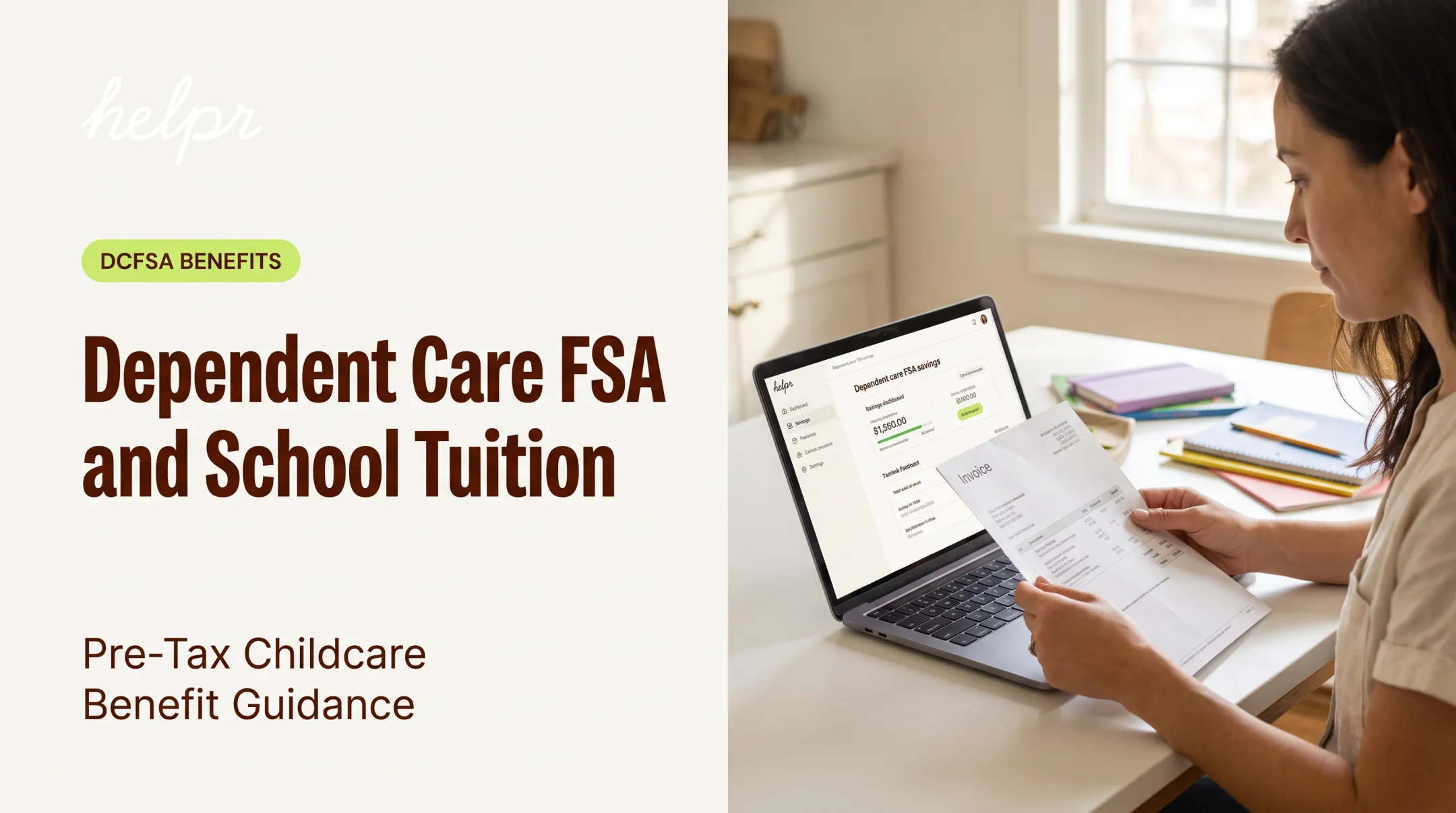
Under IRS Publication 503, the 2025 dependent-care FSA exclusion maxes out at $5,000 (or $2,500 for married filing separately). Those figures affect plan design and employee take-home pay. Tax treatment and eligibility should go through a qualified benefits advisor before rollout.
Beyond Childcare
School closures aren't the only care disruptions employees face. Many workforces also cover eldercare, disabled dependents, and other family caregiving needs.
A broader model serves those situations too. Helpr's use-based approach, for example, extends beyond childcare to elder care and other dependent-care needs, recognizing that one benefit rarely fits every employee.
Communicate the Plan Clearly and Equitably
A well-designed plan fails if employees don't know it exists or don't trust how it's applied.
The Communication Sequence
- Acknowledge the closure directly and promptly
- Explain what support is available
- State what employees need to do to access it
- Identify who to contact with questions
- Provide a timestamp for the next update if conditions are changing

Use Multiple Channels
Relying on one email misses the frontline employee without regular inbox access. Distribute through:
- Email for employees with regular inbox access
- HR portal postings for ongoing self-service reference
- Text alerts for time-sensitive updates
- Manager briefings for team-level clarity
- Printed notices at job sites without desk access
Avoid Stigma
Support should flow from care needs, not assumptions. Don't assume only parents, only women, or only certain job levels need this kind of flexibility. Base support on caregiving role—not identity or title—to keep the benefit equitable across the organization.
Manager Guidance
Managers should:
- Respond consistently across team members
- Avoid demanding unnecessary personal details
- Protect employee privacy
- Escalate anything they can't resolve themselves
Sample message framework:
"Due to [closure reason], [school/district] will be closed [dates]. Employees needing flexibility or care support can [action step] by contacting [name/team]. We'll share updates by [time]."
Measure and Improve the Response
A closure plan only gets better if someone checks whether it worked.
What to Track
- Benefit awareness and usage
- Flexibility requests and approval rates
- Leave usage patterns
- Backup-care utilization
- Schedule coverage gaps
- Absence trends before and after rollout
Avoid inventing benchmarks. Compare your own data over time instead of assuming industry-wide targets apply to your workforce.
Collect Feedback by Group
Anonymous feedback matters, but so does segmenting it:
- Frontline vs. office employees
- Hourly vs. salaried staff
- Work location
- Caregiver type (child, elder, disabled dependent)
SHRM's caregiving research found a clear retention gap tied to manager support. Organizations with managers who effectively supported caregivers retained 74% of those employees, versus 44% where support was inconsistent, according to SHRM's Caregiving Imperative report. Manager consistency is a retention lever.

Post-Closure Review
After each significant closure, ask:
- Did care providers have enough capacity?
- Were any policies unclear or inconsistently applied?
- Did communication reach everyone in time?
- Did employees who can't work remotely get equal support?
A school-closure policy should be tested and refined before the next disruption, not written for the first time in the middle of one.
Frequently Asked Questions
How many days of childcare leave do employees get?
The number of available days depends entirely on your employer's policy and applicable federal, state, or local law. Childcare leave is distinct from general paid time off, so check with HR or legal counsel for your specific entitlement.
Why is there no school today?
Closures happen for scheduled breaks, weather events, public health concerns, emergencies, staffing shortages, or local district decisions. Check your school district's official communication channel for the specific reason and updates.
What can employers do when schools close unexpectedly?
Move fast on communication, offer temporary flexibility, clarify leave options, connect employees with backup care, and cover shift gaps. Employees who can't work remotely need particular attention since flexibility alone won't solve their coverage problem.
Should employers pay for backup childcare?
Approaches vary: subsidies, reimbursements, direct-pay benefits, or negotiated provider discounts are all common. Budget, tax treatment, equity across employee groups, and compliance should all factor into the decision.
How can employers support employees who cannot work remotely during school closures?
Shift swaps, paid or emergency leave, temporary schedule changes, backup care, and short-term staffing coverage all help. Consistency matters: frontline and hourly employees need the same access to support as anyone else.