
Introduction
Picture this: you're on a work call, a toddler is tugging at your sleeve, and dinner is somehow both burning and not started. Sound familiar?
Many parents find themselves stuck between two extremes — handling everything solo or hiring a full-time nanny they don't actually need. There's a middle option that rarely gets talked about: a mother's helper.
This low-cost, flexible form of support sits right between "doing it all alone" and bringing on full-time childcare.
In this guide, we'll define exactly what a mother's helper does and how the role differs from a nanny or babysitter. We'll also cover the situations where hiring one makes sense, plus what to do when your care needs go beyond what a mother's helper can offer.
Key Takeaways
- A mother's helper supports a parent who's still home, unlike a sitter who takes over while parents are away
- Supervision level matters more than exact age; most helpers are pre-teens or teens (roughly 10-16)
- Best for everyday support: newborns, work-from-home days, and household catch-up
- Costs less than a nanny or full-time sitter
- Won't cover last-minute emergencies — backup care services fill that gap
What Is a Mother's Helper?
A mother's helper is an extra set of hands for a parent who's home and reachable, not away. They assist with the kids and light household tasks while the parent stays in charge and nearby.
The name is a bit outdated. It's interchangeable with "parent's helper" or even "father's helper." The role has nothing to do with which parent is present. Whoever's home and needs a hand can hire one.
What Age Is a Mother's Helper?
There's no hard-and-fast rule here. Mother's helpers are commonly pre-teens through teens, often somewhere in the 10-16 range, but that's a pattern, not a policy.
The real defining factor is supervision level, not age. Since the parent stays on-site and available, the risk profile is different than leaving a child with a sitter for hours unsupervised.
This is exactly why younger helpers tend to gravitate toward the role:
- Lower risk: a parent is always nearby to step in if needed
- Many teens use it as a low-pressure stepping stone before babysitting solo
- Scheduling stays flexible, often just a couple hours after school with no full shifts required
What Does a Mother's Helper Actually Do?
The job mixes light childcare with light household support. Typical duties include:
- Entertaining or engaging kids with games, crafts, or reading
- Light tidying, such as playroom cleanup rather than deep cleaning
- Simple meal or snack prep
- Homework help
- Supporting daily routines like nap time or bath time
A common real-world example: a parent is feeding or soothing a newborn while the mother's helper keeps an older sibling occupied in the next room. The parent's still fully present and reachable. The helper is simply buying a few minutes of focused time.
That's the core distinction to remember: extra hands, not sole charge. The parent remains present and ultimately responsible the entire time.
Mother's Helper vs. Nanny vs. Babysitter: What's the Difference?
Here's the distinction that matters most: a nanny or babysitter takes sole-charge responsibility while parents are out. A mother's helper assists while the parent is home and actively supervising.
According to Westside Nannies:
A mother's helper "does not have sole responsibility for the children for long stretches of time." A full-charge nanny, in contrast, has "full responsibility for the children, usually while their parents are outside of the home for extended periods of time."
Here's how the three roles compare at a glance:
| Role | Supervision Level | Typical Age | Typical Cost* | Best-Use Case |
|---|---|---|---|---|
| Mother's helper | Parent present, high supervision | Pre-teens to teens (often 10-16) | ~$21.40/hr | WFH days, newborn support, chores |
| Babysitter | Parent away, sole-charge | Teens to adults with experience | ~$21.88/hr | Date nights, short errands |
| Nanny | Independent, ongoing care | Experienced adult professional | ~$21.75/hr | Full-time, regular childcare |
*Rates based on Care.com's 2026 mother's helper comparison, reflecting average asking rates rather than fixed wages.
The focus differs too: a nanny attends directly to the children's needs, working independently. A mother's helper instead relieves the parent's workload, while the parent still makes the actual caregiving decisions.
So when does a nanny or babysitter become the better call instead? Reach for one when:
- You need to physically leave the house
- You require overnight coverage
- You need someone with formal, independent caregiving experience
When Should You Hire a Mother's Helper?
A mother's helper shines in specific, everyday scenarios rather than as a catch-all solution. Here's when it makes the most sense.
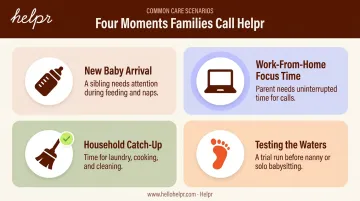
A new baby just arrived. An older sibling often needs attention and engagement while a parent tends to the infant's feeding, diapering, or naps.
You're working from home and need focus time. This is a growing need: the Institute for Family Studies found the share of mothers with young children working from home rose 7% between 2019 and 2023, about 1 million more mothers. A mother's helper lets you take that call without hiring a full-time sitter.
You need to catch up on household tasks. Laundry, cooking, cleaning, or honestly just a nap: all doable without paying nanny-level rates.
You're testing the waters. Maybe you're deciding whether to eventually hire a nanny, or you want to give a young teen supervised caregiving experience before they babysit solo.
Know the Limits
A mother's helper works best for planned, in-home, lower-stakes support. It's not built for urgent or unpredictable situations: a sick child, a canceled sitter, or a surprise school closure.
For those moments, families benefit from having a backup plan already in place. Employer-sponsored backup care platforms like Helpr connect working parents with vetted caregivers on demand, filling exactly the gap a mother's helper can't cover. If your employer offers Helpr as a benefit, it's worth having that option ready alongside your regular mother's helper arrangement.
How to Find and Hire the Right Mother's Helper
Finding a good match usually comes down to trusted networks rather than formal hiring platforms:
- Personal referrals from friends or neighbors with teens
- Community boards at schools, libraries, or local Facebook groups
- Local teen networks through sports teams, youth groups, or church programs
- Childcare platforms, though many require helpers to be 18 or older, ruling out younger candidates
Interview and Set Expectations Early
Before hiring, watch how the candidate interacts with your kids directly. Do they get down to their level? Do the kids respond well?
Then, have a clear conversation about:
- Specific duties (what's in scope, what isn't)
- Phone use during helper hours
- House rules for snacks, screen time, and guests
Skipping this step is the fastest way to build resentment on both sides later.
Put the basics in writing. Hours, pay, responsibilities, and boundaries — even a simple shared note works. It removes ambiguity and protects the relationship when questions come up down the line.
How Much Does a Mother's Helper Cost?
Mother's helper rates run lower than nanny or babysitter rates, reflecting the reduced responsibility involved. According to Care.com's 2026 Cost of Care data, the average asking rate sits around $21.40 per hour.
| Caregiver Type | Average Hourly Rate |
|---|---|
| Mother's Helper | $21.40 |
| Nanny | $21.75 |
| Babysitter | $21.88 |
Several variables push that number up or down:
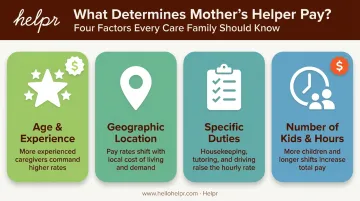
- Age and experience: a 15-year-old with two summers of babysitting under her belt commands more than a first-timer
- Geographic location: rates in major metros run higher than rural areas
- Specific duties: more household tasks generally mean higher pay
- Number of children and hours: two kids for four hours costs more than one kid for two
Practical tip: Instead of setting a rate unilaterally, ask the helper (or their parents) what they've charged before. Benchmark against local teen and babysitting rates in your area rather than guessing.
Frequently Asked Questions
What is a parent's helper?
It's another name for a mother's helper: an extra set of hands supporting a parent who's home, regardless of which parent is present. The term isn't gender-specific.
What age is a mother's helper?
Commonly 10-16, though there's no strict rule. The parent remains the supervising adult, so age matters less than the helper's maturity.
What's the difference between a mother's helper and a nanny?
A nanny takes sole charge of children while parents are away for extended periods. A mother's helper assists while the parent is home and supervising the whole time.
How much should I pay a mother's helper?
Expect lower rates than a nanny or sitter, generally in the low-to-mid $20s per hour depending on age, location, and duties. Ask locally for a benchmark before setting your rate.
Is it safe or legal to leave a mother's helper alone with my kids?
Mother's helpers work under parental supervision by design, so sole-charge legal concerns typically don't apply. Still, use judgment based on the specific helper's age and maturity level.
What should I do if I need last-minute or emergency childcare instead of a mother's helper?
For unplanned gaps like a sick child or canceled sitter, on-demand backup care services, sometimes offered through employer benefits like Helpr, can quickly connect you with vetted caregivers when a mother's helper isn't an option.