
Introduction
Nearly 57% of working mothers with children under five say childcare responsibilities have held them back professionally, according to McKinsey's 2022 research. Among parents who do miss work, the average translates to roughly 19 lost workdays per year — a direct hit to team capacity, coverage, and output.
For HR leaders, those numbers aren't just a wellness concern. They're a workforce planning problem.
This guide covers everything benefits decision-makers need to act on: what child care benefits actually are, why the business case is stronger than most finance teams realize, the full range of benefit types available, tax implications, and how to select and implement the right program for your organization.
Effective childcare benefits aren't one-size-fits-all. The difference between a benefit that moves the needle and one that gets ignored usually comes down to whether it matches the actual problem employees face — finding care, affording care, or handling sudden disruptions.
Key Takeaways
- The right child care benefit mix depends on your workforce's specific pain points, from pre-tax dependent care accounts to backup care
- Unresolved childcare challenges cost employers through absenteeism, turnover, and delayed parental leave returns
- Tax-advantaged tools like pre-tax dependent care accounts and the employer childcare credit can significantly cut program costs
- Benefits must reach all employees — regardless of role, shift, or location — to deliver real workforce impact
- Backup care directly prevents lost workdays when regular care arrangements fall through
What Are Child Care Benefits for Employees?
Child care benefits are any employer-sponsored program, policy, subsidy, or service that helps working parents find, afford, or manage care for their children. Unlike general wellness perks, they address a concrete logistical and financial challenge — one that directly affects whether an employee can show up, stay focused, and stay with the organization long-term.
The spectrum runs wide:
- Legally mandated baseline: FMLA-protected leave, payroll tax contributions toward dependent care programs
- Optional competitive benefits: Childcare stipends, backup care platforms, pre-tax dependent care account administration, on-site care, parental leave extensions
Most employers have the first category covered. The real opportunity lies in the second — and most organizations aren't there yet.
A 2023 industry study found 40% of employed parents lacked the childcare they needed, and 39% said they were much more likely to stay with an employer that offered everyday or emergency care support. Yet SHRM's 2025 survey found only 3% of employers offered a subsidized childcare center or program — meaning most organizations are falling well short of what their workforce actually needs.
The Business Case: Why Employers Should Offer Child Care Benefits
The Productivity and Absenteeism Cost
ReadyNation estimated that inadequate infant and toddler care costs U.S. employers $23 billion annually in lost productivity. That figure covers only children under three — it doesn't capture school-age care disruptions, summer gaps, or the cumulative drag of employees managing chronic care instability.
The individual-level data reinforces it: parents who miss work due to care failures average 19 missed days per year. For a team of 50 parents, that's potentially 950 lost workdays annually — before accounting for lateness, distraction, or reduced hours.
Turnover and Retention Economics
Childcare challenges push employees out of the workforce in measurable ways:
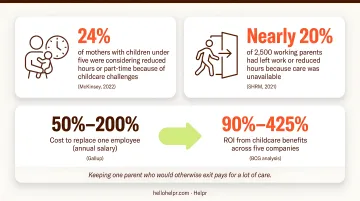
- 24% of mothers with children under five were considering reduced hours or part-time because of childcare challenges (McKinsey, 2022)
- Nearly 20% of 2,500 working parents had left work or reduced hours solely because care was unavailable (SHRM, 2021)
- Replacing one employee costs roughly 50%–200% of that person's annual salary (Gallup)
BCG's analysis across five companies modeled 90%–425% ROI from childcare benefits, driven primarily by retaining employees who would otherwise leave or reduce hours. Those figures vary by employer, but the directional case is consistent: keeping one parent who would otherwise exit pays for a lot of care.
Recruitment and Equity Advantages
Family-friendly benefits have become a differentiator in candidate evaluation, not a footnote. Among Etsy's workforce, 82% of eligible parents said childcare benefits mattered when choosing the employer; across BCG's five-company study, up to 86% said those benefits made them more likely to stay.
Those retention numbers only hold if the benefits actually reach the people at risk of leaving. For employers with distributed, shift-based, or hourly workforces, that means designing programs that work for every employee — not just those with flexible schedules or salaries high enough to absorb care costs.
Benefits scoped only to office-based, salaried staff don't move aggregate workforce metrics. They create a two-tier experience that drives resentment and attrition among the employees most vulnerable to care disruptions.
Types of Child Care Benefits for Employees
Financial Support Benefits
Three tools form the core of financial childcare support:
1. Childcare stipends and subsidies — Direct employer contributions employees can apply toward any qualified provider, including providers they already use. Highly flexible; works well for distributed workforces where provider networks vary.
2. Pre-Tax Dependent Care Accounts — Pre-tax payroll deductions employees use for eligible childcare expenses. The 2025 IRS annual exclusion limit is $5,000 for single filers or married filing jointly ($2,500 if married filing separately). Low administrative burden for employers; broadly applicable. The catch: only 5% of eligible employees participate, per Mercer's 2023 data — meaning most employers are leaving this tool underutilized.
3. Employer-funded grants or reimbursement programs — Less common but highly valued, especially for lower-income employees who can't absorb even subsidized costs upfront. Most effective when paired with clear usage guidelines.
Important limitation: These accounts work best for predictable, recurring care expenses. They offer little protection when care arrangements break down unexpectedly — which is exactly when employees most need support.
Care Access and Coverage Benefits
The three most common access benefits — and what each solves:
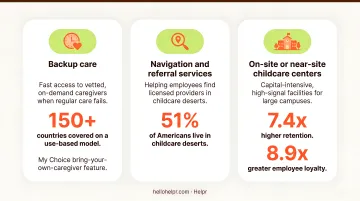
- Backup care: When regular care fails — provider illness, school closure, a last-minute scheduling gap — backup care gives employees fast access to vetted, on-demand caregivers so they can make it to work. Helpr's global platform covers 150+ countries on a use-based model, so organizations only pay for care that's actually utilized. Employees can use Helpr's vetted provider network or bring their own trusted caregiver through the patented "My Choice" feature, with employer subsidies applied directly.
- Navigation and referral services: Help employees search for, evaluate, and secure licensed providers — especially valuable in childcare deserts. According to CAP's national analysis, 51% of Americans live in childcare deserts, where more than three children compete for every available licensed slot. For new parents racing against the end of parental leave, navigation support can prevent the scramble that leads to early exits.
- On-site or near-site childcare centers: Capital-intensive but high-signal. SHRM data shows employers with on-site care achieve 7.4x higher retention and 8.9x greater employee loyalty. These facilities work best for large campuses or multi-employer consortia that share fixed costs.
Leave and Flexibility Benefits
Access benefits address the day-to-day logistics of care. Leave and flexibility benefits address what happens at either end of that window — when care hasn't started yet, or when it momentarily falls through.
Paid parental leave and phased return-to-work programs are foundational. Employees who return before affordable care is secured often exit within months — either formally or by quietly pulling back. Many employers now target 12–20 weeks of paid leave to close the gap between birth and reliable care availability.
Flexible scheduling and remote or hybrid work options complement leave, but don't replace it. Shifting a meeting helps. It doesn't give a child somewhere to be.
Tax Considerations and Cost Management
Employer Tax Advantages
Two primary tax levers are available to employers offering childcare benefits:
Pre-tax account contributions: Employee contributions are pre-tax, reducing payroll tax liability for the employer. The annual exclusion limit is $5,000 (or $2,500 married filing separately) for 2025.
Employer-Provided Child Care Credit (IRS Form 8882): For tax year 2026 and later, this credit covers 40% of qualified facility expenses and 10% of resource-and-referral expenses, capped at $500,000 (inflation-adjusted). Small businesses receive a higher rate of 50% with a $600,000 cap. For 2025 and earlier, the credit is 25% of facility expenses, capped at $150,000.
Cost Control Through Use-Based Models
Fixed-cost benefits — on-site centers, flat subscriptions — carry sunk costs whether employees use them or not. Use-based platforms flip that equation: employers only pay when care is actually booked. For organizations that want to offer meaningful childcare support without committing to fixed program overhead, this structure eliminates the budget barrier that often keeps smaller employers from offering care benefits at all.
Communicating Tax Benefits to Employees
Keeping costs low only matters if employees actually use the benefit. These accounts are chronically underutilized — a 5% participation rate reflects how poorly these benefits get explained during enrollment. HR teams should:
- Include plain-language explainers for the account in open enrollment materials
- Clarify that employees cannot double-dip — expenses excluded through the pre-tax account reduce the expense ceiling available for the separate Child and Dependent Care Tax Credit
- Send targeted reminders before high-need periods like summer and back-to-school season
How to Choose the Right Child Care Benefits for Your Organization
Start With a Workforce Diagnostic
The right benefits depend entirely on the specific challenge your employees face. Before selecting any program, identify which category is most prevalent:
- Finding care → Navigation services, referral programs, on-site care
- Affording care → Stipends, pre-tax account maximization, employer grants
- Managing disruptions → Backup care platforms
Survey employees directly, or analyze HR support request data to identify where care problems cluster.
Map Benefits to Workforce Characteristics
| Workforce Profile | Best-Fit Benefits |
|---|---|
| Distributed or global workforce | Portable, on-demand backup care; global stipends |
| Cost-sensitive / hourly workers | Stipends, pre-tax account education, use-based backup care |
| New-parent-heavy organization | Parental leave extensions, childcare navigation |
| Campus or large single-site | On-site care, referral services |
| Shift-based workers | Flexible backup care, non-traditional hours care |
Vendor Vetting Criteria
When evaluating backup care or care platform providers, assess:
- Provider network breadth — In-network caregivers, center-based options, and bring-your-own-caregiver capability
- Vetting standards — Background checks, ID verification, CPR certification, reference checks
- Coverage across every employee location, including international and rural areas
- Same-day booking available through a mobile app in minutes
- Pricing model transparency — use-based vs. flat subscription, and whether subsidies reach hourly employees equitably
Calculate Total Cost vs. Avoided Cost
The direct cost of a benefit is only half the picture. HR teams presenting to finance leadership should model the avoided costs:
- Reduced absenteeism (at 19 missed days per affected parent, even modest utilization adds up)
- Faster parental leave return rates
- Lower turnover-related replacement costs (at 50%–200% of salary per departure)
For most organizations, the avoided cost calculation alone justifies the investment — often within the first year of rollout.
How to Implement Child Care Benefits: A Step-by-Step Approach
Phase 1: Planning
- Define success metrics — Set a target utilization rate, care-related absence reduction goal, and parental leave return rate before launch
- Secure leadership buy-in — Frame the ROI case using avoided costs, not just program costs
- Start focused — Launching one well-explained benefit outperforms launching five underexplained ones; backup care is a strong first choice given its direct tie to lost workdays
Phase 2: Communication and Enrollment
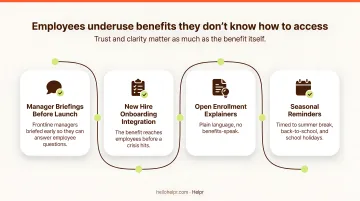
Utilization data consistently shows that employees underuse benefits they don't know how to access. Trust and clarity matter as much as the benefit itself. Recommended approach:
- Manager briefings before launch so frontline managers can answer questions
- New hire onboarding integration so the benefit reaches employees before a crisis
- Open enrollment explainers in plain language — avoid benefits-speak
- Seasonal reminders timed to summer break, back-to-school, and school holiday periods when care disruptions spike
Phase 3: Measurement and Iteration
Once communication channels are in place and enrollment is open, shift attention to whether the benefit is actually reaching the employees who need it most. Run a 90-day check after launch:
- What's the utilization rate by employee segment (role, shift, geography)?
- Are certain populations not accessing the benefit?
- What does employee feedback indicate about barriers?
At 12 months, assess whether original workforce pain points are actually improving. Use that data to adjust benefit mix, improve communication, or layer in complementary offerings. The programs that improve over time are the ones with a feedback loop built in from day one.
Frequently Asked Questions
What are the benefits of taking a child to daycare?
High-quality daycare supports socialization, structured learning, school readiness, and cognitive development — RAND's review of 115 programs found 89% improved at least one developmental outcome. For working parents, reliable center-based care provides consistent coverage that keeps them productive and present at work.
Do employees still get free childcare?
"Free" childcare depends on the combination of benefits available. Employer subsidies, pre-tax account savings, and government programs like Head Start (for income-qualifying families) can together eliminate or dramatically reduce out-of-pocket costs. Platforms like Helpr apply employer subsidies directly to reduce what employees pay per session.
Is it better for babies to go to daycare or stay home?
Research shows high-quality early care settings produce documented developmental benefits for infants, but the right choice depends on each family's circumstances. Backup care and flexible benefits help parents decide based on what works for their family — not on what they can afford.
What is a pre-tax dependent care account and how does it benefit employees?
A pre-tax dependent care account lets employees set aside pre-tax dollars to pay for eligible childcare expenses, reducing their taxable income. The 2025 annual exclusion limit is $5,000 (or $2,500 married filing separately). Most plans have a use-it-or-lose-it rule, so unused funds at year-end may be forfeited.
How do child care benefits reduce employee turnover?
Care-related disruptions are a leading driver of reduced hours and workforce exits among working parents. When employers reduce that friction — through subsidies, backup care, or scheduling flexibility — employees are far more likely to stay engaged and remain with the organization.
What should employers look for when selecting a backup care provider?
Prioritize network breadth and caregiver vetting standards, geographic coverage for distributed teams, same-day booking via mobile, and use-based pricing (pay per session rather than a flat fee). Helpr is built around all four: a global vetted network, same-day booking, and a use-based model that keeps costs tied to actual utilization.