

Introduction
If you're pregnant with your second (or third) baby, you've probably already solved the diaper bag question and the hospital bag question. But there's one logistics puzzle that keeps a lot of expecting parents up at night: who's watching your older child while you're in labor?
Unlike registry lists or birth plans, this one doesn't follow a predictable script. It depends on timing you can't control, family who may or may not live nearby, and whether your child actually feels safe with the person you've lined up. A single backup plan often isn't enough.
This guide walks through exactly how to build a childcare plan for your older kids, what to prepare in advance, the mistakes that trip up even organized parents, and what to do if you have no one lined up yet.
Key Takeaways
- Start your sibling care plan 4-6 weeks before your due date, not last-minute
- Layer backup plans (A, B, C)—your first choice may be unreachable overnight
- Familiarity beats convenience: known caregivers ease separation better than strangers
- No family nearby? Backup care, hospital policies, and elective induction are valid fallbacks
How to Plan Childcare for Your Other Kids During Labor
Building a plan that actually holds up on the day requires more structure than a single phone call to grandma.
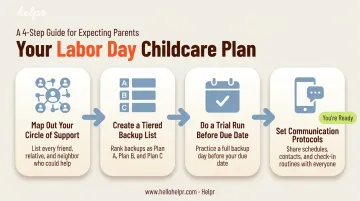
Step 1: Map Out Your Circle of Support
Start with a full list, not just your top pick. Include:
- Grandparents and other relatives
- Nearby friends or neighbors
- Your regular babysitter or nanny
- Daycare or preschool providers who might do a one-off favor
- On-demand backup care services like Helpr, which vet and background-check caregivers ahead of time
For each name, note their proximity, typical availability, and how comfortable your child already is with them. Then separate the list into two categories: who could realistically show up at 2 a.m., and who's only reliable during business hours.
Timing works against you here. A large cohort study of nearly 49,000 low-risk term labors found that median active labor lasted 7.5 hours for first-time mothers versus just 3.3 hours for mothers who had given birth before. If this isn't your first baby, you may simply have less runway than you did last time.
Step 2: Create a Tiered Backup List
Rank your contacts into Plan A, Plan B, and Plan C. It's simple math: people get sick, travel, or don't answer their phones at 3 a.m.
Share the complete list with everyone on it, including names, numbers, and addresses. That way, if Plan A can't make it, Plan B and C can coordinate a handoff without waiting on you to manage it from a hospital bed.
Step 3: Do a Trial Run Before Your Due Date
Schedule at least one practice sleepover or extended babysitting session with your chosen caregiver before labor starts. This isn't optional if your child hasn't spent real time with this person before.
Pack a "go bag" ahead of time with:
- Comfort items (a favorite stuffed animal, blanket)
- A go-to snack
- Pajamas and a change of clothes
- A written routine sheet covering bedtime, allergies, and your pediatrician's contact info
Step 4: Set Communication Protocols for Labor Day
Agree in advance on exactly how you'll notify your backup team once labor starts. A group text works better than calling people in sequence when minutes matter. Define what "on call" actually means for each person: does it mean they need to be dressed and ready, or just reachable by phone?
Decide who handles updates to your older child too. A quick video call or a few photos from the hospital can go a long way toward keeping them feeling included rather than left out.
What You Need Before Your Due Date
Your plan's success depends less on who you know and more on how prepared everyone is before labor starts.
People and Providers
Aim for two to three backup caregivers who already know your child, plus one professional fallback.
If your employer offers backup care through a platform like Helpr, activate it now rather than waiting until active labor begins. These services connect families to vetted caregivers on short notice, which matters most when the personal network falls through.
Some families also bring in a sibling doula or postpartum doula trained specifically to support the older child during the birth window. Just know that scope varies by provider, and cost isn't standardized industry-wide, so treat this as one layer, not your entire plan.
Prep Materials and Information
Put together an emergency information sheet covering:
- Allergies and medications
- Pediatrician contact information
- School or daycare details
- Comfort routines (nap schedule, favorite show, bedtime ritual)
If your caregiver might need to make medical decisions or pick your child up from school, get a signed consent or authorization note ready too.
Readiness Check
Before your due date arrives, confirm each backup contact:
- Knows your general due date window
- Has agreed to realistic notice times, including overnight
- Understands they might get bumped from Plan A to Plan B depending on timing
Key Factors That Determine Whether Your Plan Works
A solid list of names can still fall apart if a few underlying variables aren't accounted for.
Familiarity with the Caregiver
Children separate more easily from a parent when the substitute is someone they already trust. Separation anxiety typically peaks between 10 and 18 months, according to the American Academy of Pediatrics, and even a familiar relative can trigger distress if they approach too quickly. Unfamiliar caregivers raise the odds of a distress call reaching you mid-labor, which is the last thing you need while you're trying to focus.
Proximity and Response Time
Labor with a second or third baby often moves faster than a first labor. A contact who's 30-60 minutes away might not make it before you need to leave for the hospital. When you're ranking your Plan A, B, and C, distance should weigh just as heavily as trust.
Number of Backup Layers
A single point of failure, meaning one grandparent or one friend, leaves you with nothing if that person gets sick or is traveling. Families with 2-3 layered options, such as a relative, a trusted friend, and a vetted backup care service like Helpr, tend to experience far less last-minute scrambling than those relying on one plan alone.
Common Mistakes to Avoid
Most childcare-plan failures trace back to a handful of avoidable habits:
- Waiting until the third trimester to start lining up help, leaving no time for practice visits or research into backup options
- Relying on a single friend or relative without a backup, then scrambling when that person cancels
- Assuming labor will mirror your first birth, when second and third labors are often noticeably quicker
- Skipping emotional prep for your older child, which can intensify their distress in the moment
None of these are hard to fix. Starting earlier and lining up a backup network (like Helpr's vetted sitters) closes every gap above.
What to Do If You Have No One to Watch Your Kids
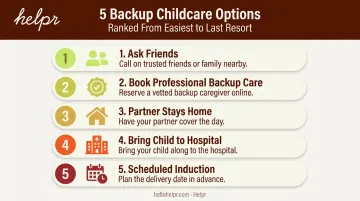
This is one of the most common worries expecting parents raise, and it's genuinely workable even without family nearby. Here are five practical options, ranked from easiest to last resort:
Ask friends, even if they seem "too busy." Busy friends with kids of their own are often happy to help for a night or two. It takes nerve to ask, so line up a backup in case they're unavailable.
Book a professional backup care service. A vetted platform like Helpr's network fills the gap when you're new to an area or lack local support. Set up an account in advance rather than scrambling mid-contraction.
Have your partner stay home with the older child. Familiar routines often reduce a child's distress more than any outside caregiver could. The trade-off: you may be alone for part of labor or right after delivery.
Bring your child to the hospital as a last resort. Most hospitals allow this if a dedicated adult, not your labor support person, supervises the child. Policies vary widely, so call your specific hospital ahead of time rather than assume.
Consider a scheduled induction. If your only reliable caregiver needs a firm travel date, an elective induction removes the guesswork. ACOG guidance on elective induction timing advises against non-medically indicated induction before 39 weeks, so discuss timing with your OB-GYN.
Frequently Asked Questions
What counts as an "emergency" for childcare planning purposes?
It means labor starting unexpectedly early, at night, or faster than you anticipated, before your primary caregiver arrangement is confirmed or in place.
How early should I start arranging childcare for my other children?
Start the conversation and build your backup list at least 4-6 weeks before your due date. Start even earlier if you're relying on out-of-town family.
Can I just bring my older child with me to the hospital during labor?
Many hospitals allow this if a separate adult is present solely to supervise the child. Treat it as a backup plan rather than your primary arrangement.
Is it true that labor moves faster with a second or third baby?
Many parents report shorter labors with later pregnancies. That's exactly why lining up a caregiver in advance matters more than arranging one last-minute.
Should I hire a sibling doula or postpartum doula for this?
A doula trained to support siblings can ease the transition, but availability and cost vary by provider. Use it as one layer of a broader plan, not your only option.
What if none of my backup contacts are available when I go into labor?
Turn to a vetted on-demand backup care service like Helpr, ask your child's daycare or school for a one-time referral, or have your partner stay home as an immediate fallback.