
Many parents assume these accounts are only for daycare centers. Others don't know the IRS rules around caregiver eligibility, documentation, and household employment taxes — and those gaps lead to denied claims or unexpected tax bills.
This guide covers exactly what you need to know: who qualifies, how to use a pre-tax dependent care account to pay a nanny compliantly, what the nanny tax requires, and how the account interacts with the Child and Dependent Care Tax Credit.
Key Takeaways
- You can use a pre-tax dependent care account to pay a nanny — but the nanny must be paid legally and documented properly
- The child being cared for must be under age 13 and care must be work-related
- 2026 contribution limits: $7,500 for single filers or married filing jointly; $3,750 for married filing separately
- Your nanny is a household employee — nanny tax obligations apply
- You cannot double-dip — reimbursements from the account reduce expenses eligible for the Child and Dependent Care Tax Credit
Who Qualifies? Eligibility Requirements for Using a Pre-Tax Dependent Care Account to Pay Your Nanny
The Work-Related Requirement
The IRS only allows reimbursement for expenses that are "employment-related." That means the care must enable both you and your spouse to work, actively look for work, or attend school full-time — it cannot cover date nights or personal errands.
A spouse who is a full-time student is treated as having earned income of $250 per month (for one qualifying person) or $500 per month (for two or more). That deemed income counts toward satisfying the work test.
Who Counts as a Qualifying Dependent
The child being cared for must:
- Be under age 13 when care is provided
- Have lived with you for more than half the year
A spouse or other household member who is physically or mentally incapable of self-care may also qualify, regardless of age.
Who Cannot Be Your Paid Caregiver
The IRS bars reimbursement for payments made to:
- Your spouse
- The child's other parent
- Anyone you or your spouse claims as a tax dependent
- Your own child who was under age 19 at the end of the tax year — even if you don't claim them as a dependent
What about a relative like a grandmother? She can qualify — as long as she falls outside those barred categories — but she must report the payment as taxable income. A written agreement and proper pay records are still required, even for relatives.
Account Access Requires an Employer Plan
A pre-tax dependent care account is an employer-sponsored benefit. Self-employed individuals and independent contractors cannot open one independently. Enrollment typically happens during your employer's annual open enrollment period or following a qualifying life event (like the birth of a child).
How to Use Your Pre-Tax Dependent Care Account to Pay Your Nanny (Step-by-Step)
The reimbursement process has four distinct stages: setting up your account, paying your nanny correctly, submitting claims, and filing taxes. Each stage has rules that affect whether your expenses qualify. Skipping steps — especially around legal payroll — will result in denied reimbursements or IRS penalties.
Setting Up Your Account
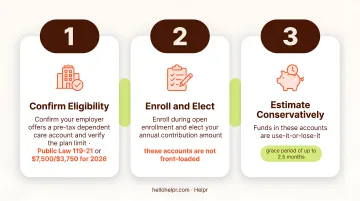
Confirm your employer offers a pre-tax dependent care account and verify the plan limit. Public Law 119-21 raised the federal ceiling to $7,500/$3,750 for 2026, but employers must opt in — your plan may still use an older limit. Check with HR.
Enroll during open enrollment and elect your annual contribution amount. Unlike Health FSAs, these accounts are not front-loaded — you can only be reimbursed up to the amount already contributed at the time of your claim.
Estimate conservatively. Account funds are use-it-or-lose-it. Account for weeks your nanny won't work (vacations, illness, turnover). Some plans offer a grace period of up to 2.5 months after year-end to incur additional eligible expenses, but balances do not roll over.
Paying Your Nanny and Maintaining Records
Your nanny must be paid on the books. Paying under the table disqualifies the expense and creates real legal risk. This means issuing regular paychecks, withholding applicable taxes, and keeping payroll records.
For every payment, retain:
- Dates of service
- Description of care provided
- Amount paid
- Nanny's full name, address, and Social Security Number (SSN) or ITIN
Submitting Claims for Reimbursement
Submit claims through your account administrator's portal or app with supporting documentation. Remember: you can only be reimbursed for care that has already been provided — not future care, not prepaid care.
Filing Your Taxes (Form 2441)
Employees who receive dependent care benefits through an employer (reported in Box 10 of your W-2) must file IRS Form 2441 with their annual tax return, even if no tax credit remains to claim. The form requires your care provider's name, address, and SSN or EIN.
If your nanny refuses to provide their SSN, request it using Form W-10 and document your attempt. The 2025 Form 2441 instructions direct you to write "See Attached Statement" and explain your due diligence. Failing to document this effort can result in the IRS disallowing the dependent care exclusion entirely.
The Nanny Tax: What Account Holders Must Know
Most in-home nannies are legally classified as household employees — this applies regardless of whether they're full-time or part-time, hourly or salaried, found through an agency or by word of mouth.
2026 Household Employer Tax Obligations
| Obligation | Trigger | Who Pays |
|---|---|---|
| Social Security (6.2%) | $3,000 in cash wages to one household employee | Employer pays 6.2%; withholds employee's 6.2% |
| Medicare (1.45%) | Same $3,000 threshold | Employer pays 1.45%; withholds employee's 1.45% |
| FUTA | $1,000+ in total household wages in any calendar quarter | Employer pays 6.0% on first $7,000 (credit up to 5.4%) |
| Schedule H | FICA threshold met, FUTA wages paid, or federal income tax withheld | Filed with your Form 1040 |
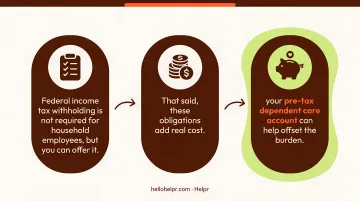
Federal income tax withholding is not required for household employees, but you can offer it. That said, these obligations add real cost — and that's where your pre-tax dependent care account can help offset the burden.
The Silver Lining
The employment taxes you pay on your nanny's wages are themselves eligible expenses — as are agency placement fees and application fees. Your account can reimburse those costs, which meaningfully offsets the sting of compliance.
Household payroll is complex. Errors here lead to back taxes, interest, and penalties. Using a household payroll service to handle withholding, filings, and year-end W-2 preparation helps most families avoid costly Schedule H mistakes — and the fees for that service may be deductible too.
Pre-Tax Dependent Care Account vs. the Child and Dependent Care Tax Credit
These two benefits cannot cover the same expenses — you must choose how to allocate costs between them.
How the 2026 CDCTC Works
The Child and Dependent Care Tax Credit (CDCTC) allows you to claim a percentage of qualifying childcare costs, up to:
- $3,000 for one qualifying dependent
- $6,000 for two or more
The applicable credit percentage under 2026 law ranges based on AGI:
| AGI | Credit Percentage |
|---|---|
| $15,000 or below | 50% |
| Above $15,000 | Decreases 1% per $2,000 of AGI, floor of 35% |
| Above $75,000 (or $150,000 joint) | Further decreases 1% per $2,000 ($4,000 joint), floor of 20% |
The No Double-Dipping Rule
Any expenses reimbursed through the account reduce your CDCTC expense base dollar-for-dollar. A family that maxes out the account at $7,500 has already exceeded the $6,000 CDCTC cap — leaving nothing to claim under the tax credit.
Which Benefit Wins?
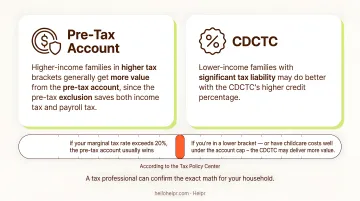
That dollar-for-dollar offset means your decision about which benefit to prioritize has real tax consequences. According to the Tax Policy Center, the better option depends on your income and tax bracket:
- Higher-income families in higher tax brackets generally get more value from the pre-tax account, since the pre-tax exclusion saves both income tax and payroll tax
- Lower-income families with significant tax liability may do better with the CDCTC's higher credit percentage
As a general rule: if your marginal tax rate exceeds 20%, the pre-tax account usually wins. If you're in a lower bracket — or have childcare costs well under the account cap — the CDCTC may deliver more value. A tax professional can confirm the exact math for your household.
Best Practices for Getting the Most Out of Your Pre-Tax Dependent Care Account
Three habits separate families who get full value from their account from those who scramble at year-end:
- Estimate conservatively. Account funds are forfeited if unspent — build in a buffer for weeks your nanny won't work. Under-electing slightly is far less painful than forfeiting a large balance.
- Treat legal payroll as non-negotiable. Documented payroll records are the foundation of every valid reimbursement claim. Without them, expenses aren't reimbursable — and you face separate legal exposure as a household employer. A household payroll service handles withholding, quarterly filings, and year-end W-2 preparation without extra lift.
- Plan for care gaps. Even reliable nanny arrangements hit unexpected interruptions — illness, family travel, or last-minute schedule changes.
Those gaps matter most. When your nanny is out, your workday is still at risk. Employer-sponsored backup care benefits, like those offered through Helpr, can fill those moments without derailing your schedule. Helpr connects employees with vetted caregivers on demand, and its "My Choice" technology lets employees upload and pay their own preferred providers through the platform. For families managing nanny care through a pre-tax dependent care account, that kind of on-demand coverage is a practical complement — not a workaround.
Frequently Asked Questions
Can I use my pre-tax dependent care account to pay a nanny, babysitter, or daycare?
Yes. Nannies, babysitters, au pairs, and licensed daycare centers all qualify as eligible expenses. The care must be work-related and the child must be under age 13 and live with you more than half the year.
What childcare expenses are eligible for a pre-tax dependent care account?
Eligible expenses include in-home nannies and au pairs, daycare and preschool (not including kindergarten), before- and after-school programs, day camps, agency placement fees, and household employment taxes. Overnight camps and kindergarten tuition do not qualify.
How much can I contribute to a pre-tax dependent care account in 2026?
The 2026 limits are $7,500 for single filers, heads of household, and married couples filing jointly; $3,750 for married individuals filing separately. These limits were increased by Public Law 119-21. Employers must opt in to the new ceiling, so confirm your plan's actual limit with HR before enrolling.
Can I pay a family member as my nanny and still use a pre-tax dependent care account?
Yes. The disqualifying relationships are your spouse, the child's other parent, anyone you claim as a tax dependent, and your own child under age 19. A grandmother or other relative outside those categories qualifies, but must report the payment as taxable income.
What happens to unused pre-tax dependent care account funds at the end of the year?
Unspent balances are forfeited to the employer under the use-it-or-lose-it rule. Some employers offer a grace period of up to 2.5 months after plan year-end to incur additional eligible expenses. Funds do not roll over the way some Health FSA carryovers can.
Does using a pre-tax dependent care account affect my Child and Dependent Care Tax Credit?
Yes. Reimbursements from the account reduce your eligible CDCTC expenses dollar-for-dollar. Families who max out at $7,500 typically have little remaining expense base for the credit, since the CDCTC cap is $3,000 for one child and $6,000 for two or more.