

The decision of who helps manage that care can determine whether your family stays afloat or slides into crisis. It's not just about money — it's about time away from work, sibling disagreements over "who's doing enough," and whether your loved one actually gets the right care at the right moment.
This isn't a small or rare problem. Sixty percent of family caregivers are employed, and among caregivers ages 18 to 64, 70% work while providing care, according to the 2025 Caregiving in the U.S. report from AARP and the National Alliance for Caregiving. Nearly half of them are caring for a parent.
This guide breaks down what a private geriatric care manager actually does, what it costs, and how to pick one that fits your family.
Key Takeaways
- Private geriatric care managers—typically licensed nurses or social workers—assess needs, build care plans, and coordinate elder care.
- Core services cover health advocacy, care coordination, benefits navigation, and family mediation.
- Vet candidates on credentials, local network strength, service scope, availability, and communication fit.
- Expect private-pay hourly rates that vary by region; Medicare and Medicaid rarely cover these fees.
- Employer-sponsored backup care can bridge the gap while you search for the right long-term care manager.
What Is a Private Geriatric Care Manager?
A private geriatric care manager (GCM), also called an Aging Life Care Professional (ALCP), is a health and human-services specialist hired directly by a family to assess, plan, and coordinate care for an aging adult.
According to the Aging Life Care Association, these professionals typically come from nursing, social work, gerontology, counseling, or occupational therapy. They act as a guide and advocate for the family.
Private-pay GCMs differ from case managers employed by hospitals or insurance companies. Facility-based coordinators typically focus on a single admission or benefit period. Private GCMs usually serve families outside publicly funded case management and work across care settings, provider relationships, and ongoing timelines.
What a Geriatric Care Manager Actually Does
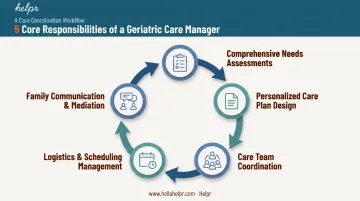
Day to day, a GCM's job looks less like paperwork and more like project management for a person's life. Core responsibilities include:
- Conducting in-home or in-person assessments that evaluate safety, mobility, and cognitive risk factors
- Designing and continuously updating a care plan based on medical needs and personal goals
- Coordinating the full care team, including doctors, aides, therapists, and financial or legal advisors
- Managing logistics like appointments, insurance claims, benefits enrollment, and hospital discharge planning
- Mediating family disagreements and serving as a single point of contact for long-distance relatives
Credentials and Qualifications to Look For
Here's something families often don't realize: "geriatric care manager" isn't a licensed job title. Anyone can print business cards with that phrase on them. Verifying qualifications is on you.
Look for these markers instead:
- Underlying professional license — nursing, social work, or a related clinical credential
- Aging Life Care Association membership — Advanced Professional, Professional, or Associate level (each requires supervised client-centered experience)
- CMC certification — National Academy of Certified Care Managers; requires 1–2 years of supervised, paid care-management work
- CCM certification — Commission for Case Manager Certification; requires at least 12 months of full-time supervised experience
A certification alone isn't proof of skill. An underlying license plus a recognized care-management credential is a stronger signal: the person has done the supervised, paid work these bodies require, not just claimed a title.
How Much Does a Private Geriatric Care Manager Cost?
Costs vary a lot by region and experience level. Many families report hourly rates between $100 and $350. An initial comprehensive assessment can run from a few hundred dollars into the low thousands, depending on complexity.
Here's the part that catches families off guard:
- Medicare and most private health plans don't pay for private GCM services, according to the National Institute on Aging.
- Medicaid only covers case management for people who qualify based on low income.
- Long-term care insurance may help, but coverage depends entirely on the specific policy.
- Most families still pay some or all of the cost out of pocket.
Before signing anything, ask for a written fee schedule that covers:
- Hourly rate and minimum billable increments
- Mileage and travel fees
- After-hours or emergency rates
- Billing frequency
A GCM who won't put fees in writing is a red flag.
Why Working Caregivers Rely on a Geriatric Care Manager
A GCM absorbs the research and coordination burden that would otherwise land on whichever family member has the most flexible schedule (or the least ability to say no). That burden is heavier than most people expect.
Caregivers overall provide an average of 27 hours of care per week, and 35% provide more than 20 hours according to AARP's 2025 report. Half of working caregivers report arriving late, leaving early, or taking time off because of caregiving duties.
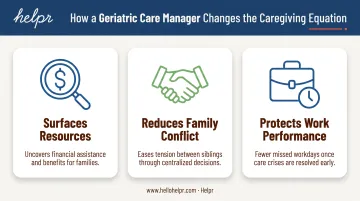
A good GCM changes that math in three ways:
- Surfaces financial assistance, benefit programs, and care options families often miss on their own, which can offset the manager's fee over time
- Reduces family conflict by taking the emotional charge out of decisions siblings might otherwise fight about for months
- Protects work performance with fewer missed days and sharper focus—the productivity link employers watch closely
What to Consider When Choosing the Best Geriatric Care Manager
There's no universal "best" GCM. The right fit depends on your loved one's health condition, family geography, budget, and how urgent the situation is.
What matters is matching a candidate's credentials and process to outcomes you can measure: faster crisis response, fewer care gaps, and lower family stress.
Use this checklist when interviewing candidates:
| Factor | Why It Matters | What to Confirm |
|---|---|---|
| Credentials and licensing | Protects against unqualified practitioners | Underlying license, ALCA membership, years certified |
| Local market knowledge | Speeds up access to hospitals, agencies, benefits | Familiarity with area hospitals, home care agencies, and Medicaid/VA resources |
| Scope of services | Needs change; a one-time assessment may not be enough | Full list of services in the written agreement |
| Availability and emergencies | Aging-related crises don't wait for business hours | Guaranteed after-hours response time |
| Cost structure | Avoids budget surprises down the line | Hourly vs. flat-fee billing, plus add-on charges |
| Communication style | Long-distance families need trust and clarity | Frequency and format of updates (calls, portal, email) |
Ask every candidate for references from other families, not just professional colleagues. Interview two or three before you commit. You need someone who can hold up when a crisis hits, not only in a calm intake call.
How Helpr Can Help
A private geriatric care manager handles the clinical and logistical complexity of elder care. Finding, interviewing, and onboarding one takes time, and your parent's needs don't pause during that search.
Helpr's global backup care platform connects working families with vetted in-home elder care providers on short notice. You get coverage during the search, transition, or crisis period before a long-term care manager is in place.
One Helpr user, a construction employee named Lacey, put it simply: "Helpr has been great when trying to find care for my elderly mother. She lives in a smaller city."
Families can also use Helpr for:
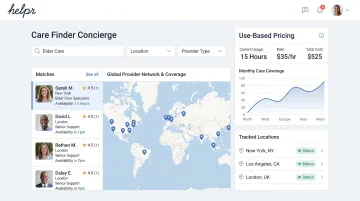
- Care Finder concierge service that pairs you with a specialist to source and vet providers for complex situations, including end-of-life support
- Use-based, employer-sponsored pricing so you pay only for care actually used, not a flat fee
- Access across 150+ countries when your aging parent lives in another city or country
Geriatric care management is rarely insurance-covered, so paying only for care you use is a meaningful offset. Helpr helps you stay covered at home and at work while you put the right long-term care manager in place.
Conclusion
Skip the hunt for the most popular or cheapest name on a directory list. Choose the geriatric care manager whose credentials, service scope, and communication style match your family's situation right now.
That match won't stay fixed. As your loved one's needs evolve, revisit whether the current care manager, or even the current level of service, still fits. Pairing professional care management with workplace caregiving benefits like backup care creates a stronger safety net: one that protects your aging parent and keeps you present and productive at work.
Frequently Asked Questions
What is a geriatric care manager?
A geriatric care manager, or Aging Life Care Professional, is a licensed nurse or social worker hired privately to assess, plan, and coordinate care for an aging adult. They act as a hands-on advocate and single point of contact for the family.
What are the 4 M's of geriatric care?
The 4 M's — What Matters, Medication, Mentation, and Mobility — form an age-friendly care framework used during assessments. Care managers apply all four together, not as separate checklist items, to guide decisions around an older adult's goals and safety.
How much does a private geriatric care manager cost?
Rates commonly fall between $100 and $350 per hour, with initial assessments costing more depending on complexity. Most families pay these costs out of pocket.
Does Medicare or insurance cover geriatric care management?
Medicare and most private insurance plans don't cover it. Medicaid only covers case management for qualifying low-income individuals, and long-term care insurance may help depending on the specific policy.
What's the difference between a geriatric care manager and a hospital case manager?
Private geriatric care managers offer broader, ongoing, family-focused support across settings and over time. Hospital case managers typically focus on a single admission or discharge transition and don't provide continuing advocacy afterward.
How do I find a reputable geriatric care manager near me?
Start with the Aging Life Care Association's online directory, then check with hospital discharge planners, the Eldercare Locator (1-800-677-1116), or referrals from licensed home care agencies in your area.