

Introduction
Realizing that a parent or spouse with dementia needs more care than you can provide at home is gut-wrenching. Many families describe it as one of the hardest decisions they've ever made, tangled up with guilt, grief, and fear of getting it wrong.
You're not alone in facing this. Memory care has become one of the fastest-growing segments of senior living. By early 2023, there were roughly 159,229 memory care units across major U.S. markets, a 10.7% jump from 2020 levels, according to NIC's analysis of the memory care sector.
This guide covers the warning signs that placement may be needed, the types of memory care available, how to evaluate a facility, what it costs, and how caregivers can find support along the way.
Key Takeaways
- Memory care offers secure, 24-hour supervision and dementia-trained staff, unlike standard assisted living.
- Safety incidents and caregiver burnout, not memory loss alone, typically signal it's time to place a loved one.
- Monthly costs range from $5,900 to $10,000+, usually covered by savings, VA benefits, and later Medicaid.
- Caregivers need their own backup support system during the search and transition, not just after.
What Is Memory Care and When Is It Time to Consider It?
Memory care is a residential long-term care option built specifically for people with Alzheimer's or other dementias. It includes 24-hour supervision, secured environments designed to prevent wandering, and staff trained in dementia-specific behaviors.
This sets it apart from standard assisted living, which generally assumes more resident independence, and from nursing homes, which focus on broader medical needs.
You'll find memory care in a few different forms:
- Stand-alone memory care communities built exclusively for dementia care
- Dedicated "neighborhoods" or units within assisted living communities
- Special care units (SCUs) inside nursing homes or continuing care retirement communities
Signs It May Be Time for Memory Care Placement
There's no single moment that signals "now." Instead, experts point to a cluster of warning signs:
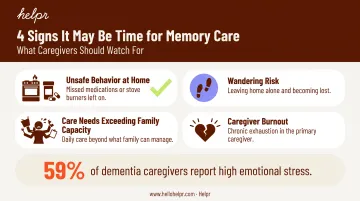
- Unsafe behavior at home, such as leaving the stove on or missing medications
- Wandering risk, including attempts to leave the house unsupervised
- Care needs that exceed what family members can physically provide
- Caregiver health decline or burnout
That last point matters more than most families realize. 59% of dementia caregivers rate their emotional stress as high or very high, and that distress is directly linked to earlier residential placement, according to the Alzheimer's Association's 2025 Facts and Figures report.
So when should someone with dementia stop living alone? It's rarely tied to a specific diagnosis stage or age. It's usually triggered by a concrete event: a fall, a wandering incident, or repeated medication mix-ups.
Early-stage dementia often allows continued independent or lightly supported living. Middle- and late-stage progression generally requires round-the-clock supervision that's difficult to sustain at home.
Types of Memory Care and Long-Term Care Settings
Not every dementia journey requires the same setting. Care needs shift over time, and understanding the full spectrum helps families plan ahead rather than scramble during a crisis.
Lower-intensity options work well in early stages:
- Retirement or independent housing: suitable only when the person can largely self-manage with minimal oversight
- In-home care or adult day programs: support daily needs at home when residential placement isn’t required yet
- **Family caregiving with respite support**: works when relatives provide primary care and need scheduled relief to avoid burnout
Mid-to-high intensity settings become necessary as symptoms progress:
| Setting | Best For | Key Feature |
|---|---|---|
| Assisted living with memory care units | Moderate dementia, some independence | Dementia services vary by provider; always confirm directly |
| Stand-alone memory care / Special Care Units (SCUs) | Wandering risk, behavioral symptoms | Secured entries, alarmed doors, enclosed outdoor spaces |
| Nursing home dementia units | Dementia plus complex medical needs | Round-the-clock medical supervision |
| Continuing care retirement communities (CCRCs) | Families wanting flexibility over time | Residents move between care levels as needs change |
A quick note on terminology: memory care units may or may not be locked, and dementia-specific programming isn't guaranteed just because a community advertises "memory care." Ask directly what's included before assuming anything.
How to Choose the Right Memory Care Facility
Brochures and glossy websites tell you almost nothing about day-to-day reality. The only way to know what a facility is actually like is to see it in person, more than once.
Visit multiple communities. Schedule your first tour, then make at least one unannounced visit, ideally in the evening when staffing tends to be thinner. That's when you'll see the real picture, not the polished one.
Facility Environment and Safety
Walk the building with a critical eye:
- Are hallways circular or clearly labeled to reduce confusion?
- Is the space clean without a strong odor of cleaning products masking something else?
- Are exits secured, and is there an enclosed outdoor walking area?
Staff Training and Care Quality
Ask direct questions rather than accepting vague reassurances:
- How many hours of dementia-specific training do staff complete?
- What's the staffing ratio, especially overnight?
- What's staff turnover like?
- How are aggressive or difficult behaviors managed, and is medication the first response or a last resort?
Programs, Meals, and Continuing Care
Check how daily life works as needs change:
- Request an activity calendar with programming for different cognitive levels, not just bingo on repeat
- Ask how dining handles texture-modified meals and feeding assistance
- Clarify the "aging in place" policy: will your loved one be discharged if care needs or finances change?
Understanding Memory Care Costs and Payment Options
Cost is often the deciding factor, and the numbers can be startling if you haven't priced this out before.
National cost benchmarks:
| Care Setting | Monthly Median/Average |
|---|---|
| Assisted living | $5,900 |
| Memory care | $8,399 (average rent) |
| Nursing home, semiprivate | $9,277 |
| Nursing home, private | $10,646 |
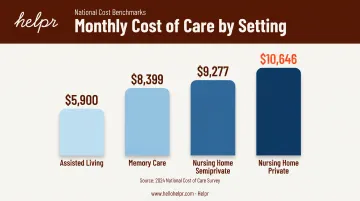
These figures come from the Genworth/CareScout 2024 Cost of Care Survey and AARP's reporting on NIC data. Actual pricing swings widely by state and by the level of care your loved one needs.
Medicare's role is limited. It doesn't cover room and board in memory care. It does cover certain medical services delivered there, such as physician visits and a separate cognitive assessment and care-planning visit under Part B.
Because Medicare leaves room and board uncovered, most families piece together payment from several sources:
- Out-of-pocket savings: the most common starting point
- Long-term care insurance: if purchased in advance
- VA Aid and Attendance benefits: an added monthly payment for eligible veterans and surviving spouses already receiving a VA pension
- Medicaid: available once assets are spent down, though it typically won't cover room and board directly
Given the complexity, especially around Medicaid spend-down rules, talking to an elder law attorney early can save families real money and stress later.
Supporting Family Caregivers Through the Search and Transition
Searching for a memory care facility while working a full-time job is exhausting. Add in touring communities, gathering paperwork, and managing a parent's emotional reaction to moving, and it's no wonder so many caregivers hit a wall. This is the reality of the "sandwich generation," caring for aging parents while still raising kids or managing careers.
This is where employer-sponsored backup care makes a tangible difference. Through Helpr, employees can access short-term elder care support that frees them up to:
- Tour facilities without burning vacation days
- Sit through intake paperwork and admissions calls
- Manage a parent's moving day without missing work entirely
Helpr's backup care benefit covers a broad range of eldercare needs, including in-home companionship, transportation to appointments, and support for aging family members. You can book with as little as 3 hours' notice through the app.

For situations requiring more hands-on help, Helpr's Care Finder service connects families with a dedicated care specialist for 1:1 support navigating complex or transitional care needs.
Coverage details, including hour caps and eligible relationships, vary by employer plan, so check your specific benefits page before you need it.
Support doesn't end on moving day. Visit as often as you emotionally and logistically can during the first few weeks—it helps your loved one adjust and lets you observe care quality firsthand. From there, most families settle into a sustainable rhythm that works for everyone.
Frequently Asked Questions
When should a person with dementia stop living alone?
This typically depends on safety incidents, wandering risk, and the ability to manage medications or emergencies, rather than a specific diagnosis stage. Use a caregiver readiness checklist to assess the situation objectively.
How often should I visit my mother with dementia?
There's no fixed rule, but frequent visits, especially in the first few weeks after a move, help her adjust and let you monitor care quality. Balance this against your own well-being to find a sustainable pace.
What is the difference between memory care and assisted living?
Memory care offers secured environments and staff specifically trained in dementia care, while standard assisted living assumes residents can manage more independently. Not all assisted living communities offer dementia-specific programming.
Does Medicare cover memory care costs?
Medicare doesn't cover room and board in memory care. It does cover certain medical services delivered there, such as physician visits and cognitive assessments under Part B.
How much does memory care typically cost per month?
Memory care averages around $8,399 per month nationally, though costs vary significantly by state and level of care needed. Assisted living typically costs less, while nursing home care usually costs more.
What should I look for during a memory care facility tour?
Check staff dementia training and turnover, secured exits and outdoor spaces, and an activity calendar with programming suited to different cognitive levels. Visit once announced and once unannounced for the full picture.