
The numbers back this up. Child Care Aware of America's 2025 report put the national average annual price of child care at $13,184, up from $13,128 the year before. For a lot of households, that's more than rent.
This article breaks down the most affordable daycare types, financial assistance programs, employer benefits, and how to vet quality care without overspending.
TL;DR
- Costs vary widely by care type and child age—infant care is usually the most expensive.
- Government subsidies, tax credits, and pre-tax accounts can cut your out-of-pocket costs.
- Employer-sponsored backup care is often already available through HR and frequently underused.
- Affordable care can still meet high quality standards when you know where to look.
Understanding Daycare Costs in the US
Daycare pricing shifts with your child's age, where you live, and the type of provider you choose. Across the US, those three factors alone can double—or cut in half—what families pay.
In California, one of the highest-cost states, the Kidsdata child care cost tracker shows licensed center care for infants ranging from $11,500 to $31,500 annually. Family child care homes for infants run $9,900 to $21,200.
Toddler and preschool rates land lower, generally between $7,600 and $24,800 for centers.
What Drives the Price Differences
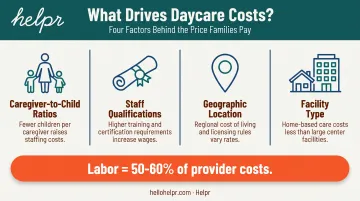
A handful of factors explain why one daycare costs twice as much as another:
- Caregiver-to-child ratios: Infants require more staff per child than preschoolers, driving up labor costs
- Staff qualifications: Centers with more educated teachers often charge more
- Geographic location: Real estate and local wages vary dramatically by region
- Facility type: Family child care homes typically run leaner operations than large centers
A 2021 U.S. Treasury analysis found labor makes up 50-60% of a provider's total costs, which is why staffing ratios matter so much to your monthly bill.
Watch for Hidden Fees
Before you sign anything, ask for a complete cost breakdown. Common add-ons that catch families off guard include:
- Registration or enrollment fees (often due before the first day)
- Late pickup charges, sometimes billed by the minute
- Supply fees for diapers, meals, or classroom materials
- Seasonal camp or field trip charges
One community college district's parent handbook, for instance, permits late-pickup fees of $1 per minute and field trip charges up to $25 per child. Always get these numbers in writing.
Top Affordable Daycare Options for Working Families
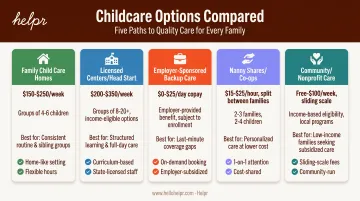
The options below are compared on affordability, accessibility, and reliability, not brand recognition. Your best fit depends on your child's age, your schedule, and your location.
Family Child Care Homes (In-Home Daycare)
Licensed in-home daycare means a state-approved provider cares for a small group of children in a residential setting. These providers still meet state licensing standards, but their overhead is lower than a large center's.
A 2017 Treasury benchmark found national averages of roughly $10,000 for center care versus $8,000 for family-home care, though this gap varies by state and shouldn't be treated as a fixed percentage.
Smaller group sizes also mean more individualized attention, which many families prefer for infants.
| Feature | Details |
|---|---|
| Typical Monthly Cost | Generally lower than center-based care; verify local pricing |
| Group Size | Small, often under 6-12 children depending on state rules |
| Best For | Infants, toddlers, and flexible or non-traditional hours |
Licensed Daycare Centers, Head Start & Pre-K Programs
Centers offer structured curricula and consistent staffing. Federally funded Head Start programs go a step further: eligible families pay $0 for participation, and providers cannot charge fees that create a barrier to enrollment.
Eligibility typically requires household income at or below the poverty line, though programs can enroll a limited percentage of children up to 130% of poverty after prioritizing lower-income families first. Many centers also offer part-time or half-day tracks that cost less than full-time enrollment.
| Feature | Details |
|---|---|
| Typical Monthly Cost | Varies by age tier; Head Start-eligible families pay $0 |
| Eligibility | Head Start is income-based; centers are open enrollment |
| Best For | School readiness and families who qualify for subsidies |
Employer-Sponsored & Backup Care Benefits
More employers now bundle subsidized or on-demand backup care into their benefits packages, and it's often the most underused line item on a benefits menu.
With Helpr's patented "My Choice" technology, employees can upload someone they already trust—a grandparent, neighbor, or family friend—and pay them through the app using employer subsidy dollars. Network sitters remain available when you need a new caregiver.
In practice, that can look like a $5-per-hour copay for network sitters, with the employer covering the rest up to a set hourly contribution.
| Feature | Details |
|---|---|
| Typical Cost to Employee | Heavily subsidized flat copay per use, varies by employer plan |
| Availability | On-demand, app-based; bookable in as little as 3 hours |
| Best For | Occasional, last-minute, or backup coverage needs |
Nanny Shares & Childcare Co-Ops
Splitting a nanny's salary between two families, or rotating supervision duties in a parent co-op, can cut your cash outlay significantly compared to hiring solo. There's no single verified national savings figure for this arrangement, but the math is straightforward: two families splitting one nanny's rate each pay less than they would for a private hire.
The tradeoff is coordination. You need aligned schedules, shared expectations, and real trust between families.
| Feature | Details |
|---|---|
| Typical Monthly Cost | Roughly split in half (nanny share) or near-zero cash cost (co-op) |
| Flexibility | High; schedules customized among participating families |
| Best For | Flexible schedules or multiple children needing personalized care |
Community & Nonprofit-Based Care
Organizations like the YMCA and faith-based centers often use sliding-scale fees tied to household income, and some accept children as young as six weeks. YMCA of San Diego County, for example, bases aid on monthly income, family size, and need, and accepts certain employer or public program payments.
These programs frequently bundle in meals, enrichment activities, or scholarship funding, so total value often exceeds the monthly fee alone.
| Feature | Details |
|---|---|
| Typical Monthly Cost | Sliding scale based on household income |
| Eligibility | Income-based; varies by organization |
| Best For | Lower-income families wanting community-based care |
Financial Assistance, Subsidies & Employer Benefits That Cut Daycare Costs
Even after picking the right care type, layering in financial assistance is where families see the biggest savings.
Child Care and Development Fund (CCDF) subsidies are administered state by state. Eligibility is income-based. Under a 2024 federal rule, family copayments can't exceed 7% of household income—states set their own thresholds and exemptions on top of that cap.
The Child and Dependent Care Tax Credit (CDCTC) lets you claim eligible care expenses on your federal return. For 2025, the IRS caps eligible expenses at $3,000 for one child or $6,000 for two or more.
The credit rate starts at 35% for lower incomes and steps down to 20% once adjusted gross income passes $43,000.
Dependent Care FSAs (DCFSAs) let you set aside pre-tax payroll dollars for care costs. The exclusion limit for 2026 is $7,500 (or $3,750 if married filing separately).
Helpr's app integrates directly with DCFSA cards, so you can pay at booking or submit receipts for reimbursement without extra paperwork.
Beyond federal programs, don't overlook:
- Head Start/Early Head Start — free federally funded care for income-qualifying families
- Employer-sponsored backup care — ask HR about benefits like Helpr that subsidize care via direct payments, stipends, or vetted-provider networks
- Local nonprofit grants and scholarships — supplemental aid for families who don't qualify for government assistance
How to Evaluate Daycare Quality on a Budget
Cost-cutting shouldn't mean cutting corners on safety. A few checks protect both your budget and your child.
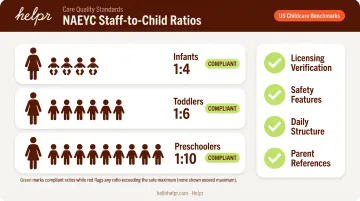
Check staffing ratios first. The National Association for the Education of Young Children recommends a ratio of 1 caregiver to 4 infants, moving up to 1:6 for toddlers and 1:10 for preschoolers. A center that stretches these ratios to cut costs is cutting corners on safety, not just price.
Before enrolling, visit in person and verify:
- Licensing — see the current certificate yourself, not a verbal claim
- Safety — secured entry, visible smoke detectors, and clean bathrooms
- Daily structure — a simple schedule, even for infants, shows intentional care
- References — two or three current parent contacts, not website testimonials alone
If a low-cost option fails on ratios or licensing, it isn't a bargain—it's a risk.
Conclusion
Affordable care can still be high-quality. Families who pair the right daycare type with subsidies, tax credits, and employer benefits often get both.
Start with one concrete action this week: check your eligibility for a state CCDF subsidy or the federal tax credit, and ask your HR department whether backup care benefits already exist in your plan.
Platforms like Helpr work with employers across dozens of industries to make backup care more equitable and affordable for working families. If your company doesn't offer it yet, ask HR to look into adding it.
Frequently Asked Questions
What age is daycare most expensive?
Infant care is generally the most expensive age group. Lower caregiver-to-child ratios required for safety mean centers need more staff per baby, which drives up cost. Prices typically decrease as children move into toddler and preschool age groups.
What is the minimum income for free childcare?
Eligibility for free or subsidized care, like Head Start or state CCDF programs, is generally tied to the Federal Poverty Level and varies by household size and state. Check your specific state's threshold before assuming you don't qualify.
What should I do if I can't find childcare?
Join waitlists at multiple providers simultaneously, tap into community or co-op networks, and check whether your employer offers backup care benefits. Local Child Care Resource and Referral (CCR&R) agencies can also connect you with immediate options.
What is the cheapest type of childcare?
Family child care homes, nanny shares, and parent co-ops are generally the most affordable options compared to center-based care, though actual savings vary significantly by region.
How much does daycare typically cost per month in the US?
Most families pay around $1,100 per month on average nationally (about $13,184 per year). Rates vary widely by state, provider type, and the child's age—infant care costs more than toddler or preschool care.
Can my employer help cover daycare costs?
Many employers now offer dependent care FSAs, discounted center partnerships, or on-demand backup care platforms like Helpr. Ask your HR department what's already available before assuming you have to pay full price out of pocket.