
But wanting to stay home and actually being able to do it safely are two different things. Many families get stuck trying to figure out home modifications, caregiving logistics, and costs, often without a clear starting point.
This guide walks through what aging in place really means, why so many older adults choose it, how to prepare a home for the long haul, how to build a support system, what it costs, and how employers are stepping up to help caregivers juggling work and family responsibilities.
Key Takeaways
- Most older adults prefer home over a facility, yet few have a modification plan.
- Simple safety upgrades, like grab bars and better lighting, prevent falls and delay costly care transitions.
- A mix of family caregivers, paid help, and technology keeps aging in place sustainable long-term.
- In-home care often costs less than a nursing home but can exceed assisted living as hours add up.
- Employer elder care benefits, including on-demand backup care, can ease the load on working caregivers.
What Is Aging in Place?
Aging in place means living in your own home and community safely, independently, and comfortably, regardless of your age, income, or ability level. That's the working definition used by public health officials, and it's intentionally broad.
It's different from assisted living or a nursing home in one key way: instead of moving you into a new environment with built-in staff, aging in place brings support to you. Your home stays your home. Care gets layered in as needed.
You'll sometimes see this concept called "aging in community" or "independent living at home." Both describe the same basic idea, just with slightly different emphasis on social connection versus the physical dwelling itself.
The preference for staying home is well documented. AARP's 2024 Home and Community Preferences Survey found 75% of adults 50 and older want to remain in their current home, and 73% want to stay in their current community.
Who Typically Chooses to Age in Place?
Not every aging-in-place journey looks the same. People generally fall into three groups:
- No urgent needs — proactive planners who modify their home before problems arise
- Progressive conditions — adults managing diabetes, heart disease, or arthritis whose support needs grow gradually
- Sudden traumatic change — people facing a fall, stroke, or diagnosis that creates urgent, immediate care needs
All three paths are becoming more common as the older population grows. The U.S. had 61.2 million adults 65 and older in 2024, roughly 18% of the population, and that share keeps climbing. The Census Bureau projects that by 2030, one in five U.S. residents will be of retirement age.
Why Older Adults Choose to Age in Place
Most older adults who stay home aren’t only avoiding a move. They’re protecting independence, community ties, and often their budget.
Independence and Control
Staying home preserves something facilities can't always replicate: control over your own routine. What time you eat breakfast. Where your furniture sits. Who visits and when.
For many older adults living with disabilities, dignity and autonomy sit at the center of quality of life. Handling daily activities independently—even small ones—directly shapes how people feel about their lives.
Familiarity and Community Connections
Staying in a known neighborhood keeps people connected. Long-time friends. A regular coffee shop. A church group you've attended for decades.
That connection isn't just emotional; it's protective. A 2025 study following nearly 1,900 dementia-free older adults for an average of 6.7 years found that each one-unit increase in social activity was linked to a 38% lower risk of dementia.
Staying socially engaged, something far easier in a familiar environment, supports long-term cognitive health.
Financial Considerations
Money plays a real role in this decision too. Many older homeowners own their homes outright, with no mortgage weighing on their monthly budget. Harvard's Joint Center for Housing Studies reports that 59% of homeowners aged 65-79 and 69% of those 80 and older were mortgage-free as of 2022.
Here's how the numbers typically stack up on a monthly basis, based on 2025 national cost survey data:
| Care Type | Estimated Monthly Cost |
|---|---|
| In-home caregiver (44 hrs/week) | ~$6,673 |
| Assisted living | ~$6,200 |
| Nursing home (semi-private room) | ~$9,581 |
| Nursing home (private room) | ~$10,798 |
Home care isn't automatically the cheapest option. It beats nursing home care by a wide margin, but at higher weekly hours it can cost more than assisted living.
How to Prepare Your Home for Aging in Place
Planning ahead, before care becomes urgent, makes a measurable difference. Yet most people wait too long. The University of Michigan's National Poll on Healthy Aging found that only 31% of older adults had actually modified their home, even though 46% had taken some aging-in-place step.
Among those still lacking key features, 36% planned to add bathroom grab bars, 25% wanted a walk-in shower, and 12% each were planning a stair-free entry or a first-floor bedroom.
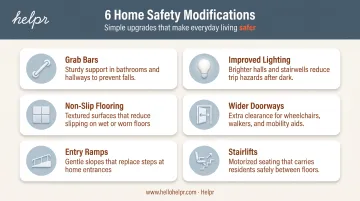
Common home safety modifications include:
- Grab bars in bathrooms and near stairs
- Improved lighting in hallways, stairwells, and entryways
- Non-slip flooring in kitchens and bathrooms
- Wider doorways for walkers or wheelchairs
- Entry ramps to eliminate steps
- Stairlifts for multi-level homes
Rather than guessing where the risks are, walk through each room with a home safety checklist. Bathrooms, stairs, and kitchens tend to be the highest-risk zones.
If that walkthrough feels overwhelming, a Certified Aging-in-Place Specialist (CAPS)—a credential from the National Association of Home Builders—or an occupational therapist can guide renovation decisions based on your mobility and health needs.
Cost shouldn't stop the planning process. Funding leads for eligible homeowners include:
- State housing finance agencies
- HUD's Community Development Block Grant program
- The Administration for Community Living's Housing and Services Resource Center
Home modifications reduce fall risk, but many families still need reliable in-home help as needs change. Pairing a safer layout with vetted eldercare support makes aging in place more sustainable day to day.
Building Your Support Network
No one ages in place alone, even when it looks that way from the outside. Support generally comes from two directions.
Informal caregivers — family, friends, neighbors — typically handle:
- Companionship and emotional support
- Occasional transportation
- Light household help
- Check-ins and oversight
Formal in-home care services cover more structured needs, including:
- Meal preparation
- Medication management
- Transportation to medical appointments
- Assistance with activities of daily living (bathing, dressing, mobility)
- Post-hospital recovery support
- Hospice-related care
Helpr connects families with vetted in-home caregivers for these tasks—whether you need a ride to a cardiology appointment or ongoing recovery support after surgery. For a more tailored, longer-term arrangement, Care Finder helps you build a lasting match rather than a one-off booking.
Technology fills in the gaps between visits. Medical alert systems, smart home sensors, and telehealth platforms let family members and providers monitor safety remotely, without hovering.
Local resources matter too:
- Area Agencies on Aging coordinate services in your region
- Adult day programs offer supervised social time and respite for family caregivers
- NORCs (Naturally Occurring Retirement Communities) bring support services into buildings or neighborhoods where older residents have aged in place together
Understanding the Costs of Aging in Place
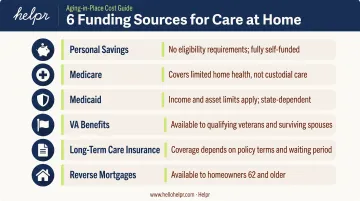
Paying for aging in place usually means combining several funding sources rather than relying on just one:
- Personal savings — the most common starting point
- Medicare — covers skilled, intermittent home health (nursing, therapy), not standalone custodial care
- Medicaid — may cover custodial care for people who meet state financial and functional rules
- VA benefits — available to qualifying veterans
- Long-term care insurance — if purchased in advance
- Reverse mortgages — convert home equity into usable funds
That Medicare distinction trips people up constantly. Medicare will pay for a nurse changing a wound dressing. It generally won't pay for someone to help a parent bathe or get dressed if that's the only service needed.
Medicaid can fill that custodial care gap, but only for those who qualify under their state's program.
A practical way to stretch the budget: Dependent Care FSA (DCFSA) funds. Through Helpr, employees can apply pre-tax DCFSA dollars to eldercare bookings, either with a DCFSA debit card at checkout or by submitting in-app receipts for reimbursement. That helps when in-home care hours add up quickly.
Even with extended hours, aging in place usually costs less than institutional care—especially a nursing home. The gap narrows against assisted living, but when families weigh quality of life next to cost, home often wins on both.
Supporting Family Caregivers: How Employers Can Help
A large share of working adults are managing careers while caring for aging parents, often called the "sandwich generation." Research from Harvard Business School found that 73% of employees have some current caregiving responsibility, and 32% have left a job because of caregiving demands. That's not just a productivity problem. It's a retention problem too.
Employer-sponsored benefits are starting to catch up. Helpr's global backup care platform connects employees with vetted in-home elder care on short notice. That speed matters because elder care emergencies rarely give advance warning.
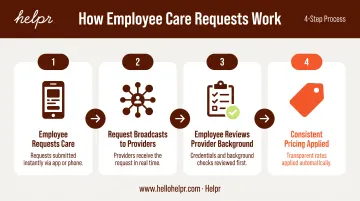
Here's how the matching process works:
- An employee requests care through the Helpr app, sometimes with as little as 3 hours' notice
- The request broadcasts to all available in-home providers in that employee's area
- The employee reviews provider background, education, and experience before choosing
- Pricing stays consistent regardless of which provider gets selected
Every provider passes a 7-point screening process before joining the network, including:
- Virtual interviews
- Criminal background checks
- CPR certification
- Reference verification
Helpr's patented My Choice technology adds another layer of flexibility. Employees can designate a trusted person (a neighbor, family friend, or relative) as a paid caregiver for an aging parent, with the employer subsidizing much of the cost. That option matters most in smaller communities where professional in-home care is limited.
More companies now treat elder care support as essential, not optional. Benefits that stop at childcare leave a large share of the workforce without help when aging parents need it most.
Frequently Asked Questions
What are the pillars of aging in the right place?
The core pillars are health, home safety, financial security, and social connection. Address these four first—they cover what most families need to stay independent at home.
What is the 40/70 rule for aging?
The 40/70 rule is informal guidance: start talks about aging plans, finances, and care wishes when a parent turns 70 or an adult child turns 40. It isn’t a clinical standard—just a prompt to talk before a crisis forces the issue.
What is another term for aging in place?
"Aging in community" is the most common alternate term, stressing social and neighborhood ties—not only the physical home. "Independent living at home" is also used descriptively.
What is the biggest challenge of aging in place?
Home safety risks like falls top the list, followed by social isolation and difficulty accessing reliable caregiving support. Transportation and managing multiple healthcare needs without on-site staff are close behind.
At what age should you start planning to age in place?
There’s no fixed age. Start in your early-to-mid 60s, or as soon as health changes appear—while you can still make clear decisions—rather than waiting for a specific birthday.
Does Medicare pay for home modifications?
Original Medicare generally does not cover structural modifications like ramps or grab bars. Medicaid waivers, state grants, or Medicare Advantage supplemental benefits may help—check your specific plan and local programs.