

Maybe you're heading back to full-time work after parental leave. Maybe your mom's health has taken a turn and she needs someone at the house most days. Whatever the trigger, you're suddenly facing a much bigger question: how do you find ongoing, reliable care?
For dual-income households and sandwich-generation caregivers juggling kids and aging parents at once, this transition is confusing and emotionally draining. It's rarely planned. This guide breaks down what long-term placement actually means, how it differs from backup care, the caregiver types available, and how to vet and afford the right fit — including how employer-sponsored benefits like Helpr can lighten the load.
Key Takeaways
- Long-term placement is ongoing in-home care from a dedicated caregiver, lasting months to years.
- Job changes, health declines, and ending parental leave often push families from short-term into long-term care.
- Benchmark in-home rates against facility options; costs vary by caregiver type, location, and hours.
- Written agreements, trial periods, and background checks reduce the risk of a bad placement.
- Employer benefits increasingly cover long-term care coordination, not just emergency backup.
What Is a Long-Term Placement for Childcare or Eldercare?
A long-term placement is an ongoing arrangement, generally lasting anywhere from a few weeks to several years, where a dedicated caregiver provides regular in-home childcare or eldercare. It's built into the family's routine rather than called on only when something goes wrong.
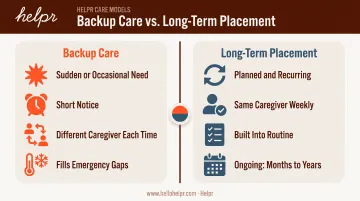
This differs from backup or short-term care. Backup care fills sudden gaps: a sick daycare, a snow day, a nanny who calls out. Long-term placement is a planned, recurring solution: the same caregiver showing up on the same schedule, week after week.
Families typically shift from short-term to long-term care needs because of specific events:
- A parent returning to full-time work after leave
- A grandparent's declining health following a hospital stay
- Daycare waitlists with no open slots
- A child with special needs requiring consistent, one-on-one attention
"At home" placements aren't one-size-fits-all. They can range from a caregiver who comes three afternoons a week to a live-in provider who's present around the clock. The right structure depends on your family's schedule, the level of care needed, and, frankly, your budget.
More households land here than you’d expect. Rising childcare costs and a growing preference for aging in place are pushing families toward dedicated in-home care as a lasting part of daily life—not a temporary patch.
Why Families Turn to Long-Term In-Home Care
Childcare Drivers
For many parents, the math simply doesn't work with center-based care. Common friction points include:
- Daycare waitlists that run months long
- Hours that rarely cover a full workday
- Infants or kids with special needs who need one-on-one attention a classroom can't provide
Cost is a huge part of this equation. The 2024 national average child care price hit $13,128, equal to 10% of income for a married-couple family and 35% for a single-parent household, according to Child Care Aware of America's 2024 price report. Prices climbed 29% between 2020 and 2024, well ahead of general inflation.
Eldercare Drivers
On the eldercare side, the driver is often preference as much as necessity. 75% of adults age 50 and older want to remain in their current home, and 73% want to stay in their current community, according to AARP's 2024 home and community preferences survey. Preference alone isn't always the full story. Post-hospitalization recovery, chronic conditions, or a family caregiver's own health limits often make in-home support the practical choice.
The Workplace Angle
Unresolved caregiving doesn't stay contained at home. It follows people to work. Among employed family caregivers surveyed in AARP's Caregiving in the US 2025 report, 56% arrived late, left early, or took time off, and 18% cut back their hours entirely.
That means lost productivity for employers and lost income for families. More companies now offer care benefits so employees aren't left to solve it alone.
Types of Long-Term Home Care Placements
Long-term care at home isn't a single service. Families typically choose from a handful of models depending on age, health, and schedule needs.
Childcare Placements
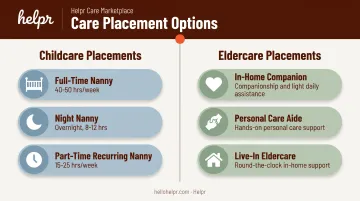
- Full-time nannies — either live-in or live-out, usually committing to 30-50 hours a week, handling daily routines, meals, and activities
- Night nannies — specialize in overnight infant care, often for newborns, so exhausted parents can get consistent sleep during those first months
- Part-time recurring nannies — consistent weekly hours for after-school care, partial workdays, or shared coverage without a full-time hire
Eldercare Placements
- In-home senior caregivers / companions — provide non-medical support like meal prep, transportation, medication reminders, and companionship
- Personal care aides — help with activities of daily living such as bathing, dressing, and mobility, without providing skilled nursing
- Live-in eldercare — round-the-clock supervision for seniors who need more oversight but want to stay out of a facility
Hybrid and Shared-Care Models
Not every family needs full-time coverage. A part-time long-term caregiver might supplement what family members already provide, or fill in a few dedicated hours a week alongside facility-based care. This flexibility is often the most realistic path for households balancing multiple responsibilities.
Placement agencies and care platforms also differ from hiring on your own. Agencies and concierge-style services typically pre-screen candidates and handle sourcing, while independent hiring puts the full vetting burden on you. The right path depends on how much time you can invest in the search.
How Long Does a Long-Term Placement Typically Last?
"Long-term" generally means placements lasting from a few months to several years, distinguishing them from short-term or temporary arrangements measured in days or weeks. There's no fixed national average. Every placement is shaped by the family's changing circumstances.
Several variables influence how long a placement lasts:
- A child aging into school: reducing or eliminating the need for daytime coverage
- A senior's changing health status: requiring either more or less support over time
- Family relocation: ending an otherwise stable arrangement
- Caregiver availability: turnover happens, even in strong placements
Because circumstances shift, long-term doesn't mean permanent or rigid. Build flexibility into any care agreement:
- A trial period (commonly 30-90 days) before locking in a longer commitment
- A scheduled check-in, such as a six-month review, to reassess hours and duties
- Clear notice requirements, typically two to four weeks, if either side needs to end the arrangement
Treat the relationship as a living agreement you revisit as needs change.
How to Find and Vet the Right Long-Term Caregiver
Finding someone you trust to care for your child or aging parent, day after day, takes more effort than booking a one-off sitter. Families typically search through:
- Personal referrals from friends, neighbors, or pediatricians
- Local care agencies
- Online caregiver marketplaces
- Employer-sponsored care benefit platforms
Essential Vetting Steps
Whichever route you choose, don't skip these steps:
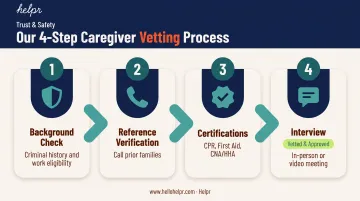
- Background checks: criminal history, identity verification, and work eligibility
- Reference verification: actually call previous families, don't just read reviews
- Certifications: CPR and First Aid at minimum; CNA or HHA credentials matter more for skilled eldercare needs
- In-person or video interviews: a resume doesn't tell you how someone interacts with your child or parent
Before committing to a longer contract, run a trial shift or short trial period. It's the best way to see how a caregiver handles your routines and your household before you're locked in.
Finally, put everything in writing. A clear care agreement covering hours, duties, compensation, and termination terms prevents a lot of headaches later. Vague verbal understandings are where most disputes start.
If you'd rather not run that search alone, Helpr's Care Finder pairs you with a dedicated care specialist. They source and vet candidates, run background screening, and coordinate placement under Helpr's Direct Hire framework.
Helpr's patented My Choice technology also lets families formalize care with someone they already trust, such as a grandparent, neighbor, or family friend, and turn an informal arrangement into a structured one.
Costs and Support Options for Long-Term Home Care
Long-term care pricing swings widely based on a handful of factors:
- Location — urban markets run higher than rural ones
- Live-in vs. live-out status — live-in arrangements often lower hourly cost but require room and board
- Certifications required — CNA or HHA-level skills command higher rates than companion care
- Weekly hours — part-time supplemental help costs less overall than full-time coverage
Here's how in-home care benchmarks against facility-based alternatives:
| Care Model | Typical Cost | Notes |
|---|---|---|
| Daycare (one child) | ~$321/week | Center-based, 2023 advertised rates |
| Full-time nanny (40 hrs) | ~$766/week | Averaged 2023 rates |
| Nonmedical home caregiver | ~$6,292/month | Based on 44 hrs/week, 2024 median |
| Assisted living (private room) | ~$5,900/month | Facility-based comparator, 2024 median |
These figures come from different survey years and methods, so treat them as directional benchmarks rather than an apples-to-apples match. In-home long-term care and facility care often land in a similar cost range, so the decision usually turns on preference and fit as much as price.
Employer support is closing part of this gap. More companies now offer family care benefits that go beyond emergency backup care.
Helpr's employer-sponsored programs, including Global Care Stipends and Care Finder, help subsidize or streamline access to long-term placement. That eases ongoing care costs for families and helps employers cut absenteeism and improve retention.

Frequently Asked Questions
How long is a long-term placement?
Long-term placements typically last from a few months to several years, depending on how your childcare or eldercare needs evolve. Short-term or backup care, by contrast, is measured in days or occasional shifts.
What's the difference between long-term placement and backup care?
Backup care covers short-notice, occasional gaps — a sick day or a canceled sitter. Long-term placement is a planned, recurring arrangement built into your family's ongoing routine.
How much does long-term in-home care cost?
Costs vary by caregiver type, weekly hours, and U.S. market. Compare live-in packages versus hourly live-out rates, and agency pricing versus independent hires, before you commit.
How do I find a reliable long-term caregiver for my child or aging parent?
- Run background checks and verify references
- Confirm CPR/First Aid or other relevant certifications
- Use a paid trial period before a longer commitment
- Put schedule, pay, duties, and terms in writing
Can my employer help cover long-term childcare or eldercare costs?
Many employers now offer family care benefits, including platforms like Helpr, that support both backup and longer-term caregiving needs through stipends, concierge placement, or subsidized care.
What qualifications should a long-term caregiver have?
For childcare, look for current CPR and First Aid certification at minimum. For eldercare, non-medical companions need less formal training, while CNA or HHA credentials matter for higher-need medical support.