Introduction
Most people want to age in place. In AARP's 2024 Home and Community Preferences Survey, 75% of adults 18 and older said they want to remain in their current home, and 73% wanted to stay in their community as they age.
That preference is driving demand for in-home support. Families searching for help quickly hit a wall of confusing terms: private caregiver, home health aide, companion, personal care aide. Each means something different, and picking the wrong one can create real legal and safety headaches.
This guide breaks down exactly what a private caregiver is, what they do day-to-day, how they compare to agency and family caregiving, and what it actually costs to hire one.
Key Takeaways
- Private caregivers are hired directly by the family, which becomes the legal employer
- Duties cover personal care, household help, health support, and companionship
- Four main caregiver types exist, ranging from companions to certified nursing assistants
- Private hire often costs less per hour, but families absorb taxes and liability that agencies typically handle
What Is a Private Caregiver?
A private caregiver — sometimes called a private-duty caregiver — is a non-medical caregiver hired directly by a family, rather than through a home care agency. The family manages recruiting, scheduling, and payment themselves.
This creates a direct employer-employee relationship. When you hire privately, you're not a client of an agency. You're the employer, and that comes with real responsibilities.
The IRS is clear about this. If you control what work gets done and how it's done, your caregiver is legally a household employee, not a freelance contractor, no matter what either of you calls the arrangement. See IRS Publication 926 (2024) for household employment rules.
A few things distinguish private caregivers from other care roles:
- They generally cannot perform clinical or medical tasks like medication administration or wound care
- Often labeled independent contractors, though IRS rules usually treat them as household employees
- Some are Certified Nursing Assistants (CNAs) or Home Health Aides (HHAs) working independently, outside an agency's supervision
- The term covers elder care as well as family and disability care settings
That distinction matters before you hire. When a caregiver works outside a licensed agency, your family owns the compliance and safety obligations an agency would otherwise handle.
What Do Private Caregivers Do? Core Duties and Responsibilities
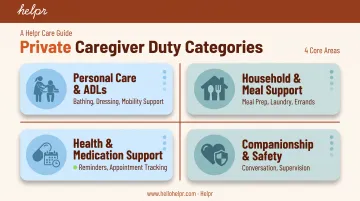
Private caregiver duties generally fall into four buckets: personal care, household support, health-related assistance, and companionship. The exact mix depends on the written care plan you and the caregiver agree on upfront.
Personal Care & Activities of Daily Living (ADLs)
This is hands-on support with daily self-care tasks, including:
- Bathing and showering assistance
- Dressing and grooming
- Toileting and incontinence support
- Mobility assistance to help prevent falls
These tasks require trust and physical proximity, which is why matching personality and comfort level matters as much as skill.
Household & Meal Support
Beyond direct personal care, most private caregivers handle the everyday tasks that keep a household running:
- Meal planning and preparation
- Light housekeeping and laundry
- Grocery shopping and errands
- Transportation to appointments or social outings
Health & Medication Support
Here's where scope matters most. A non-medical private caregiver can:
- Provide medication reminders
- Track upcoming appointments
- Monitor general well-being
- Accompany a client to medical visits
They typically cannot administer medication, check vital signs, or perform wound care. The Bureau of Labor Statistics assigns those clinical tasks to home health aides working under a nurse's direction, not independent private caregivers.
Companionship & Safety Supervision
Isolation is a real risk for aging or homebound adults. Companionship duties include:
- Conversation and shared hobbies
- Emotional support
- General safety monitoring while family members are away
The U.S. Department of Labor defines this core role as providing "fellowship and protection": keeping the client company, engaged, and safe when family cannot be there.
What Are the 4 Types of Private Caregivers?
Caregivers are typically categorized by training level and the scope of care they're qualified to provide. Knowing which type you need shapes both your search and your budget.
Companion Caregivers
Companion caregivers focus on social interaction, supervision, and light incidental assistance. They don't perform hands-on personal care as their primary function. That limit matters under federal wage rules too: any personal care they provide must stay incidental, generally capped around 20% of weekly hours, for a specific overtime exemption to apply.
Personal Care Aides / Home Care Aides
Personal care aides assist directly with activities of daily living (ADLs) and personal hygiene. A high school diploma is common, though some positions require no formal education at all. Training requirements get stricter for aides working through certified home health or hospice agencies, but that's outside the private-hire scope.
Certified Nursing Assistants (CNAs)
CNAs complete a state-approved training program and pass a competency exam. Their added training allows basic health monitoring under a licensed nurse's supervision in most settings. A CNA hired privately keeps their credential, but working privately doesn't grant them authority to perform supervised clinical tasks outside that structure.
Specialized Caregivers
Some caregivers pursue focused training for specific conditions:
- Dementia and Alzheimer's care: for example, the Alzheimer's Association's essentiALZ certification, a three-hour course with a two-year renewal cycle
- Disability support: tailored to mobility, communication, or behavioral needs
- Chronic condition management: for clients with Parkinson's, stroke recovery, or similar needs
Private Caregiver vs. Home Care Agency vs. Family Caregiver
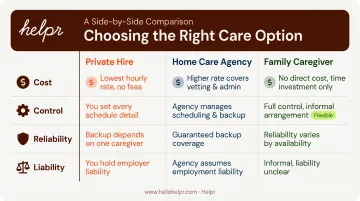
Families typically weigh three paths: hiring privately, going through an agency, or relying on unpaid family caregiving. Each differs across cost, control, reliability, and liability.
Cost & Payment Structure
Private hire generally has a lower hourly rate since there's no agency markup. Families still absorb administrative costs (payroll setup, taxes, and insurance) that agencies bundle into their higher rates. Unpaid family caregiving skips wages entirely, though it carries a real time cost—AARP valued 36 billion hours of family care in 2021 at roughly $600 billion.
Control & Personalization
Hiring privately lets you choose your exact caregiver and negotiate the schedule directly. Agencies match you with staff from their roster and may rotate caregivers based on availability, which can affect consistency. Family caregivers give you full say over the arrangement, limited mainly by their own schedule and competing responsibilities.
Reliability & Backup Coverage
This is where agencies tend to win. Per AARP guidance on hiring a caregiver, if an agency caregiver calls in sick, the agency usually sends a substitute. With private hire, you're responsible for arranging your own backup plan if your caregiver gets sick, takes vacation, or leaves. Family care has no formal backup system either.
Liability, Taxes & Legal Responsibility
Hire someone directly and you become a household employer, responsible for payroll taxes, potential workers' comp, and liability coverage under IRS Publication 926. Agencies typically absorb that liability themselves. Family caregivers avoid employer tax duties but still carry personal and financial risk if something goes wrong.
| Factor | Private Hire | Home Care Agency | Family Caregiver |
|---|---|---|---|
| Cost | Lower hourly rate, hidden admin costs | Higher rate, bundled services | No wage, high time cost |
| Control | Full choice of caregiver | Agency assigns/rotates staff | Full control |
| Reliability | Family arranges backup | Agency provides substitutes | No formal backup system |
| Liability | Family is legal employer | Agency assumes liability | Family absorbs personal risk |
How Much Does a Private Caregiver Cost?
Pricing varies widely, and the numbers you'll find online don't always compare apples to apples.
For context, the 2024 Genworth/CareScout Cost of Care Survey put the national median for agency-provided homemaker services at $33 per hour, up from $30 in 2023. That figure reflects agency-billed rates, not what an independently hired caregiver charges.
Separately, BLS reported a median wage of $16.78 per hour for home health and personal care aides in May 2024. That's the worker's pay, not the family's total cost.
Several factors move the price up or down:
- Geographic location — urban markets run higher than rural ones
- Hours and schedule — overnight or live-in arrangements price differently than daytime hourly visits
- Level of specialization — dementia or disability-specific training commands a premium
- Live-in vs. hourly — live-in arrangements often trade a lower effective hourly rate for a flat daily or weekly fee
Here's the catch families often miss: the "savings" of private hire can shrink fast once you add payroll taxes, workers' comp, and liability insurance. What looks like a bargain on paper sometimes lands closer to agency pricing once you account for your obligations as an employer.
How to Find and Hire a Private Caregiver Safely
Finding a qualified private caregiver takes more legwork than posting an ad and hoping for the best.
Common sourcing paths include:
- Personal referrals from friends, neighbors, or your doctor's office
- Community and senior center networks
- Online caregiver marketplaces and job boards
Whichever route you take, run a real background check and call every reference. Don't skip this step because a candidate seems friendly in the interview.
Once you've chosen someone, put everything in writing. A signed care agreement should spell out:
- Specific duties and daily schedule
- Pay rate and payment method
- Time off, sick days, and backup coverage expectations
- Confidentiality and household rules
This single document prevents the majority of disputes that crop up later.
Sourcing and vetting a caregiver on your own is a real lift. Some employers now offer backup care as a benefit so you don't have to carry that process alone.
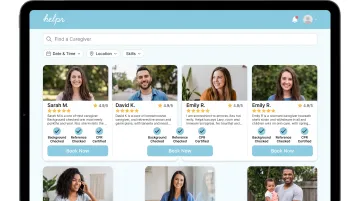
Helpr's global backup care platform gives employees on-demand access to caregivers who have already cleared background checks, reference checks, and CPR certification. Families skip managing payroll and liability themselves. Ask your HR team whether a similar benefit is already in your package before you start sourcing independently.
Frequently Asked Questions
How much does a private caregiver cost?
Private caregivers often charge less per hour than agency rates. Agency pricing (around $33/hour nationally for homemaker services) bundles in taxes, insurance, and backup coverage. Actual cost depends heavily on your location and the level of care needed.
What are the duties of a private caregiver?
Private caregivers handle personal care (bathing, dressing, mobility), household support (meals, laundry, errands), health-related assistance (medication reminders, appointment support), and companionship. Clinical tasks fall outside their scope.
What are the 4 types of caregivers?
The four main types are companion caregivers, personal care aides or home care aides, Certified Nursing Assistants (CNAs), and specialized caregivers trained in areas like dementia or disability care.
Do I need to pay employment taxes for a private caregiver?
In most cases, yes. If you control what work is done and how, the IRS classifies your caregiver as a household employee, which triggers Social Security, Medicare, and potentially unemployment tax obligations.
Can a private caregiver provide medical care?
No. Private caregivers provide non-medical support only. Tasks like medication administration, vital sign checks, and wound care require a licensed home health aide or nurse operating under clinical supervision.
How is a private caregiver different from a home health aide?
A private caregiver is hired independently and provides non-medical support. A home health aide typically works under an agency or clinical supervision and can perform limited medical tasks under a nurse's direction.