

Introduction
Maybe it's the phone calls that feel shorter than they used to. Or the fridge that's a little emptier every time you visit. Adult children often notice these small shifts long before they can name what's wrong.
A parent isn't sick, exactly. They're just... slower. Quieter. Alone more than they should be.
Companionship care fills exactly this gap. It's non-medical, low-intensity support focused on connection, conversation, and daily living help — without turning a parent's home into a medical setting.
This guide breaks down what companionship care actually includes, who it helps most, what it costs, and how families (including working caregivers juggling jobs and aging parents) can pay for it.
Key Takeaways
- Companionship care is non-medical—social connection, light household help, and safety check-ins, not personal or clinical care
- Often the first step in a senior’s care journey for independent adults facing isolation
- Expect costs to hinge on location, provider type, and weekly hours
- Private pay, VA benefits, LTC insurance, and employer-sponsored backup care can all offset costs
What Is Companionship Care?
Companionship care means someone shows up, sits down, and engages. It's built on a "being with, not doing to" philosophy. Rather than checking tasks off a list, a companion caregiver focuses on presence: conversation, shared activities, and a watchful eye for safety.
This distinguishes it from personal care (hands-on help with bathing or dressing) or skilled nursing care. Companionship care never touches medical territory.
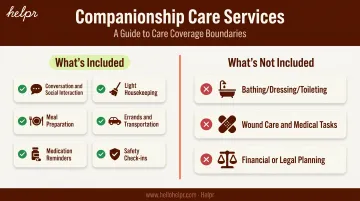
Typical Services Included in Companionship Care
A companion caregiver typically provides:
- Conversation and social interaction
- Light housekeeping (tidying, laundry, dishes)
- Meal preparation
- Errands and transportation to appointments or social outings
- Medication reminders (not administration)
- Safety check-ins and fall-risk awareness
Companion caregivers do not provide:
- Bathing, dressing, or toileting
- Wound care or other hands-on medical tasks
- Financial or legal planning
If a senior needs help with activities of daily living, that signals a need for personal care instead.
Who Companionship Care Is Right For
The ideal candidate is largely independent but showing signs of disconnection:
- Lives alone and has limited daily contact with others
- Recently lost a spouse or close friend
- Shows early withdrawal from hobbies or social activities
- Has family members who live far away and want reassurance
For families juggling distance or full-time work, it offers a middle ground: real support without medicalizing a parent's daily life.
Benefits of Companionship Care for Seniors and Families
Social isolation isn't a minor issue for older adults. In a national poll of adults ages 50 to 80, 34% felt isolated in the prior year, 37% lacked companionship, and 33% had infrequent contact outside their household, according to a University of Michigan poll on aging.
Research from the National Academies has linked social isolation to a roughly 50% higher risk of dementia and elevated cardiovascular risk. Regular companionship counters this in a few concrete ways:
- Cognitive stimulation through conversation, games, and shared activities
- Routine and structure, which many seniors lose after retirement or widowhood
- A renewed sense of purpose, especially when a companion shares hobbies or interests
Beyond mental well-being, companionship care helps seniors stay in their own homes longer. Regular check-ins catch small problems (a missed meal, an unlocked door) before they become emergencies that force a move to assisted living.
Families get practical support as well as peace of mind:
- Adult children who can't be there daily get real-time reassurance that someone is checking in
- Flexible care plans scale hours up as a parent's needs change
- Families avoid restarting the caregiver search from scratch when needs grow
How Much Does Companionship Care Cost—and Who Pays for It?
Pricing varies more than most families expect. Recent industry surveys put non-medical in-home care at roughly $26 to $35 per hour nationally, depending on scope and provider type.
CareScout's 2025 national survey found a median of $35/hour, translating to about $80,080 per year at 44 hours per week, according to CareScout's 2025 Cost of Care Survey. That figure blends homemaker and home-health-aide rates, so it runs higher than companionship-only pricing. AARP's earlier estimate for companionship and homemaker services specifically landed closer to $26/hour.
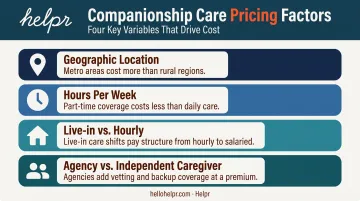
What Drives the Price
- Geographic location — metro areas typically cost more than rural regions
- Hours per week — a few visits weekly costs far less than daily coverage
- Live-in vs. hourly — live-in arrangements bundle pay differently and aren't the same as 24/7 shift care
- Agency vs. independent caregiver — agencies charge more but handle vetting, backup coverage, and payroll
Who Typically Pays for Companionship Care
Original Medicare generally does not cover companion care, since it's non-medical by definition. According to Medicare.gov, homemaker services and standalone custodial care fall outside covered benefits. Some Medicare Advantage plans offer limited supplemental in-home support, but availability is plan-specific.
Families typically cover costs through:
- Private pay — the most common source for companionship-only care
- Long-term care insurance — often requires meeting an ADL-based eligibility trigger and elimination period first
- VA Aid & Attendance — added pension income for eligible veterans, though eligibility usually requires a functional need beyond loneliness alone
- Family cost-sharing — siblings splitting the bill
Employer-sponsored backup care is another option many families overlook. Helpr, for example, offers working caregivers subsidized access to vetted companion and elder care through employer benefit programs.
Employees typically get a set number of subsidized hours per benefit term, paying a modest copay per hour while the employer covers the remainder. The model is use-based, so employers only pay for care actually booked, and many programs integrate with a Dependent Care FSA for additional tax savings.
Before assuming you'll pay full price, check whether your employer offers a dependent or elder care benefit. It's one of the most underused perks in most benefits packages.
Companionship Care vs. Other Types of Senior Care
Companionship care sits at the lightest end of the care spectrum. Here's how it compares:
| Care Type | Scope | Setting |
|---|---|---|
| Companionship care | Conversation, light housekeeping, errands, safety check-ins | Senior's own home |
| Personal care | Hands-on ADL support: bathing, dressing, toileting | Home or care facility |
| Home health | Skilled nursing, wound care, therapy | Home (clinical) |
| Assisted living | Housing plus meals and varying personal-care support | Residential facility |
The key distinction: personal care includes hands-on ADL assistance; companionship care does not. Assisted living moves a senior out of their home entirely—companionship care is built to keep them there.
Many families start with companionship care and later move into more comprehensive home care, personal care, or memory care as needs change.
When that shift happens, Helpr's Care Finder concierge service can help families find and place a caregiver matched to the new level of support.
How to Find the Right Companion Caregiver
Start local. Area Agencies on Aging coordinate homemaker and companionship services in most communities, and the Eldercare Locator (1-800-677-1116) connects families to nearby options. Licensed home care agencies and reputable caregiver-matching platforms are the next logical step.
When evaluating candidates, prioritize fit over credentials alone:
- Assess personality match: a strong conversationalist often matters more than a resume line
- Look for shared interests: a caregiver who enjoys gardening or cards builds rapport with your parent faster
- Confirm care needs alignment: make sure the caregiver’s scope matches what your parent actually needs
- Verify background checks and references through the agency or platform
If your employer offers a backup care benefit, you may already have access to pre-vetted companion caregivers. Helpr’s app, for example, lets employees browse screened providers in the Helpr Network, pay a trusted family friend through My Choice, or request a 1:1 Care Finder consultation for longer-term placements. One interface can shorten the search when you need support quickly.

Frequently Asked Questions
What is companionship care?
Companionship care is non-medical, in-home support focused on social interaction, light household help, and safety check-ins. It's designed for seniors who are largely independent but could use regular connection and light assistance.
How much do you pay a companion?
Rates typically run $26 to $35 per hour nationally, though this varies by location, hours needed, and whether you hire through an agency or independently. Agency care generally costs more but includes vetting and backup coverage.
Who pays for companionship care?
Most families pay privately. Long-term care insurance, VA Aid & Attendance for eligible veterans, and employer-sponsored backup care benefits can offset costs. Check your employer's benefits before assuming you'll cover it entirely out of pocket.
What's the difference between companionship care and personal care?
Personal care includes hands-on activities of daily living support, such as bathing and dressing. Companionship care focuses only on social interaction, light housekeeping, and safety check-ins, with no hands-on physical assistance.
Does Medicare cover companionship care?
Original Medicare typically does not cover non-medical companion care. Some Medicare Advantage plans offer limited supplemental in-home support benefits, but availability depends entirely on the specific plan.
How do I find a companion caregiver near me?
Start with your local Area Agency on Aging or the Eldercare Locator, then compare licensed home care agencies in your area. If your employer offers a care benefit platform, that's often the fastest path to a pre-vetted caregiver.